
Mahaballipuram and Pondicherry, December 7 – 8, 2024.
As previously noted, these final posts involve some catch-up, and are being composed from the safety of my apartment in NYC.
December 7, 2024
After breakfast in Chennai, we headed to Pondicherry, the primary place of French colonization in India. As is usually the case, the’ve changed the name from the colonial version to the original, “Puducherry;” nonetheless “Pondicherry” seems to stick). We stopped first at the DakshinaChitra Art Museum. It’s an open-air museum, showing reconstructions of traditional houses from different parts of southern India.
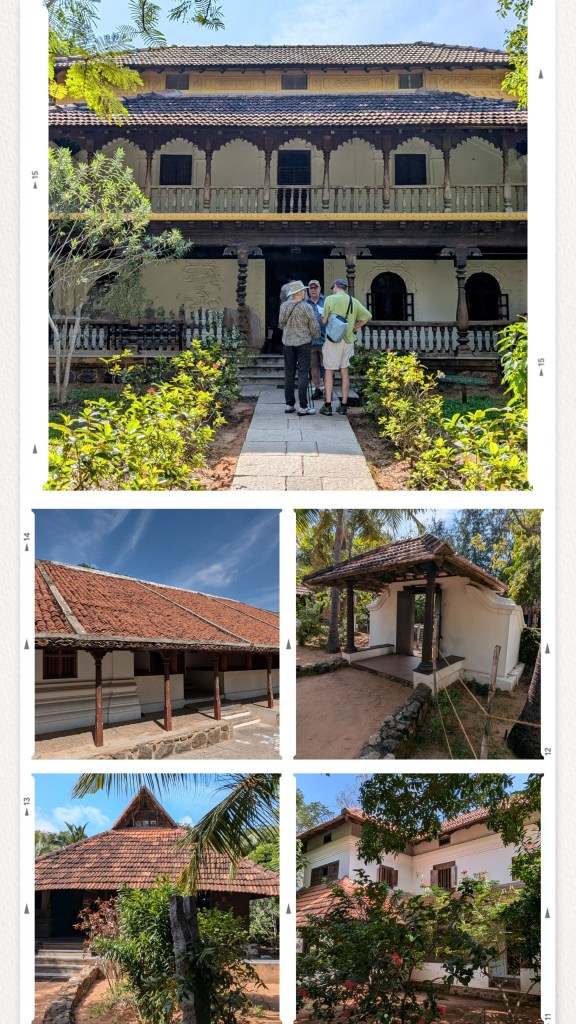
We were informed that the curved terracotta roof tiles for one of the the structures (above, middle left) were made by wrapping the clay around the thigh of one of the workers. Since they had to be uniform, it would have to be the same worker’s thigh for all the tiles. The structures included a typical West Coast (India’s, not California’s) home of a Muslim merchant (above, top), which had pictures of iconic mosques without domes or minarets.
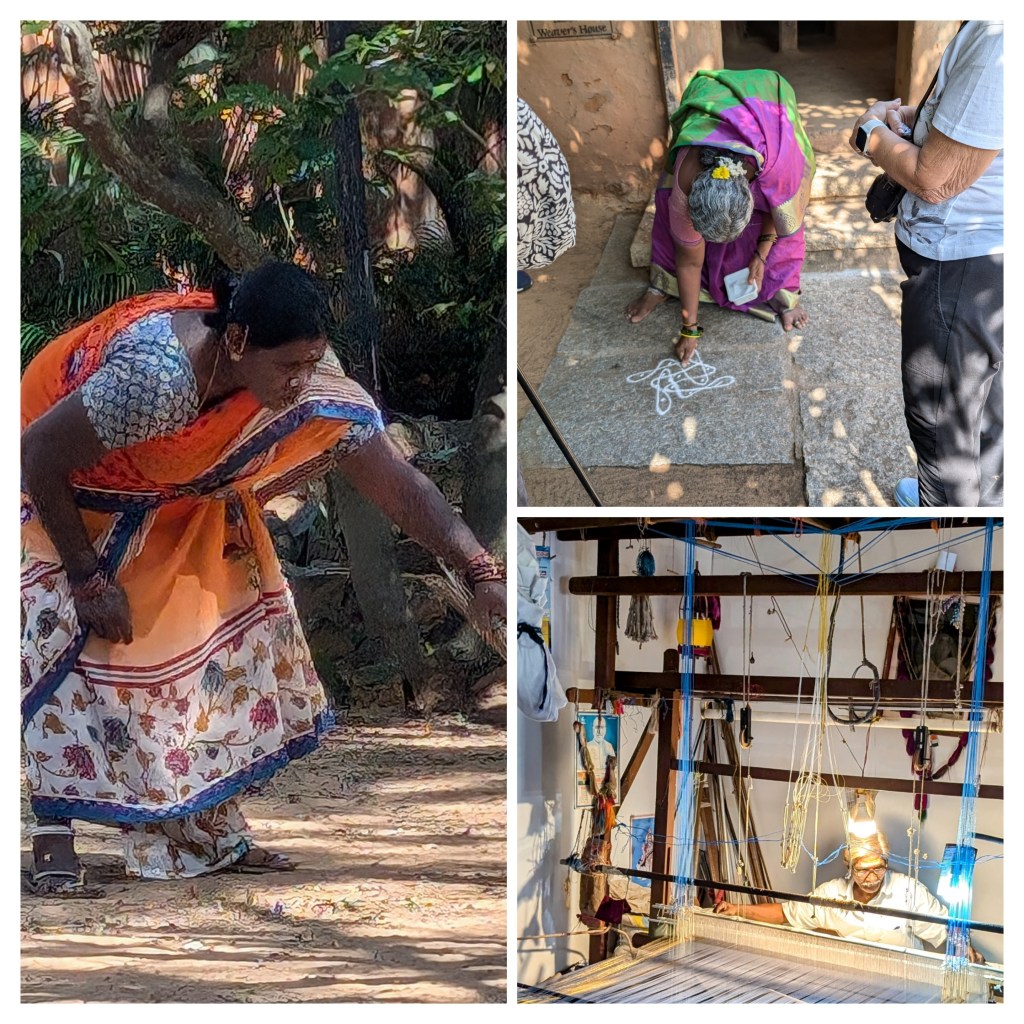
In addition to the structures, we saw people sweeping the leaves (above, left), a woman doing designs on the ground by strewing (artistically) a mixture of chalk and rice powder (above, upper right), and weaving silk for saris on a loom (above, lower right).
Before we got to Pondicherry, we stopped again, at the seaside town of Mahabalipuram. Along a stretch of the road, we viewed the works of the Pallava dynasty, who were the rulers of southern India from 275 to 897 CE. These rulers were patrons of architecture, and they experimented with monuments carved out of single boulders and blocks of the local granite.
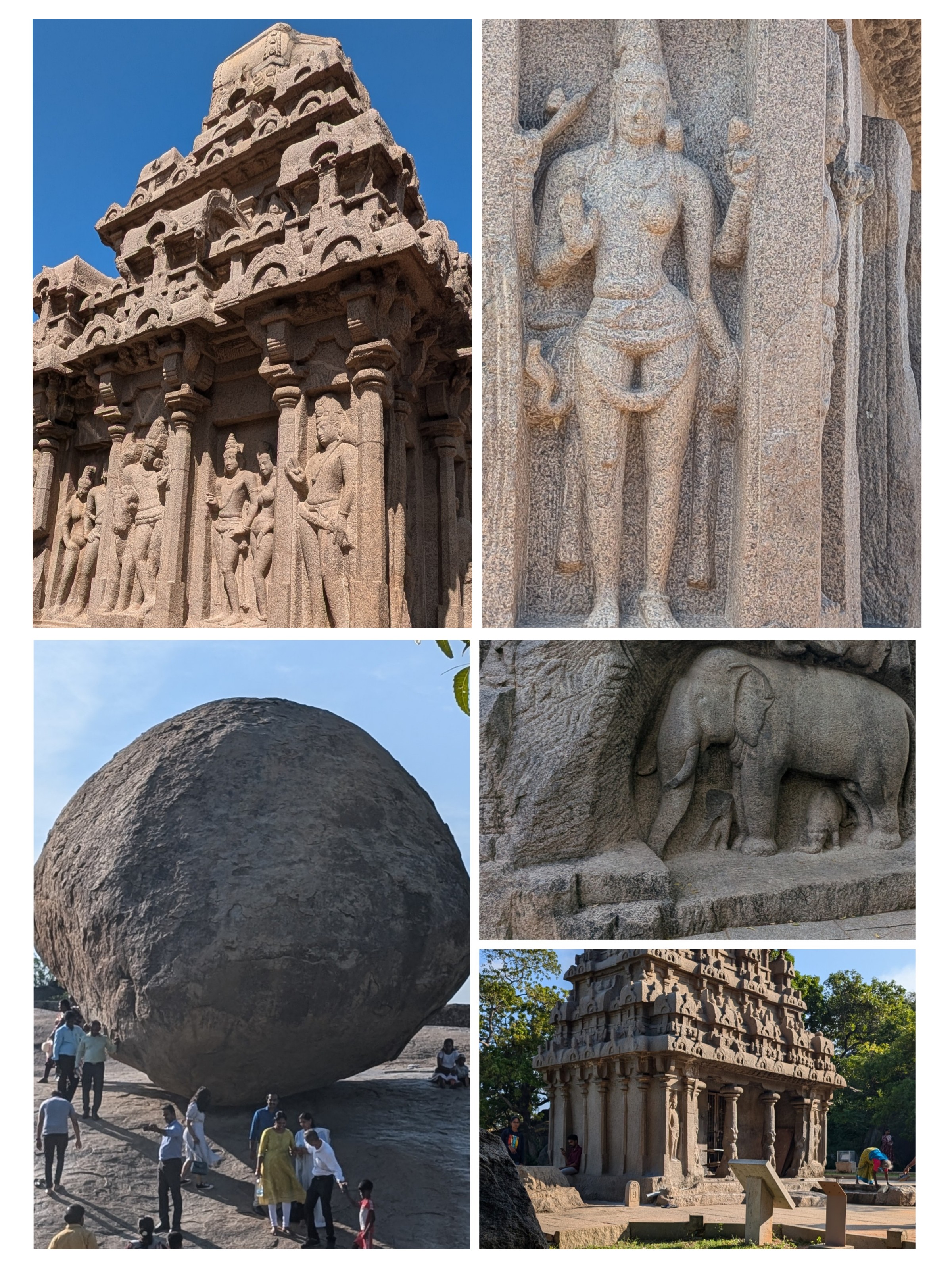
Note the half male/half female figure of Shiva (above, top right) that we’ve seen before. The landscape also included a spherical glacial erratic (a glacially-deposited rock differing from the rock native to the area where it rests), which had been given the name, “Krishna’s Butterball (above, lower left).
December 8, 2024.
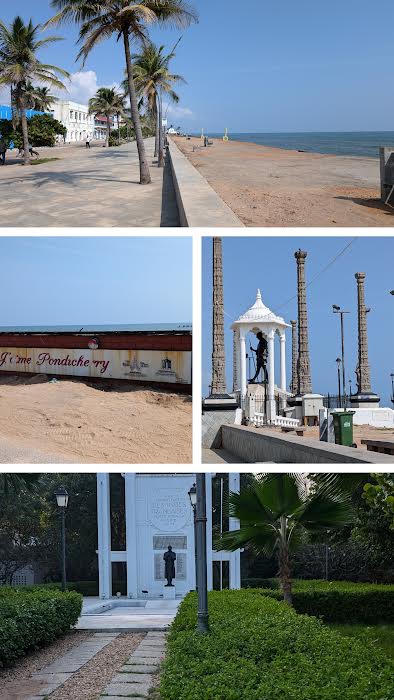
Pondicherry had been a French outpost in a country ruled by the British. Below are the iconic ochre-colored buildings (such as the French Consulat Général):

There is also a promenade along the Bay of Bengal, with views of the monument to Gandhi, and the memorial to Indo-French soldiers killed in World War I.
We returned to the Palais de Mahé Hotel in one of the ubiquitous “tuk-tuks” (three wheeled taxis).
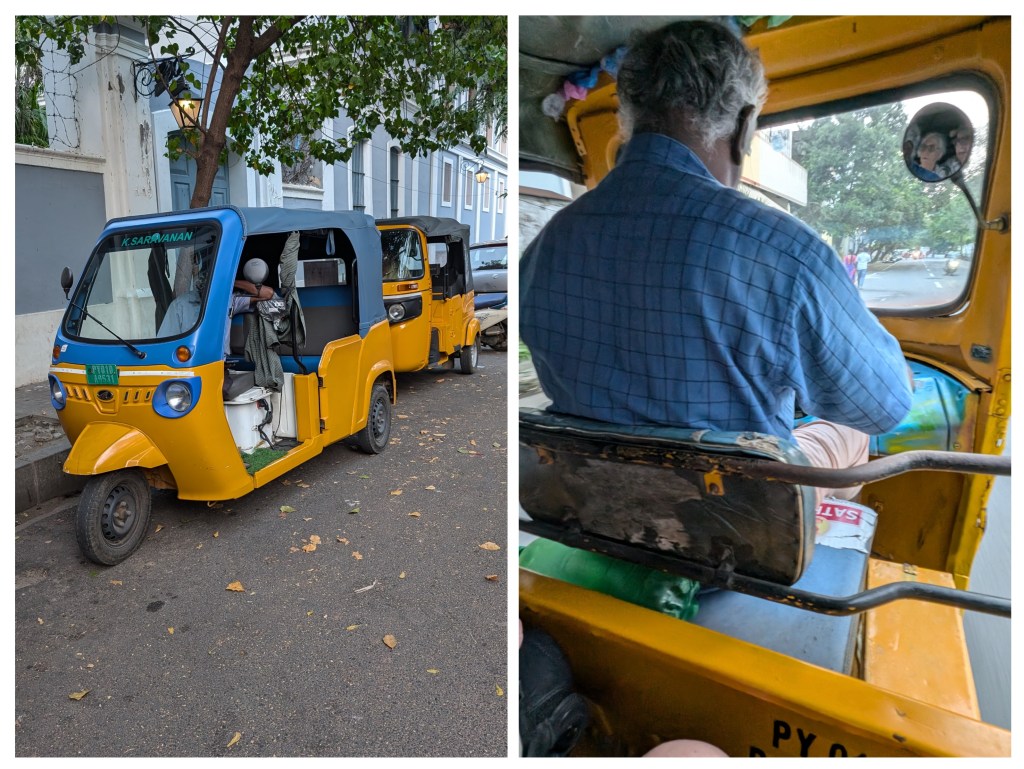
It was an “interesting” ride (!), careening rapidly through the streets (accompanied by the usual cacophany of horns), missing collisions with motorbikes and pedestrians by inches.
Next post from Thanjavur and Kambakonam.


 Something to Declare
Leave a comment