
Almost at the Fin[n]ish Line
Friday, June 27, 2025
Friday was a highpoint of the trip! First stop was the Helsinki Synagogue. We had failed to submit our documentation in advance; the kind but professional security guard offered to examine our passports and emails from another synagogue (the one in Tallinn, which we didn’t have time to visit on Thursday), and we were allowed entry. Some of the bonhomie with the guard was due to his having family in New Brunswick, New Jersey, and my Rutgers connection there seemed to confirm my trustworthiness. We were introduced to Boel (pronounced Boo-el) who does the administrative work for the Synagogue, as well as conducts the tours.
Boel told us that the Jewish community of Finland was originally derived from Jewish soldiers of the Tsarist army, sent to serve in Finland, and then were permitted to stay after their enlistments were up; they were able to have their families and womenfolk join them. Among the Russian troops were Tatar soldiers of the Muslim faith, who shared a house of worship at their barracks on the island of Suomenlinna (ironic, no?).
The Jewish community requested permission to build a house of worship in Helsinki, which request was granted in1901. The structure was completed in 1906, and has remained on the site ever since.
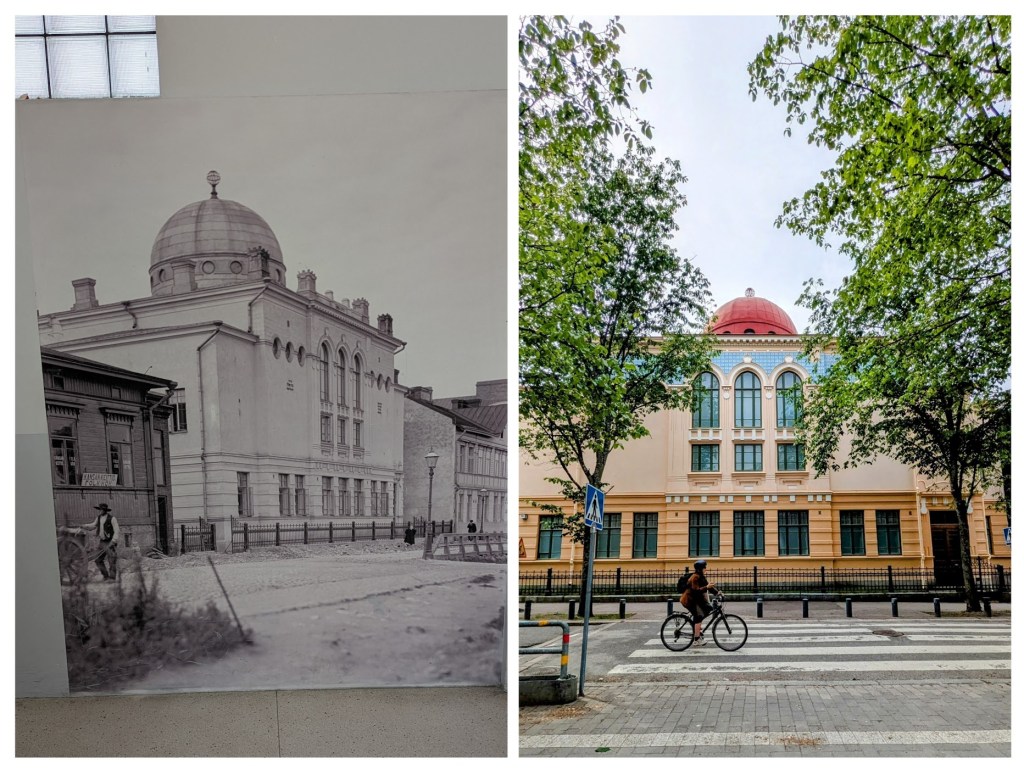
When Finland established its independence from Russia in 1917, the descendants of these Russian Jewish solders and their families were not automatically considered citizens of Finland. They had to apply for citizenship.
An interesting factoid is that, during the Second World War, Finland was loosely allied with Germany (because of their joint enmity for the Russians). Finland declined German requests to deport the Jewish community to the concentration camps. Indeed, in some joint military exercises, German troops were under the command of Jewish officers of the Finnish army!
A wreath and plaque signed by President Carl Gustaf Emil Mannerheim commemorate Finland’s appreciation to the Jews who served in the Finnish army:
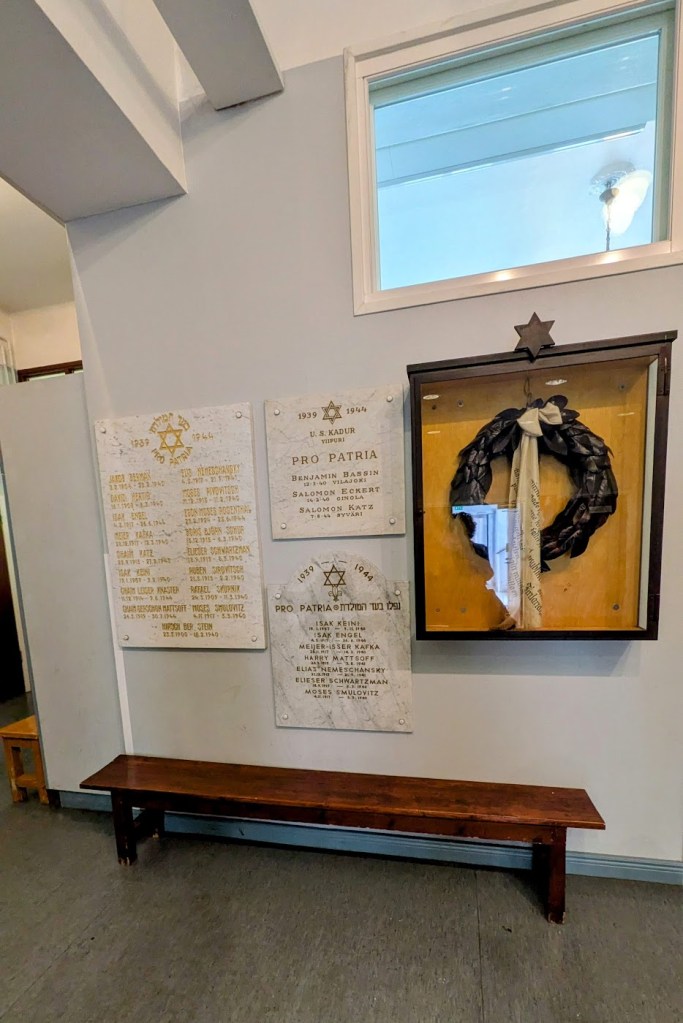
The plaque on the far left lists the members of the Congregation who died during WWII. Boel got teary when she told us about one person on the plaque, Egon Moses Rosenthal (1924-44) whose bones were found in Russia only a few years ago. After his identity was confirmed by DNA, his remains were brought back to Helsinki and the Synagogue held a formal funeral for Egon.
As she showed us around the Synagogue…..

…..Boel let us know that her mother tongue was Swedish, and that she was a convert to Judaism (in order to get married). Her entire career was spent at the Synagogue, from which she will retire next year. The Synagogue has about 1000 members. It also operates a day school for children, and serves as a Jewish community center.
We walked from the Synagogue to the renowned Design District of Helsinki, where we stopped for lunch at a place called Sushibar+Wine:
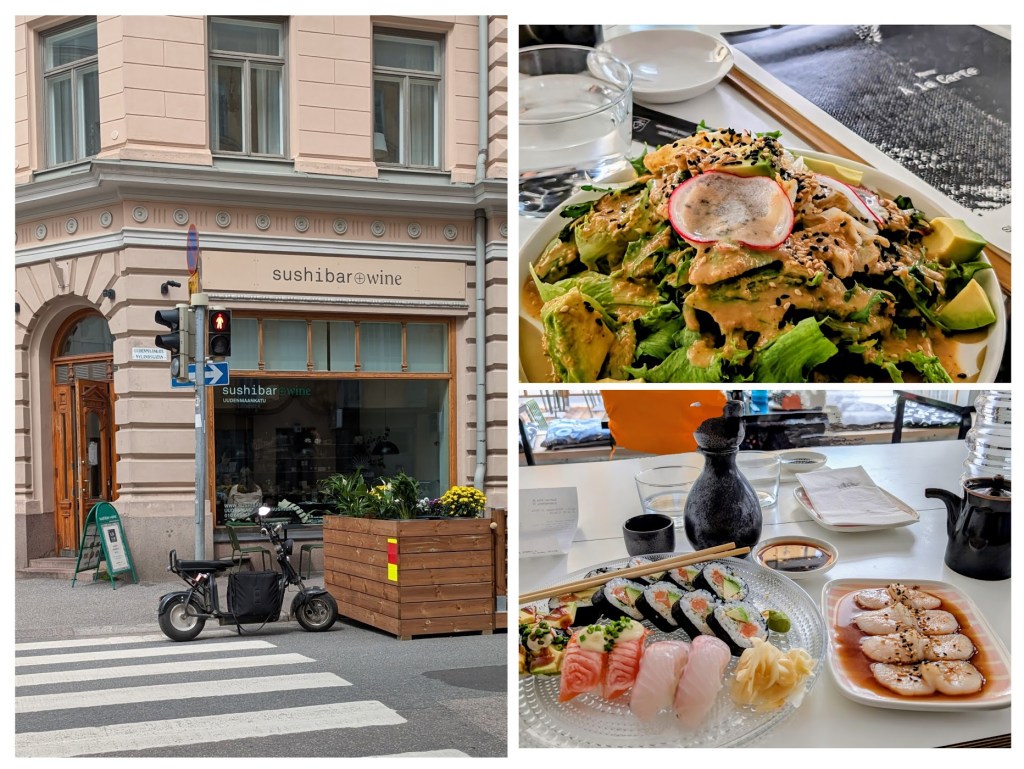
I’d never before tasted whitefish sushi. Quite good!
After lunch we proceeded to the Design Museo of Helsinki.
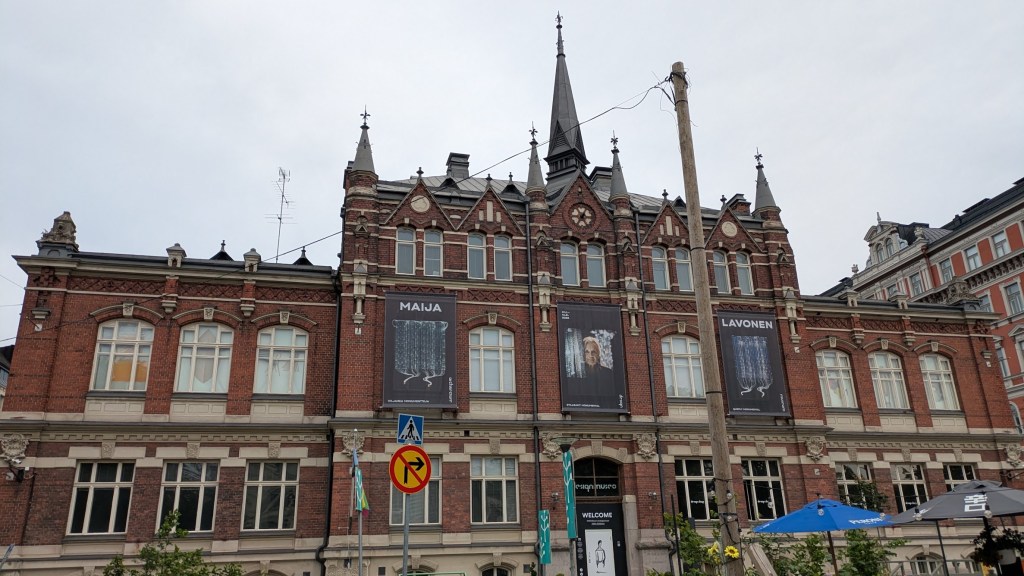
We entered the Museum to displays of a chair made from metal rings, and a rack of fabric pieces, which visitors were urged to take weave their own designs.

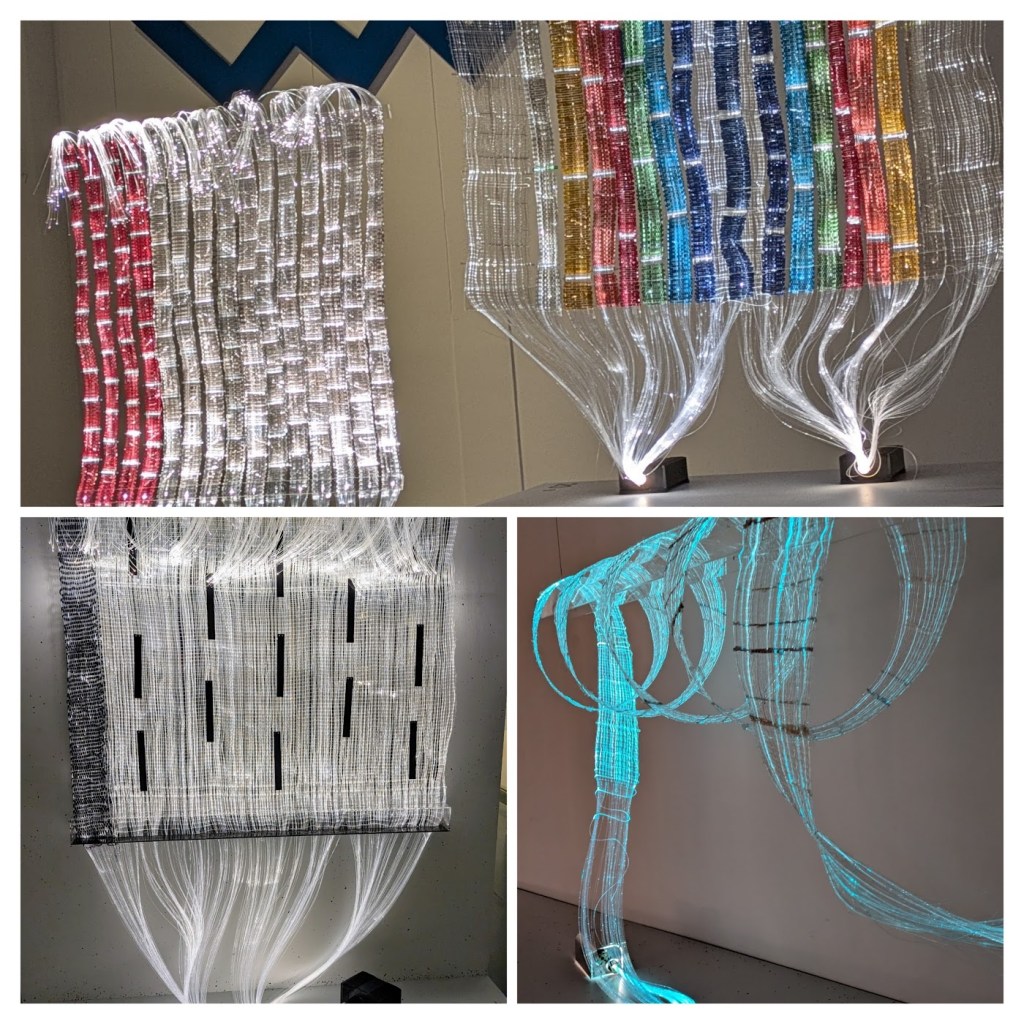
The main attraction was an exhibit of the works of Finnish artist Maija Lavonen. Her earlier works involved textiles, like patterns displayed on ryijy (rya rugs):

She later moved on to optical fiber:
Leaving the Design Museo, we walked toward the harbor, passing by the nearby Kolmikulma park with its Dianapuisto (statue of the goddess Diana) (below, top left), and through the Vanha Kauppahalli (Old Market Hall) (below, top right), into a 2-month long street fair called “Superterrassi” (below, bottom left).
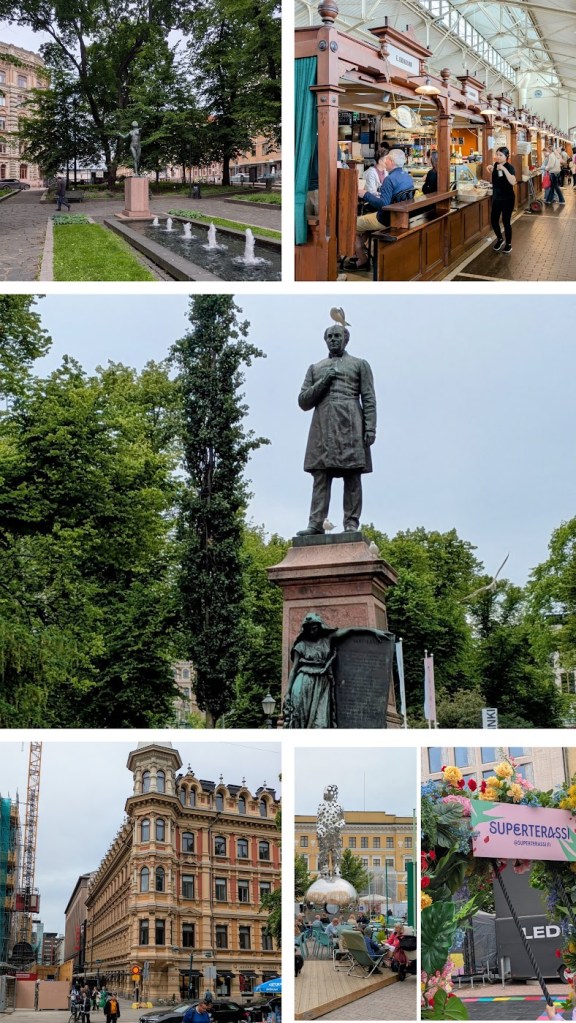
We finally reached the Esplanadi, a large, elegant park built in 1818 between two parallel shopping streets (above, middle and lower left). And then home, to dinner (smoked whitefish and salmon, purchased at the famed Stockmann department store—Helsinki’s version of Harrod’s or Bloomies).
 Something to Declare
Leave a comment