
The Grande Place Walk
Friday, October 17, 2025
One of the many things we like about traveling the apartment-rental route is the absence of fixed schedules. On a guided group tour, we’d wake to an alarm, rush to the hotel dining room for a buffet breakfast, and then meet in the lobby before being bused en masse to our first tourist site at 8 or 9 am.
By contrast, we slept in again this morning, had a leisurely breakfast over the on-line New York Times, did some exercising, and then took the Métro to the Gare Centrale again, and walking to the Grande Place to take Rick Steves’ self-guided walking tour of the area:
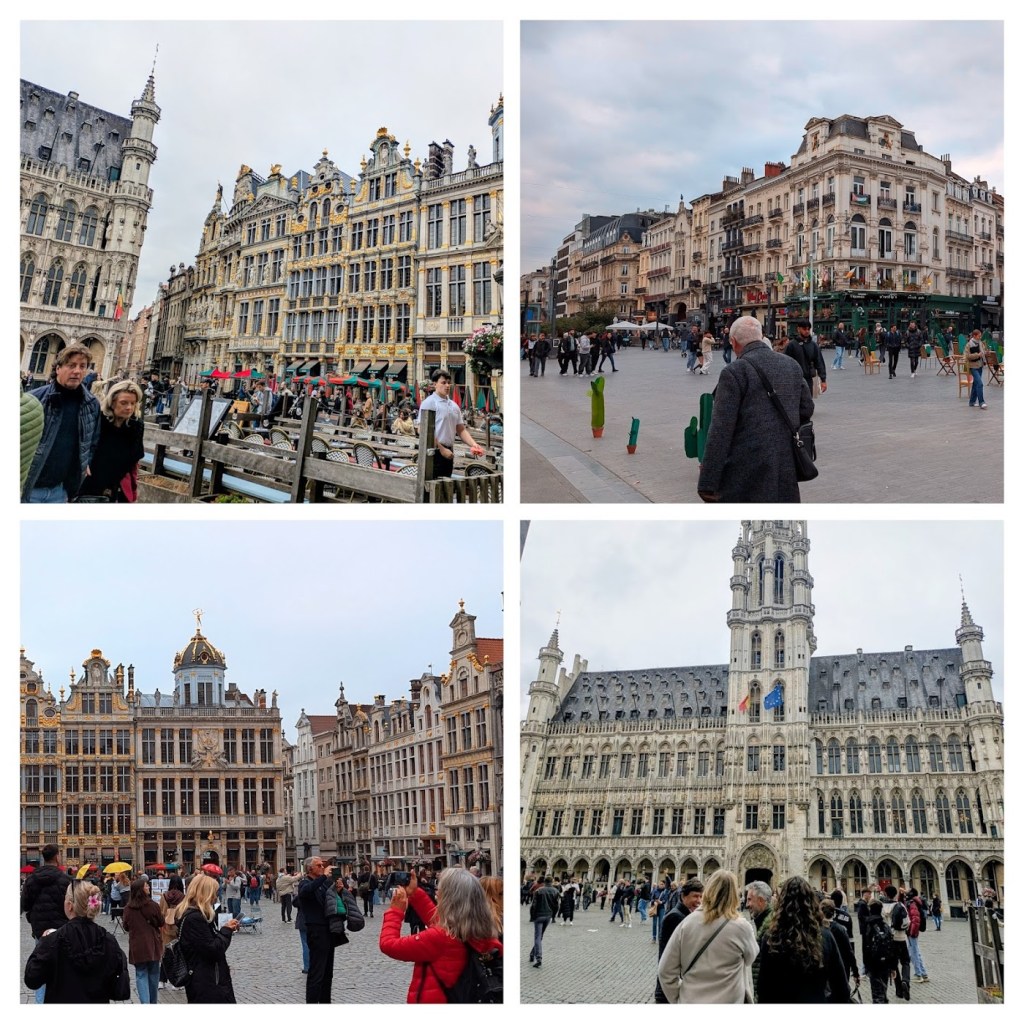
As noted in the previous post, the Grande Place is ringed by the Hotel de Ville (Town Hall), the Maison de Roi (King’s House), and lots of buildings that had been Guild Halls (the 16th-17th Century Brussels equivalent of Wall Street).
Of course, back in the good old 1600s, farmers and merchants sold their wares in open-air stalls. Eventually, they became flush enough to want to preserve and maintain their economic power in the form of Guilds.
When we use the expression “Guild Halls,” there is also an embedded (unintended) pun, since these buildings were also “gilded” (adorned with gilt):
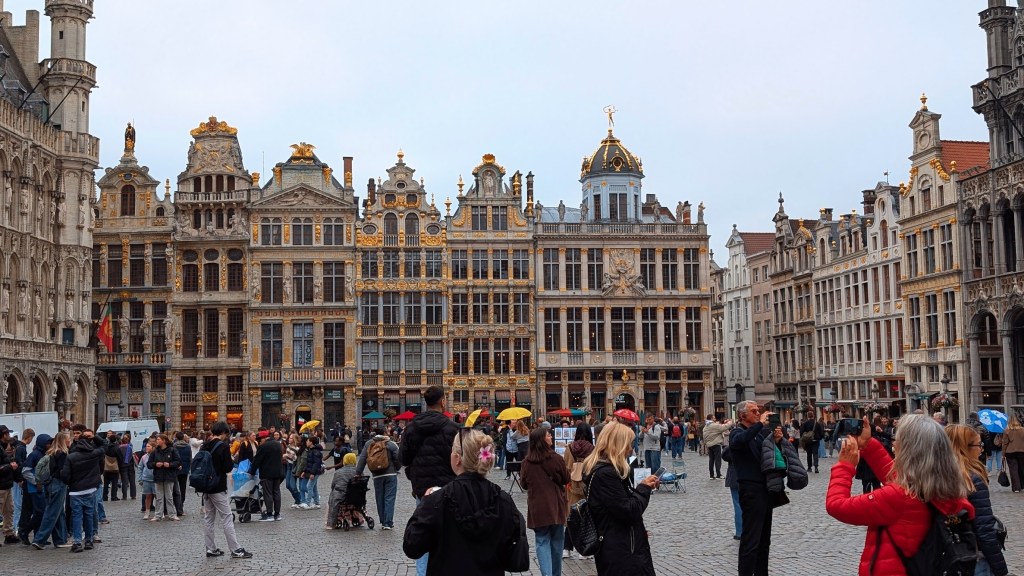
These edifices replaced the original wooden structures, which had been leveled by cannon fire from the forces of King Louis XIV of France in 1695 (“the Bombardment of Brussels“). This was an attempt by the Ancien Régime to forestall the rise of the bourgeoisie in the Low Countries. And we all know who won in the end: Think 1794, the Storming of the Bastille, the guillotine, “A Tale of Two Cities,” etc., with Louis XIV’s grandson winding up paying the price. Brussels’ brewers, bakers, tanners, millers, rebuilt their Guild Halls with a vengeance. If you got it, flaunt it, n’est-ce pas?”
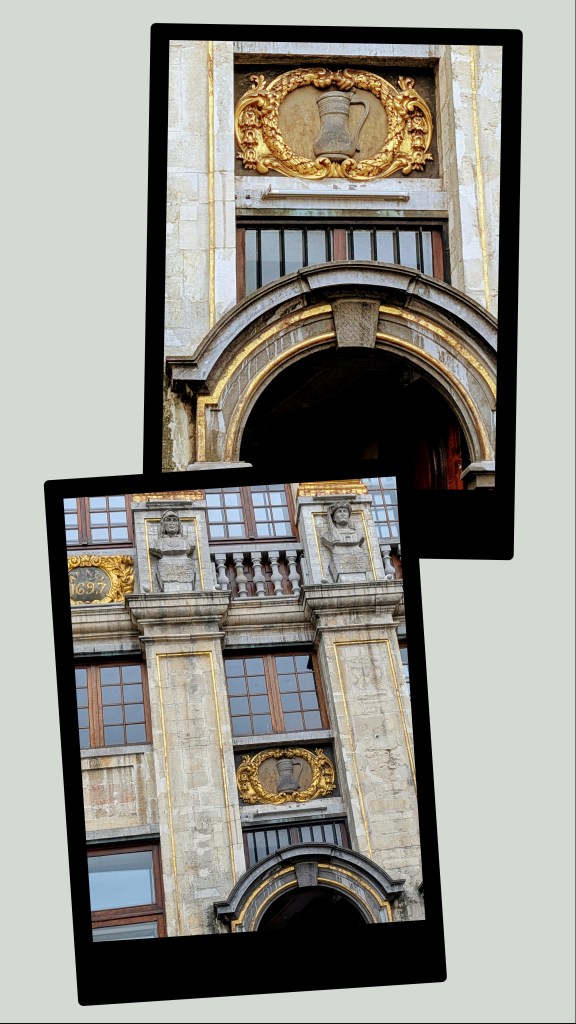
The Guild Halls were sometimes decorated with symbols of their particular craft or trade, like the one that housed the Brewers’ Guild:
Some of these buildings have other particular historical significance, such as the Maison du Cygne (“Swan House”), which had been the headquarters of the Craftsmen’s Guild:
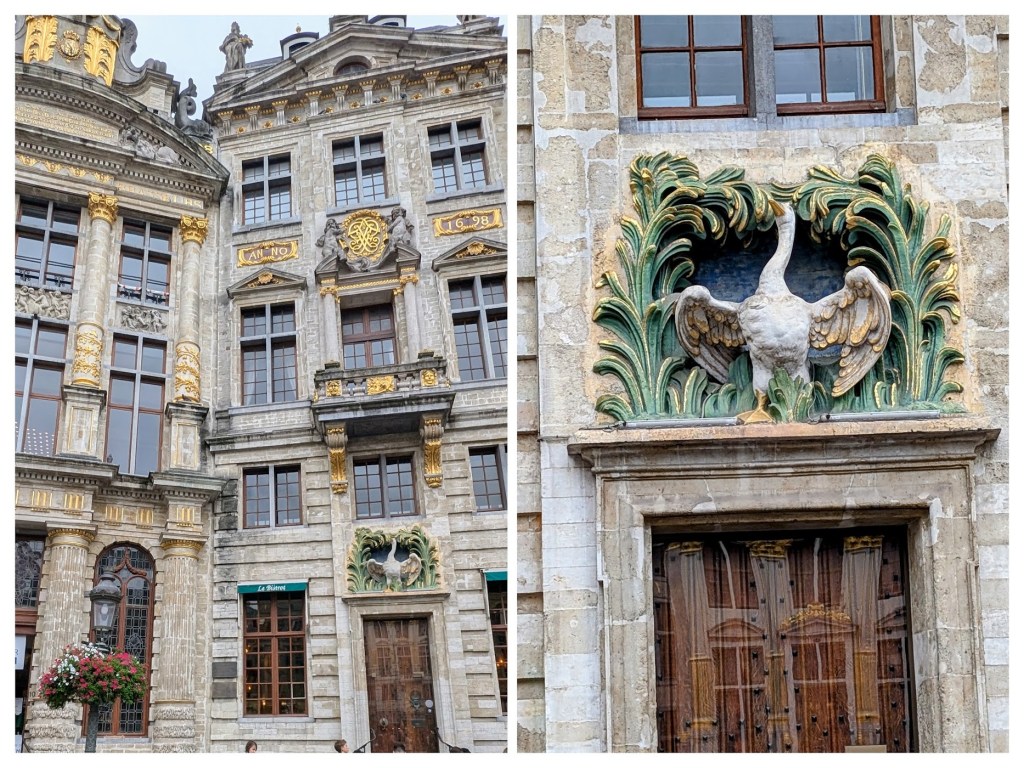
This was where Karl Marx and Friedrich Engels met and formulated their “Communist Manifesto” in 1848 (the uprising in response to which got them exiled from Belgium).
A short walk away from the Grande Place we found the Galeries Royales St. Hubert. Built in 1847, it is one of the oldest, still-operating shopping malls, with nary a chain store in sight:
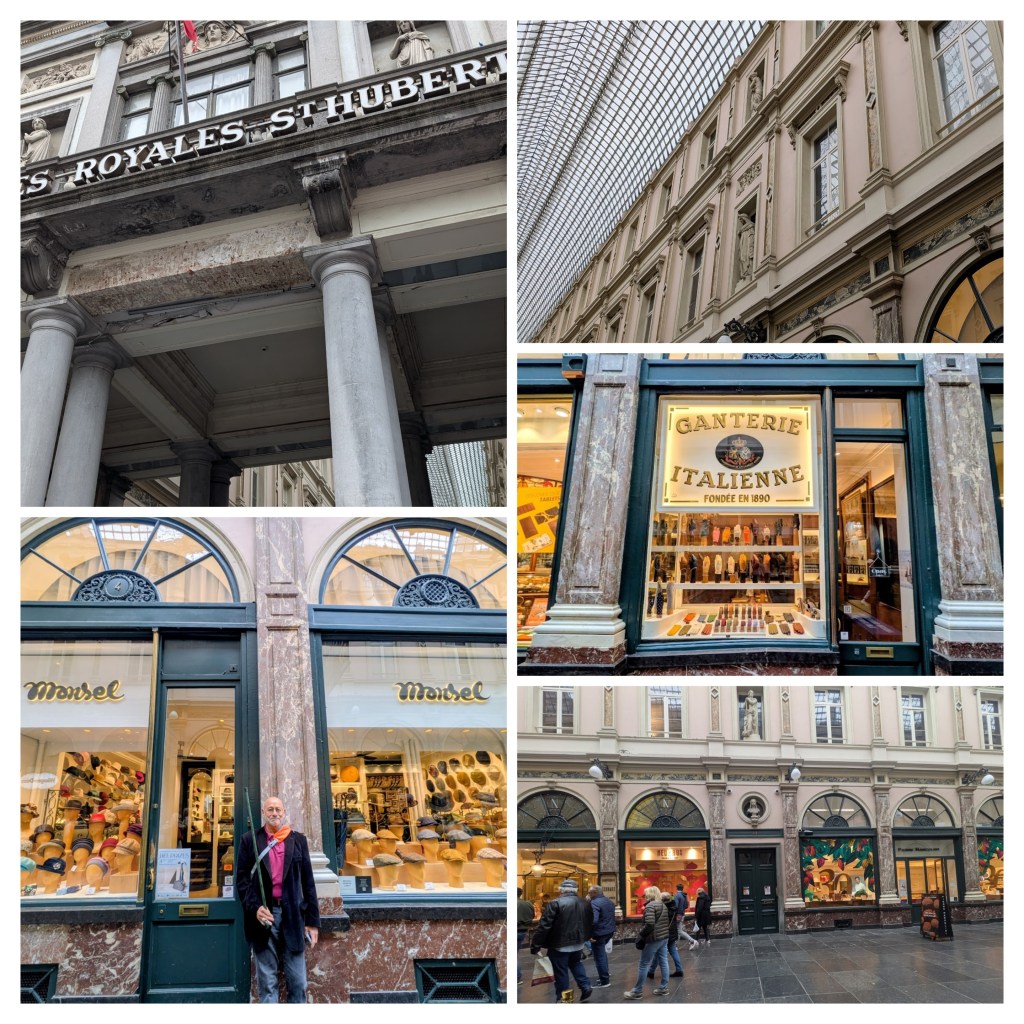
Not exactly like the one in, say, Paramus? (No offense, Cindy.) In the lower left, above, you will see Monsel, the store where Stef bought me a new spiffy cane as a birthday present.
Speaking of purchases, the entire Grande Place seemed to be something of a monument to consumption.
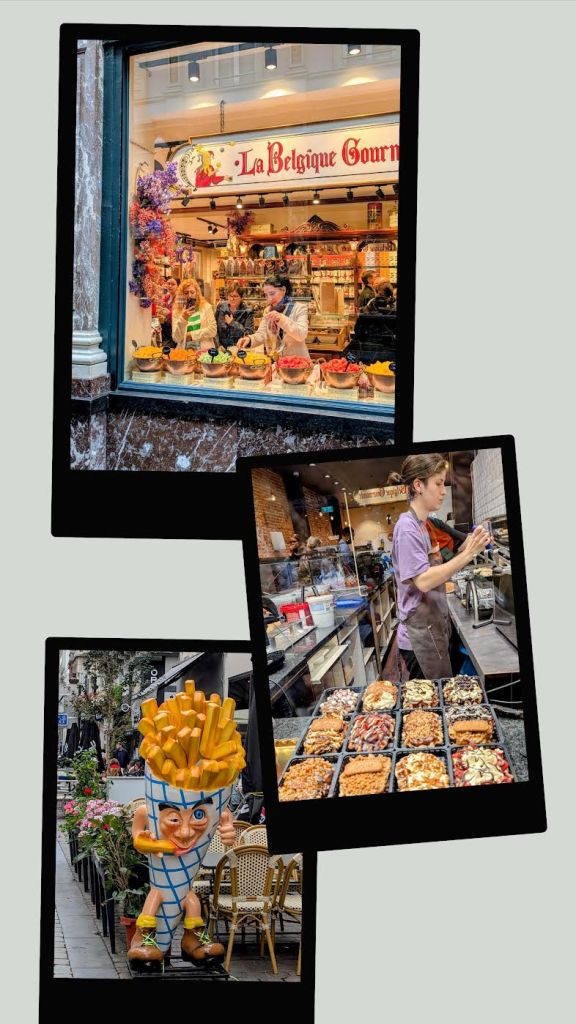
This includes the ubiquitous frites, patisseries, gaufres (waffles). And chocolat, like the ones sold in Chocolaterie Mary, founded in 1919 by Mary Delluc, the first woman chocolatier(e) in Brussels, if not in the world. Her chocolates became favorites of the royal family (take that, Godiva and Neuhaus!). Today the store, and the packaging of its wares, are the same as they were in the 1920s.
We then stopped at the Church of St. Nicholas (below, left, top and bottom), and then to the Bourse (Beurs), the old stock exchange (below lower right), which has been given over to cultural exhibits, including (yet another) Beer Museum.

Note the white banner outside the Bourse, which references an upcoming demonstration against the city government’s budget cuts to social services. We feel solidarity with them, as we await news of the “No More Kings” demonstrations taking place today in the U.S.
Right outside the back of the Bourse is Boulevard Anspach (above, right). Brussels had once been a major port on the Senne River. But the river water was also giving rise to deadly cholera epidemics. So, between 1867 and 1871, Mayor Jules Anspach covered the foul-smelling portions of the Senne. Over the covered (but still-running) river, the city built several public structures, as well as boulevards such as the one bearing the Mayor’s name.
Capping the Grande Place Walk was a visit to the inimitable statue, Manneken Pis.

This 58 cm tall statue of a little boy, urinating, was made in 1619, to provide drinking water for the neighborhood. It has become something of a symbol for the people of Brussels. King Louis XV of France knighted the figure in 1747, as the result of which his soldiers were required to salute the statue while marching by.
In 1698, the governor of the Netherlands presented Brussels with a blue woolen coat for the little boy. This began a tradition of clothing the figure. The costumes change on a schedule of seasons and events, e.g., wearing the clothes of an Elvis Presley impersonator on Presley’s birthday. More than a thousand of these costumes are stored in the nearby Garde-Robe Manneken Pis. Oh, one more factoid: During Prostate Awareness Day, the flow from the statue is reduced to a trickle.
Manneken Pis is obviously a hard act to follow, so this seems like a good place to end this post. Tomorrow we take Rick Steves’ walk in the Upper Town. See ya!
 Something to Declare
Leave a comment