
Poste No. 5. Bienvenue en France (Colmar)
Le 6 Septembre, 2023.
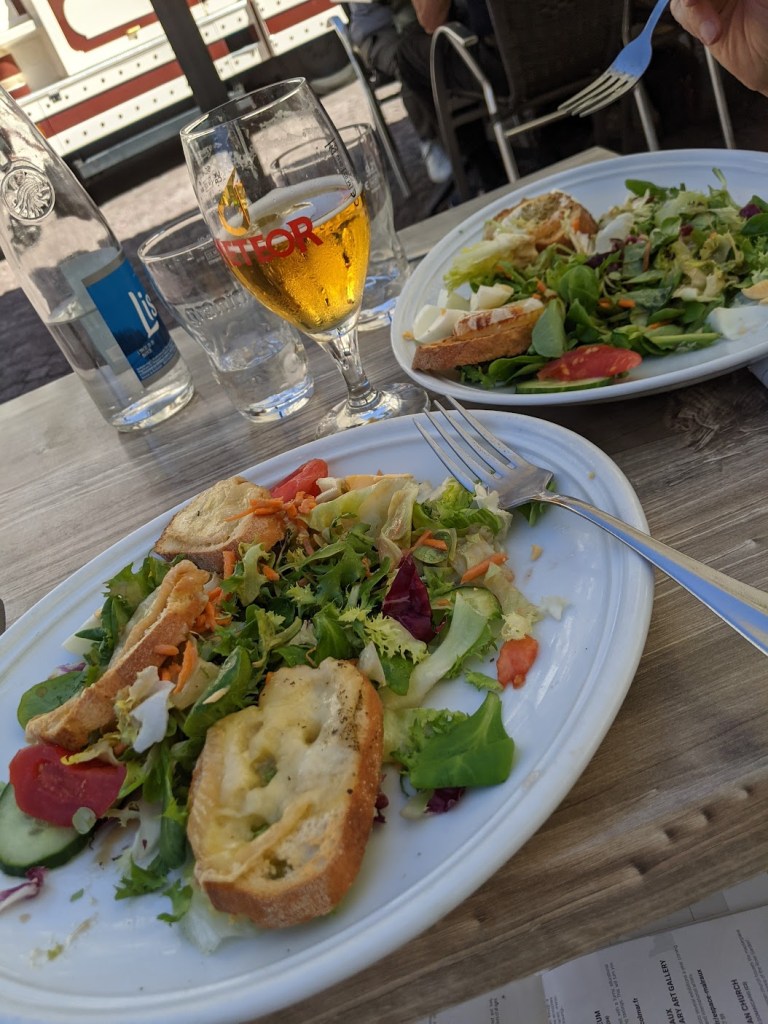
This morning, our GPS got us from Zürich to Colmar in an hour and a half. After checking into the Hotel Mercure Unterlinden, out to find lunch. They have an interesting way of serving salad in this town, i.e., by depositing pieces of toasted bread with cheese on top of the lettuce. The local cheeses include cow’s-milk Munster and chèvre. Both, it turned out, were yummy.
Colmar is like Stein-am-Rhein on steroids. Again, the characteristic architecture:
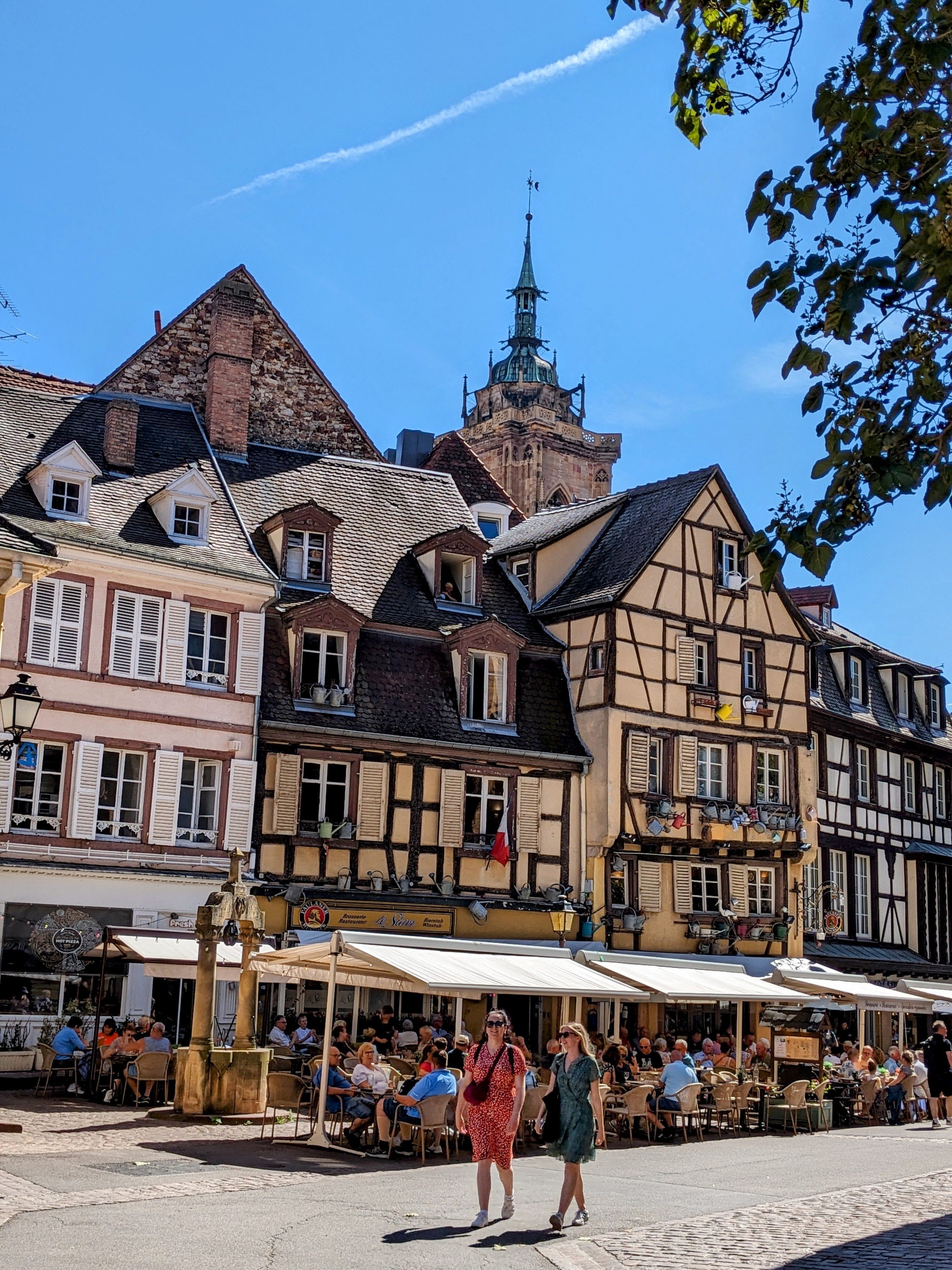
Like Stein-am-Rhein, these are originals. Rick Steves comments, “Historic beauty was usually a poor excuse for being spared the ravages of World War II, [see my previous blog reference to Dresden] but it worked for Colmar. The American and British military were careful not to bomb the half-timbered old burghers’ houses, characteristic tiled roofs, and cobbled lanes of Alsace’s most beautiful city. The town’s distinctly French shutters combined with the ye olde German half-timbering gives Colmar an intriguing ambience.”
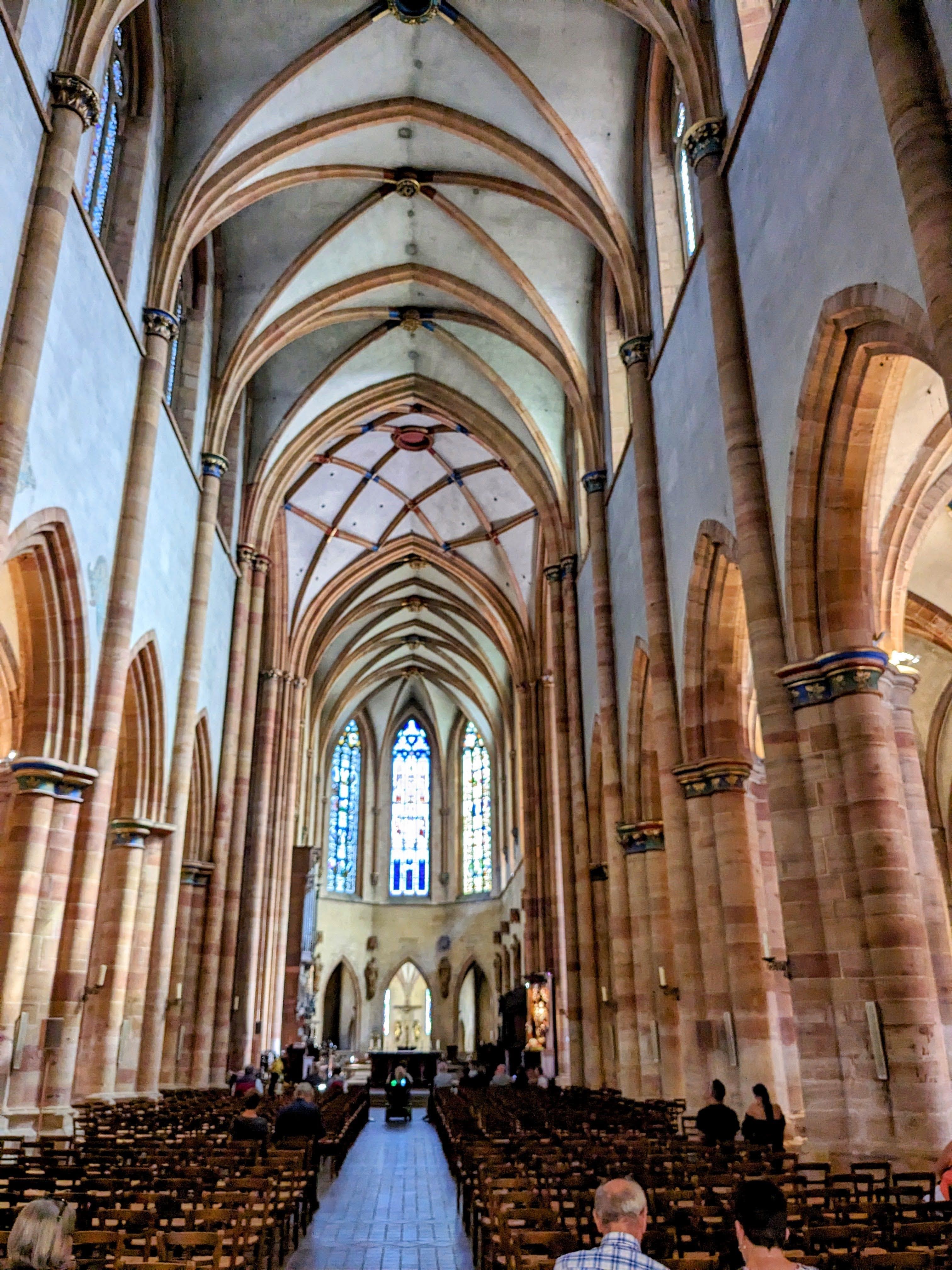
Colmar has a beautiful yet not excessively ornate Gothic Cathedral, Eglise des Dominicains:
We also undertook Rick’s (we are on a first-name basis by now) walking tour of Colmar, starting at the old customs house, Place de l’Ancienne Douane. Apparently Colmar got a lot out of being a privileged city, i.e., ruled directly by the Holy Roman Emperor (not one of his venal underlings), with the authority to make its own rules regarding taxes and customs duties, to build fortified walls, and run its internal affairs. This lasted to the 17th Century.
The walking tour directed us to the Bartholdi* statue of General Lazarus von Schwendi.
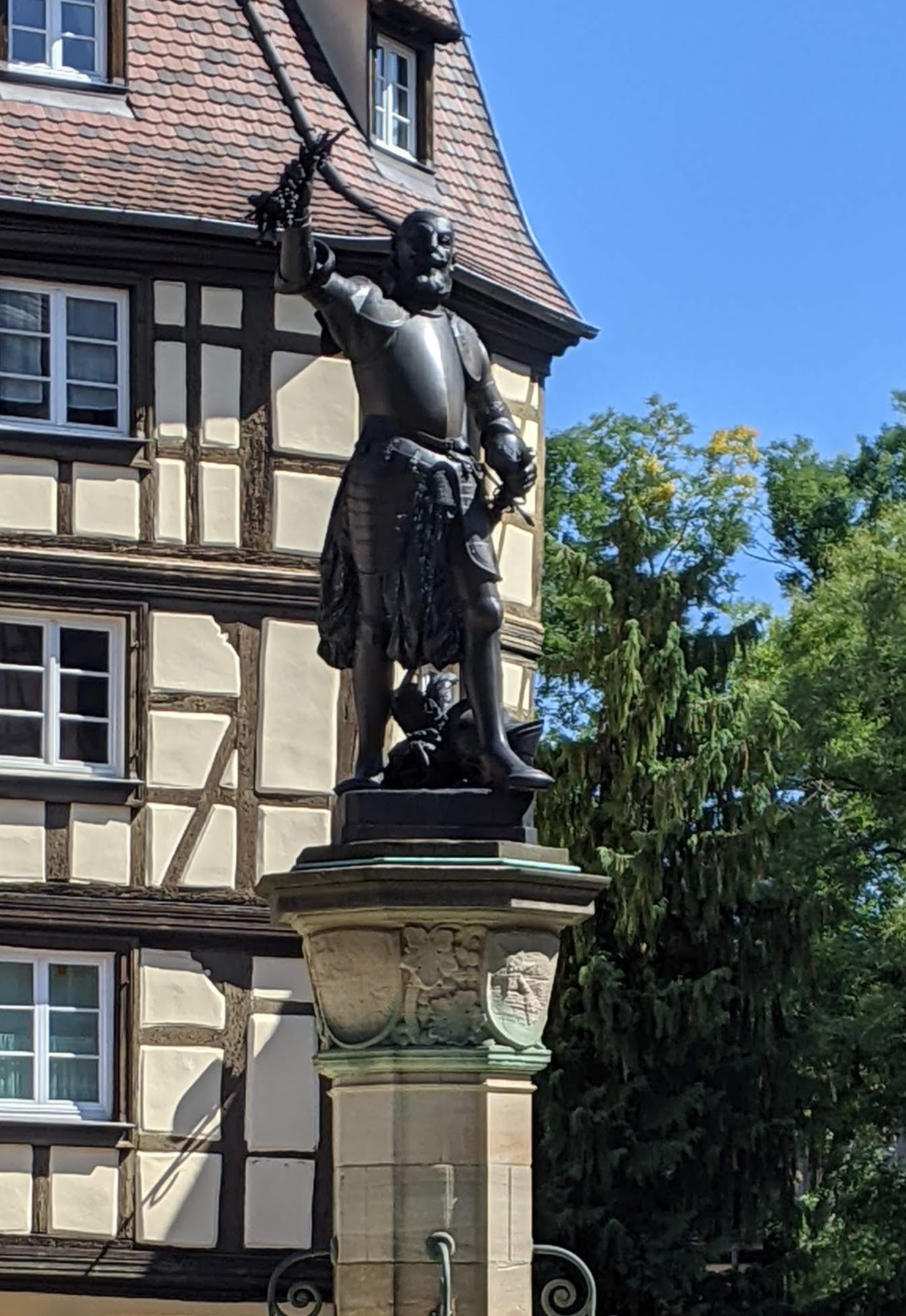
*(Frédéric-Auguste Bartholdi, a famous son of Colmar, is the artist and sculptor who made the Statue of LIberty that stands now in New York harbor.)
As you can see, the General has his arm raised (Statue-of-Liberty-style) and is holding a bunch of local pinot gris grapes. He’s credited with having brought that grape from Hungary to Alsace. You are left with deciding which was more significant: The Statue of Liberty, or the wine grape that makes up 15% of the wine produced in the region. Hmmmmmm………
We also took in the forecourt of the Bartholdi Museum, in which there stands his sculpture Les Grandes Soutiens du Monde (“The Great Pillars of the World”):
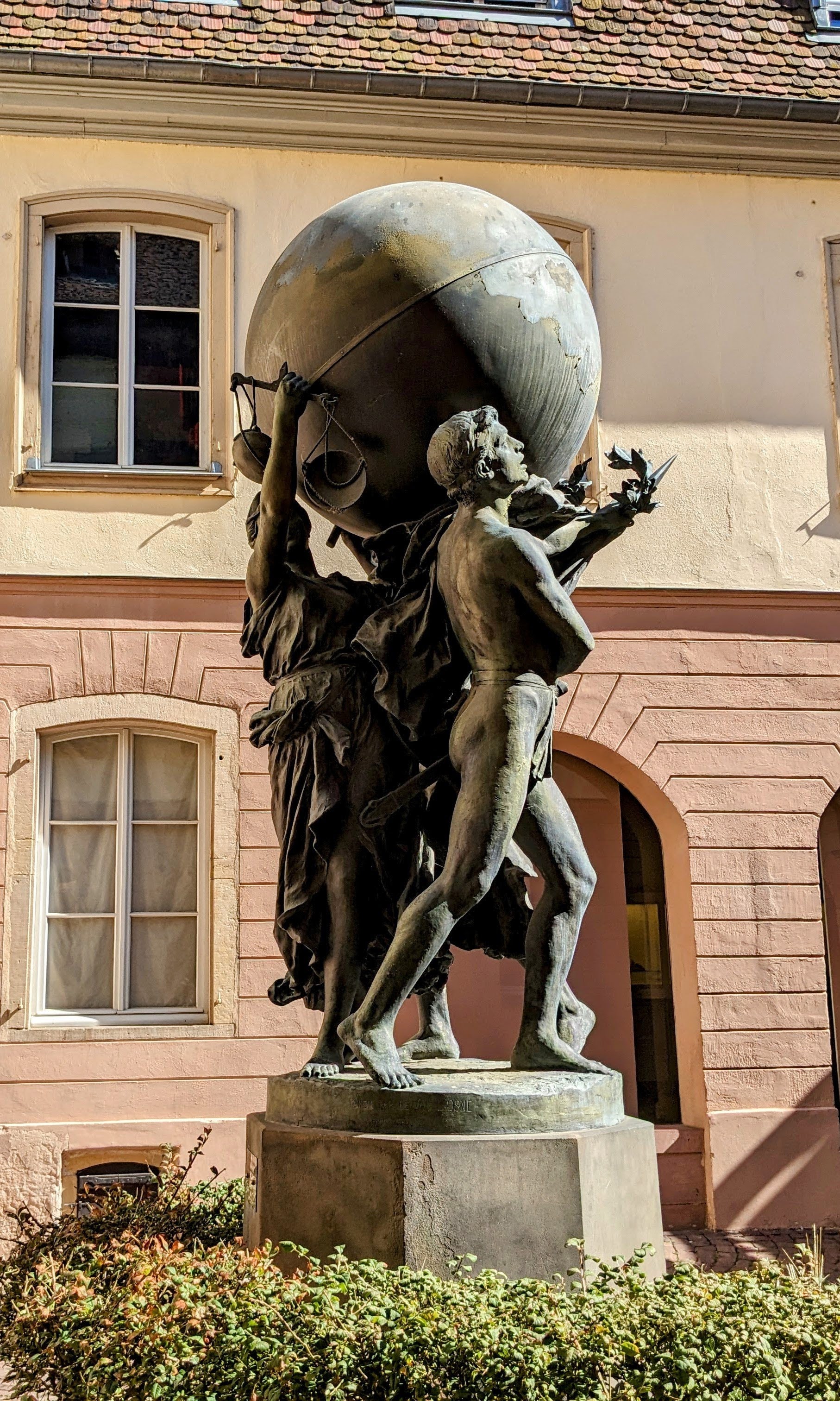
The sculpture was cast in 1902 (two years before Bartholdi died). In the work, the world is supported by three figures representing Patriotism, Hard Work and Justice. Justice is the figure on the left, holding her traditional scales. All three figures have a foot stepping forward (progress, the spirit of the Industrial Age) (says Rick).
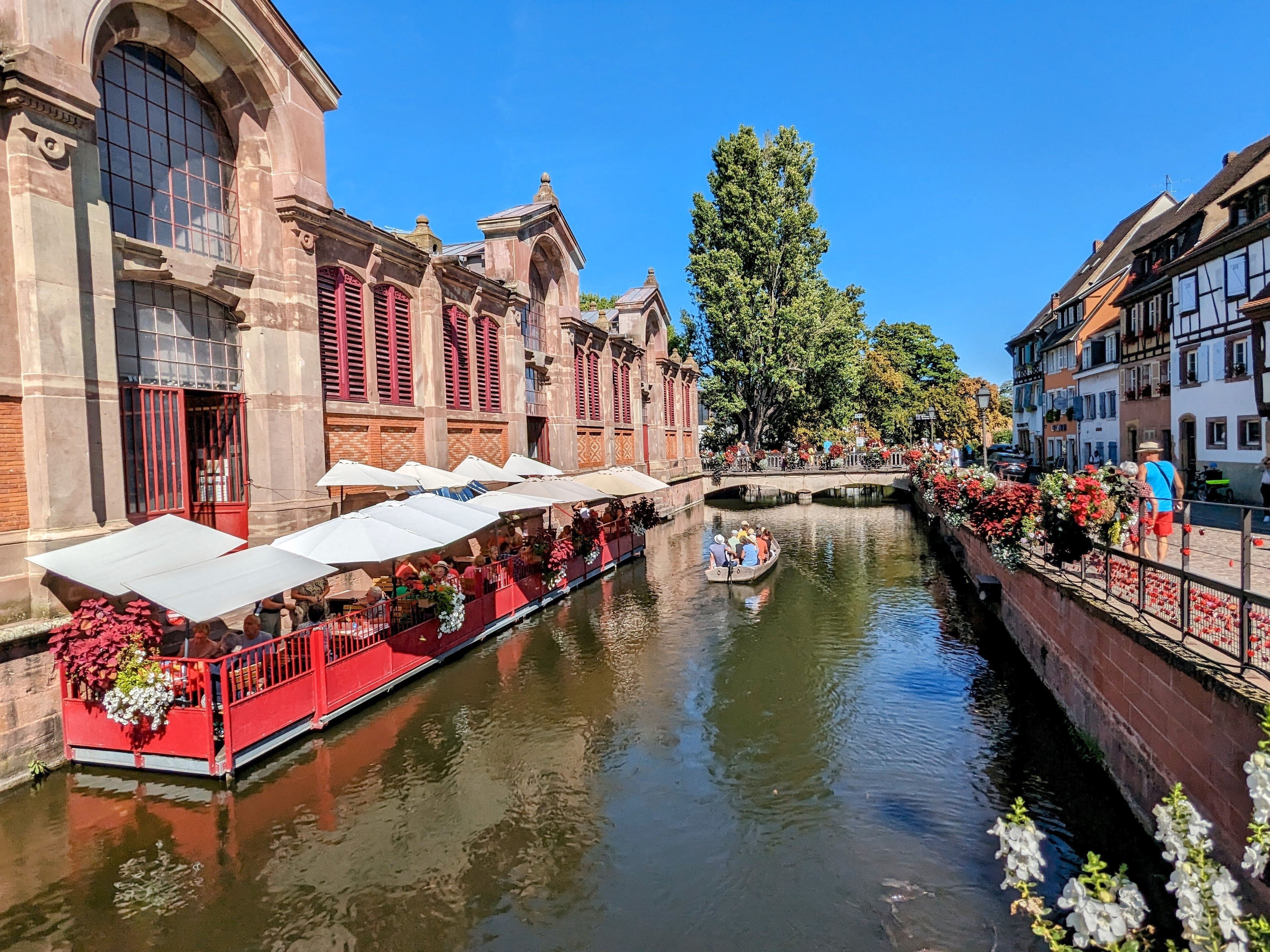
We also walked along the lovely canal that gives this part of Colmar the sobriquet of “Petite Venise” (“Little Venice”):
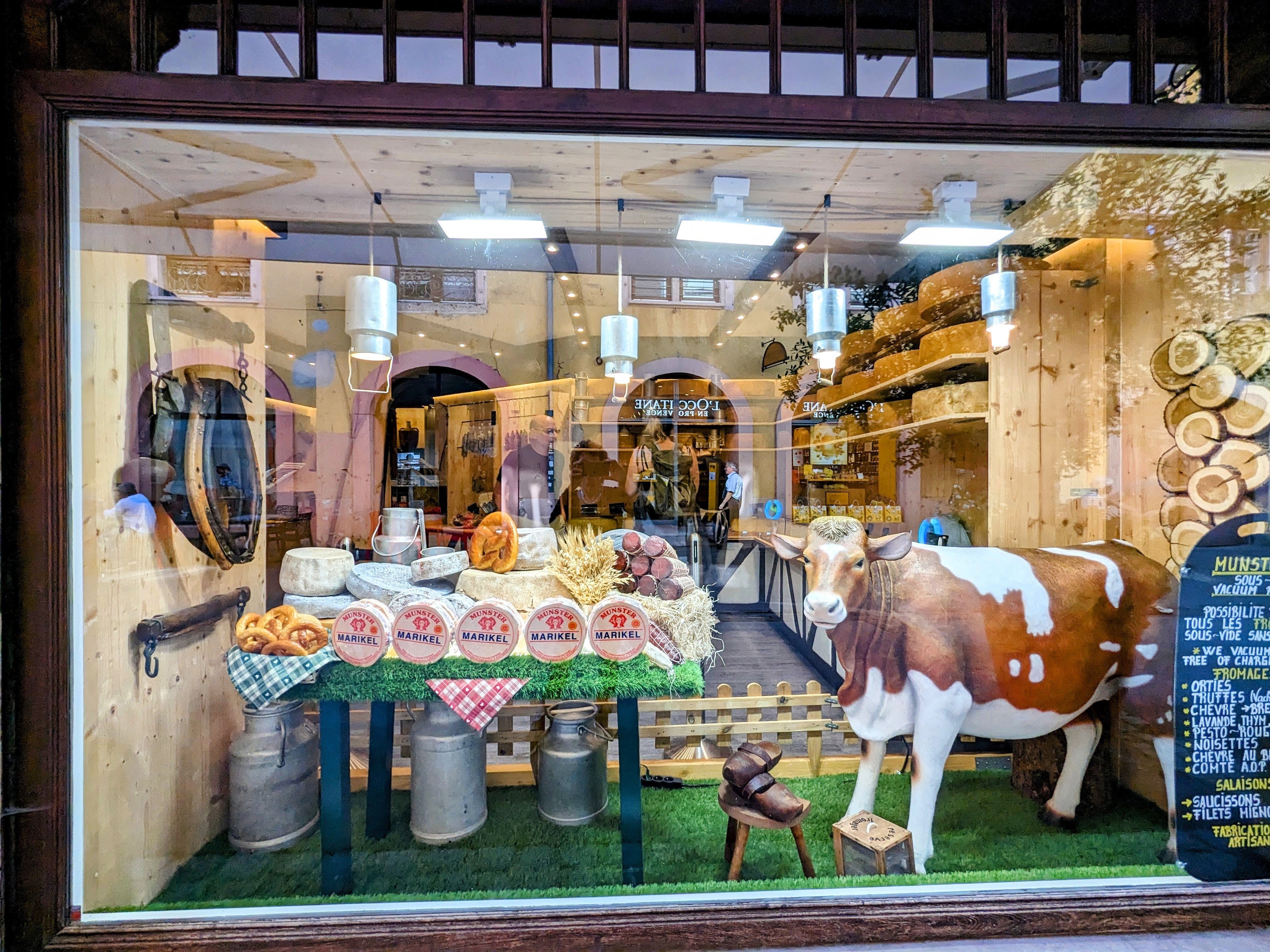
I had decided that it was important to purchase a chunk of the local Munster cheese. And Glory be! We came upon a store with a cow in the window and wheels of various Munsters.
The proprietor was a wonderful guy who insisted that we taste samples of all the various variations of Munster.
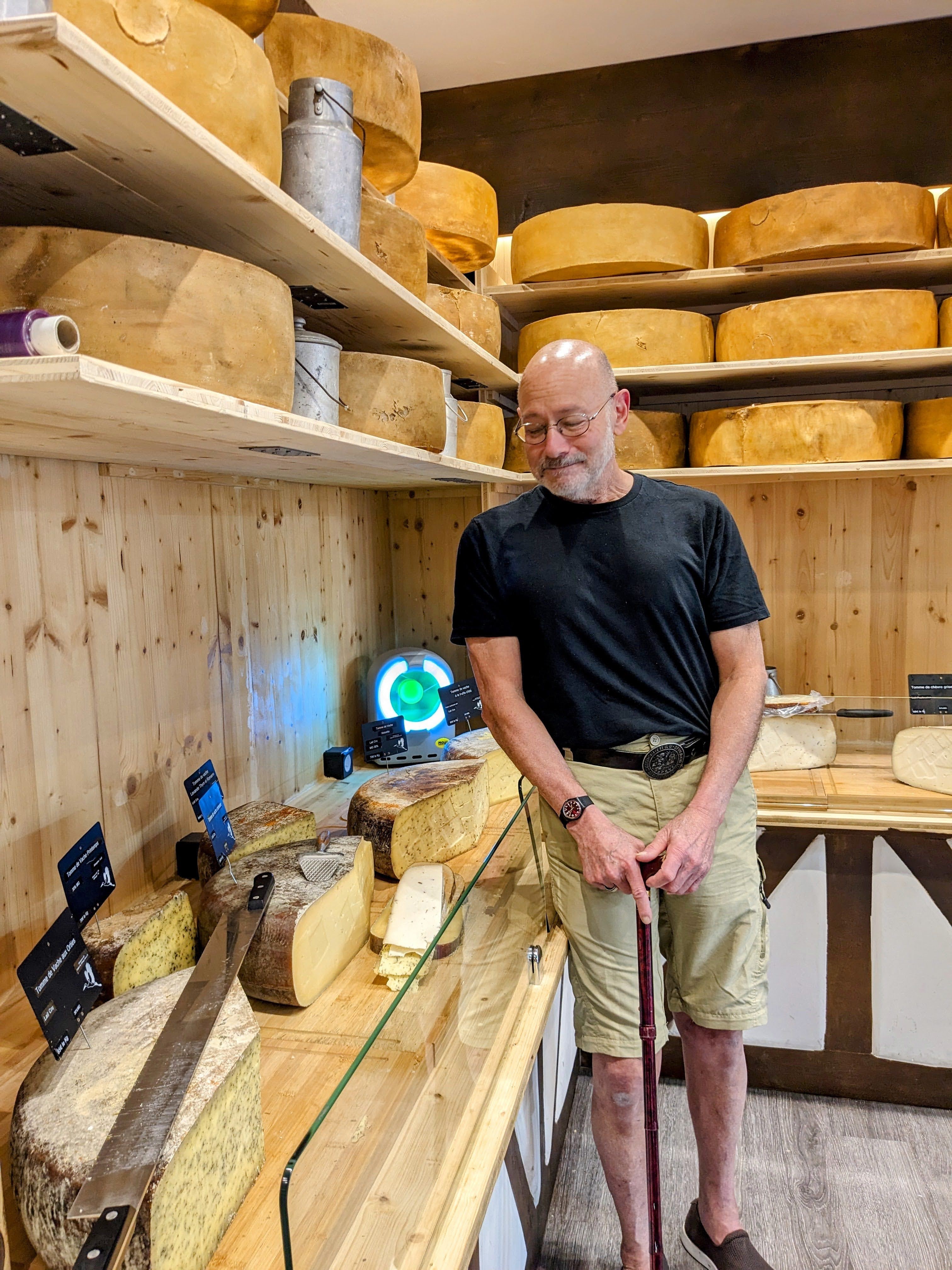
We settled on two of his offerings (in the foreground above), the basic Munster, and the one with “nettles.” He had the machinery to vacuum-wrap the chunks of cheese, so as to obviate the need for refrigeration, and to keep the aroma away from the cheese-sniffing beagles when we pass U.S. Customs.

Back to the Mercure Hotel to rest before dinner, at the Restaurant Pfeffel. Since we didn’t feel like waiting an hour (the kitchen had just opened), we opted for the. easier-to-prepare tartes flambés, which are the traditional Alsatian version of pizza. Very thin crust, with cheese, cream and other toppings (onions, wild mushrooms, speck [a kind of prosciutto], smoked salmon, whatever).

The dish was apparently invented during the time that Alsace was German, and it was called Flammeküche (“flame cake”?) and was used primarily to test the heat of the oven before the important stuff was to be cooked. In any event, when Alsace became French again, the dish was already an Alsatian tradition. But they couldn’t call it by a German name (sacre bleu, non!). So it became (voila!) tarte flambé. (Stef violated her vegan rules and loved it). It tasted real good So did the bottle of Riesling to wash it down.
Tomorrow, taking a train to Strasbourg for a day trip.


 Something to Declare
Leave a reply to Deborah Cancel reply