
September 19 – 20, 2024. Mostar, Sarajevo.
Yesterday, Thursday (September 19), we left Dubrovnik for our stay in Bosnia and Herzegovina. That’s one country, divided a great number of ways. First, by physical geography: Herzegovina is the part closer to the Adriatic, with a Mediterranean climate; Bosnia is the other part, with the continental climate.
After geography, there is politics: Under the Dayton Accords (1995), the country was divided into two co-equal states, the Republic of Bosnia and Herzegovina (mostly Muslim Bosnians and Catholic Croats) and the Republic of Serbs (mostly Orthodox Christian Serbs, not to be confused with the Republic of Serbia proper). “Confusion” being the operative word here.
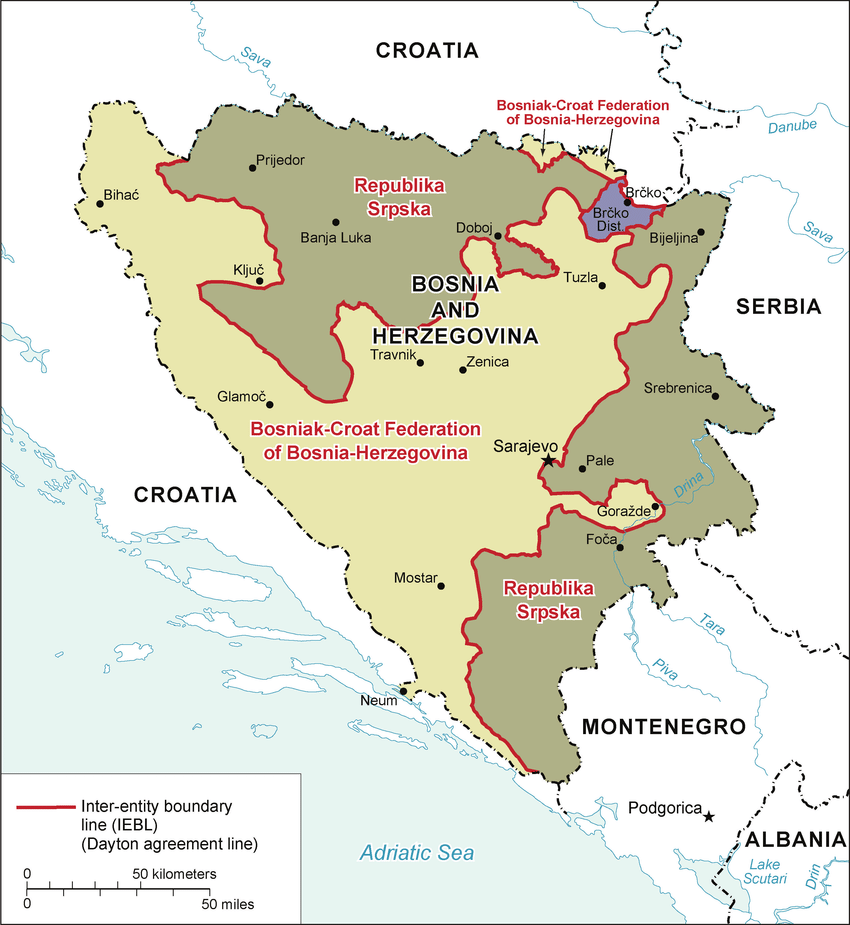
(Map from Internet) The two republics operate pretty much the way U.S. states do, taking care of almost all governmental functions except for foreign policy and national security. The latter responsibilities are the charge of the federal government, which consists of three Presidents, one each for the Bosnian, Croatian, and Serbian communities. Each President has executive authority over the whole country for rotating eight-month periods. Given our system (Electoral College and all that), we are not really in a position to criticize. At least, for now, they’re not actively at each others’ throats (ahem!).
We stopped for lunch in the town of Mostar, famous for its bridge across the Neretva River, a masterpiece of 16th Century Ottoman Turkish architecture, separating Muslim and Croat sections (below, upper left). We arrived there in pelting rain, and we walked to the restaurant on very uneven, slippery cobbles (below, lower right).
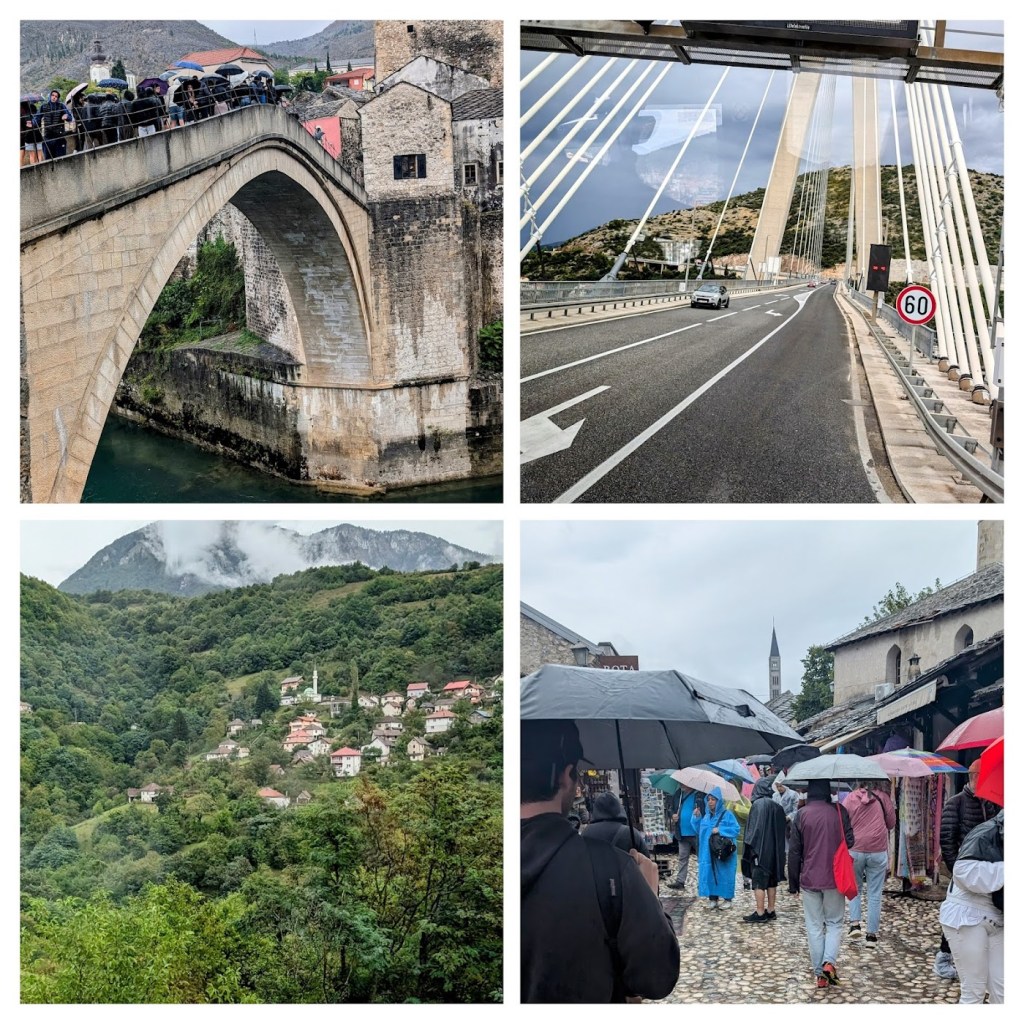
We left Mostar by way of the Franjo Tuðman Bridge named for the first president of independent Croatia (above, upper right). Pretty scenery on the way from Mostar to Sarajevo (above, lower left).
Entering Sarajevo, you couldn’t miss the buildings that still sported damage from bullets, artillery shells and bombs.
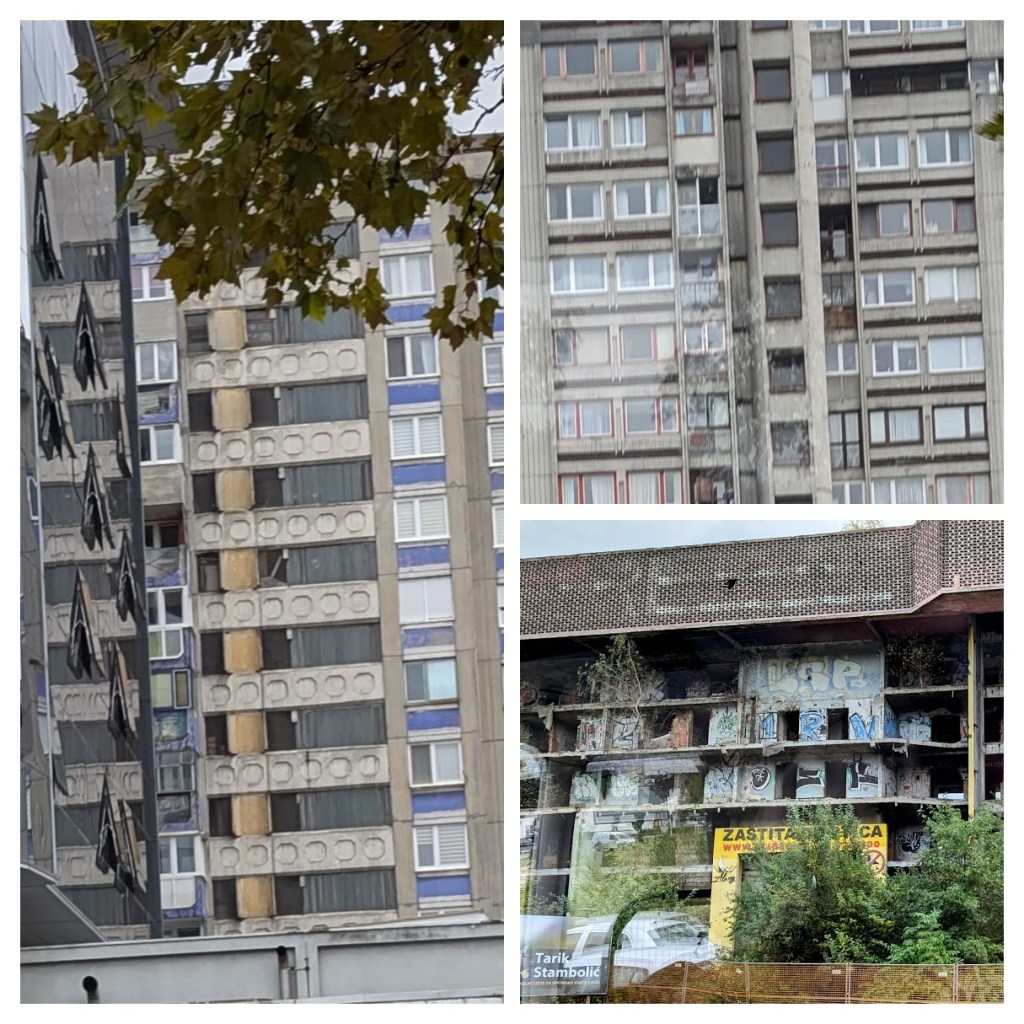
Our guide, Elsa, explained that, despite the external damage, people live in these apartments. The interiors of many buildings have undergone restoration, including utilities, the shrapnel holes on the exteriors notwithstanding.
This morning (Friday, September 20), Elsa introduced us to our local Sarajevo guide, Neira. Neira took us on a walk to the Latin Bridge (one of many that span the Miljacka River). Near the bridge, on June 28, 1914, Austrian Archduke Franz Ferdinand (the nephew and heir of Emperor Franz Josef) was assassinated in his open limousine by a 19-year-old Serbian nationalist named Gavrilo Princip. Which, as we all know, was the match that started the fire which became World War I.
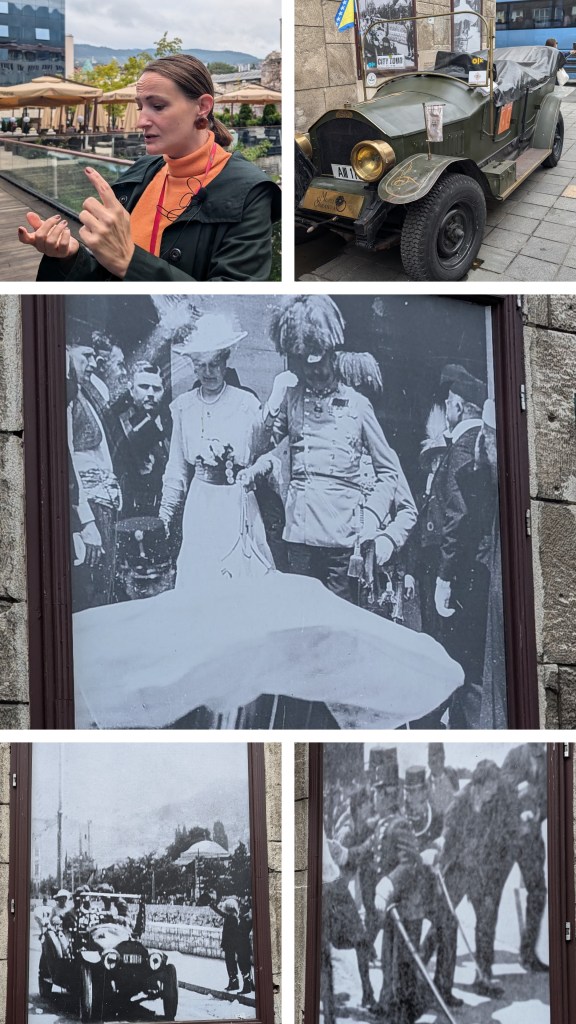
That’s Princip above, lower right, after his arrest. Since he was a minor, he received a sentence of only 20 years’ imprisonment. He died in prison from TB before completing his term.
Neira took us further along the Miljacka River, bridges over which were festooned with banners supporting Palestinian independence (but see below, lower right). She pointed out the brewery established by a Jewish entrepreneur (below, upper right), which abuts a Muslim mosque (below, upper left) and a Catholic monastery. Sarajevo has always prided itself on being ecumenical.
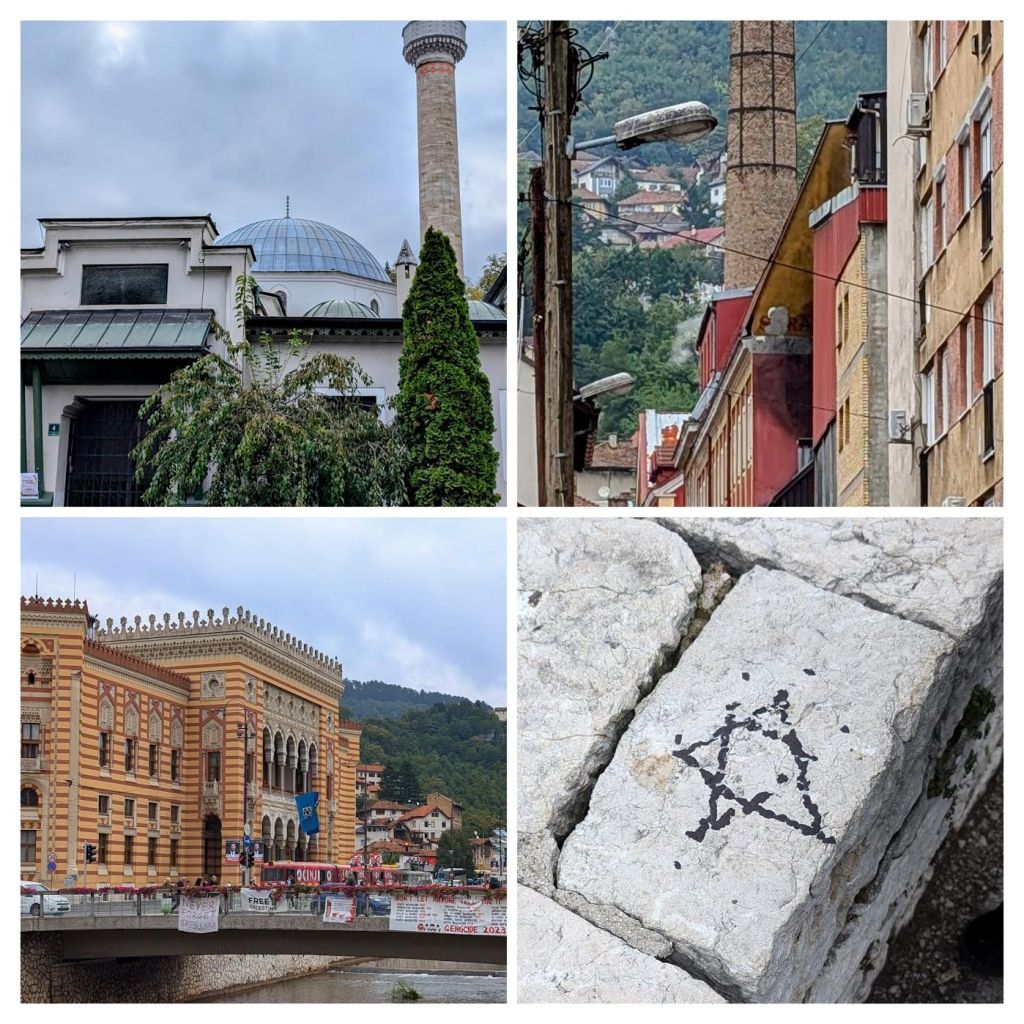
This sentiment extends to the City Hall (above, lower left), built by Austria-Hungary in 1896, and designed in the “Moorish” style.
We visited the workshop of a coppersmith who displayed vases made out of discarded artillery shells from the 1990s war.
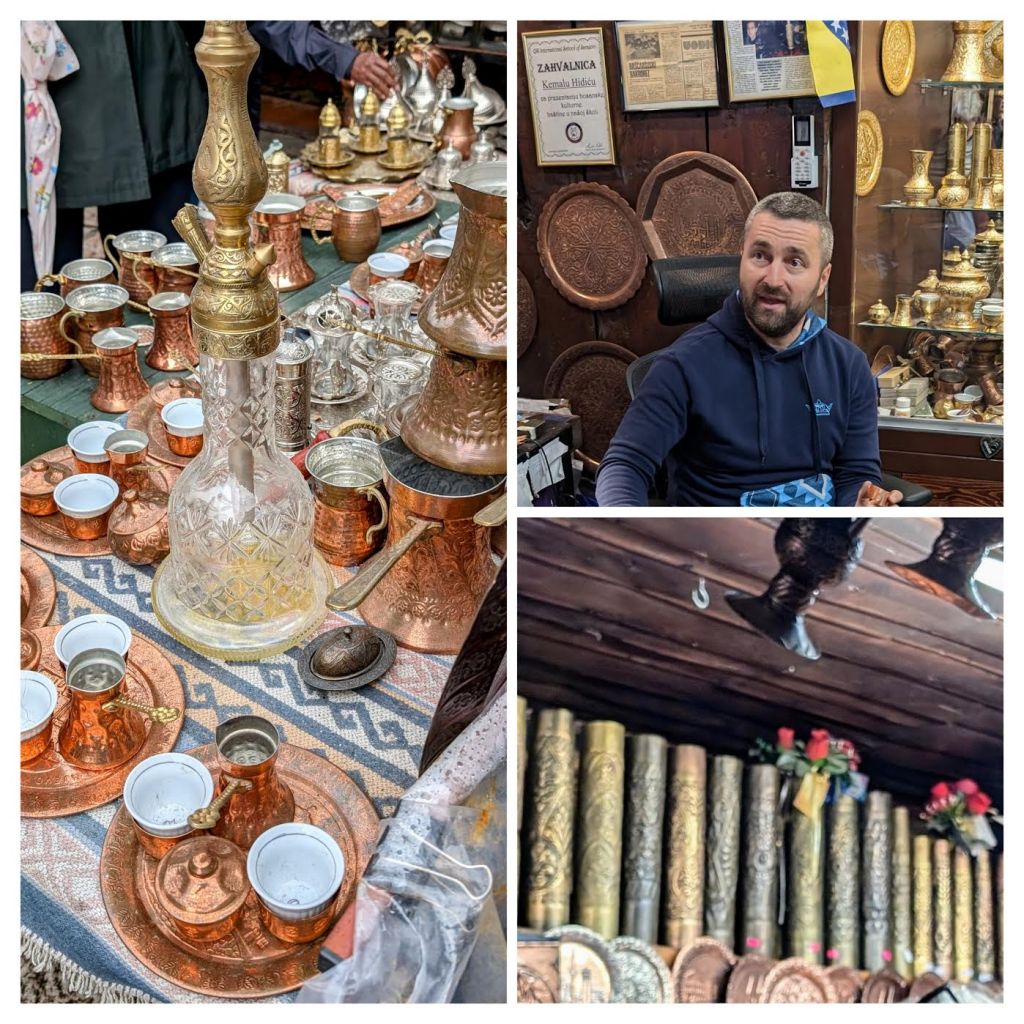
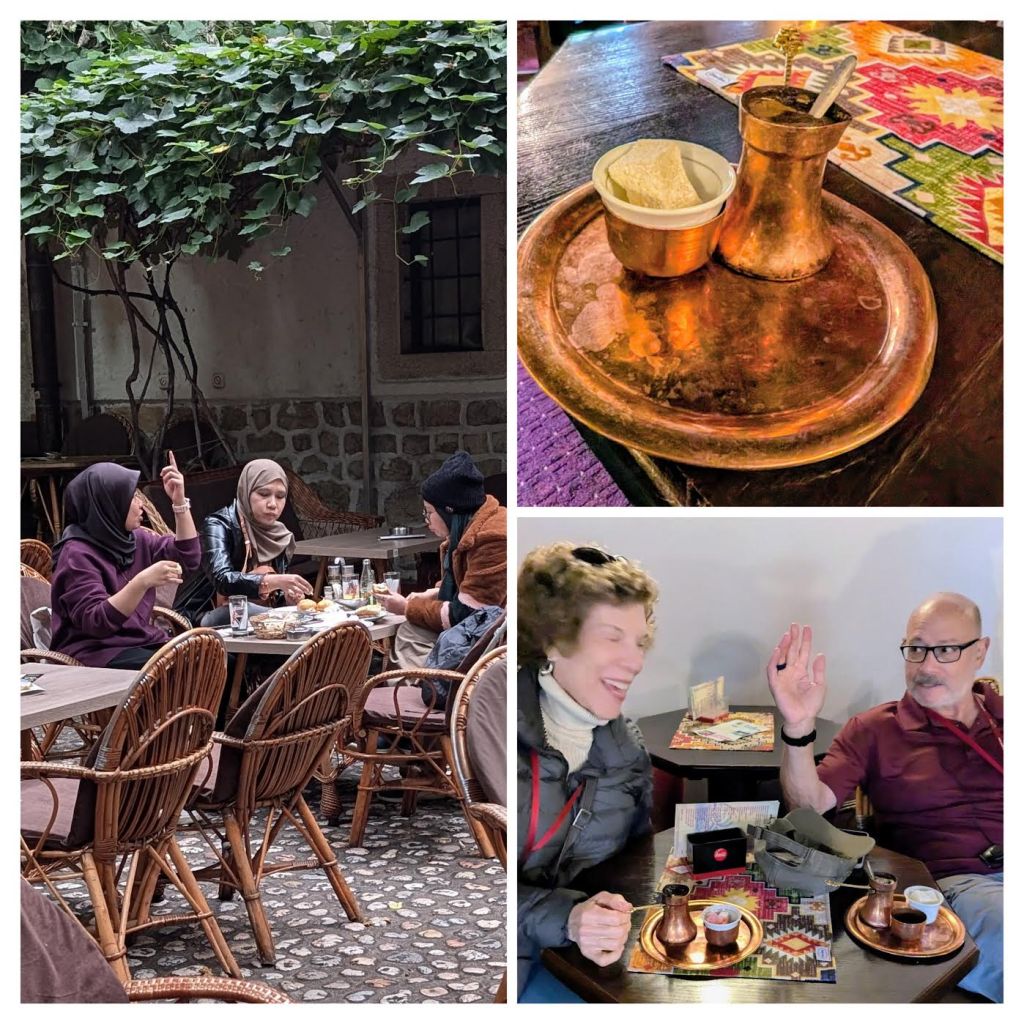
And we participated in the Bosnian coffee experience at a nearby coffee house:
Neira took us to the Ali Pasha Mosque, the chandeliers in which were given to the mosque by Emperor Franz Josef, another act of ecumenism.
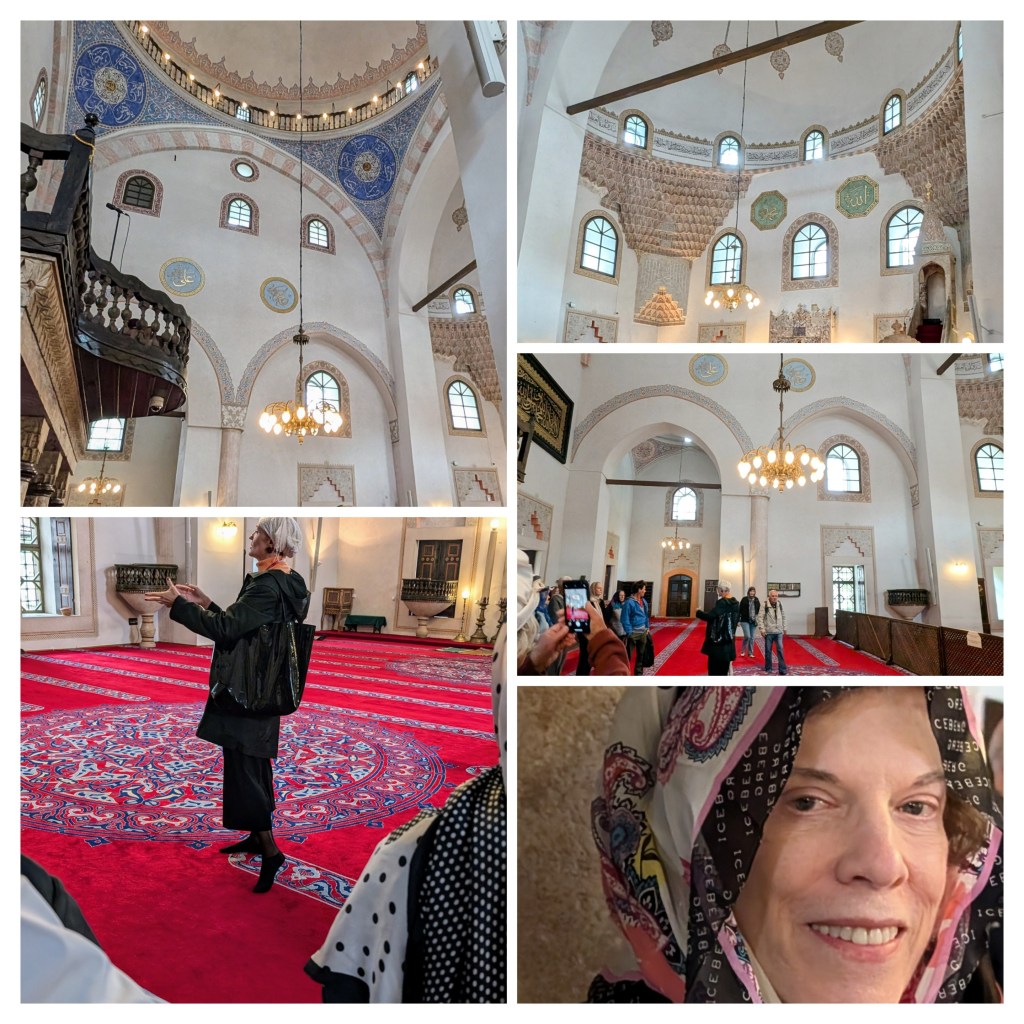
Like a lot of other forms of worship, prayers are in the traditional language (Arabic), but the sermons are delivered in the vernacular. Stef looked fetching in an improvised hijab.
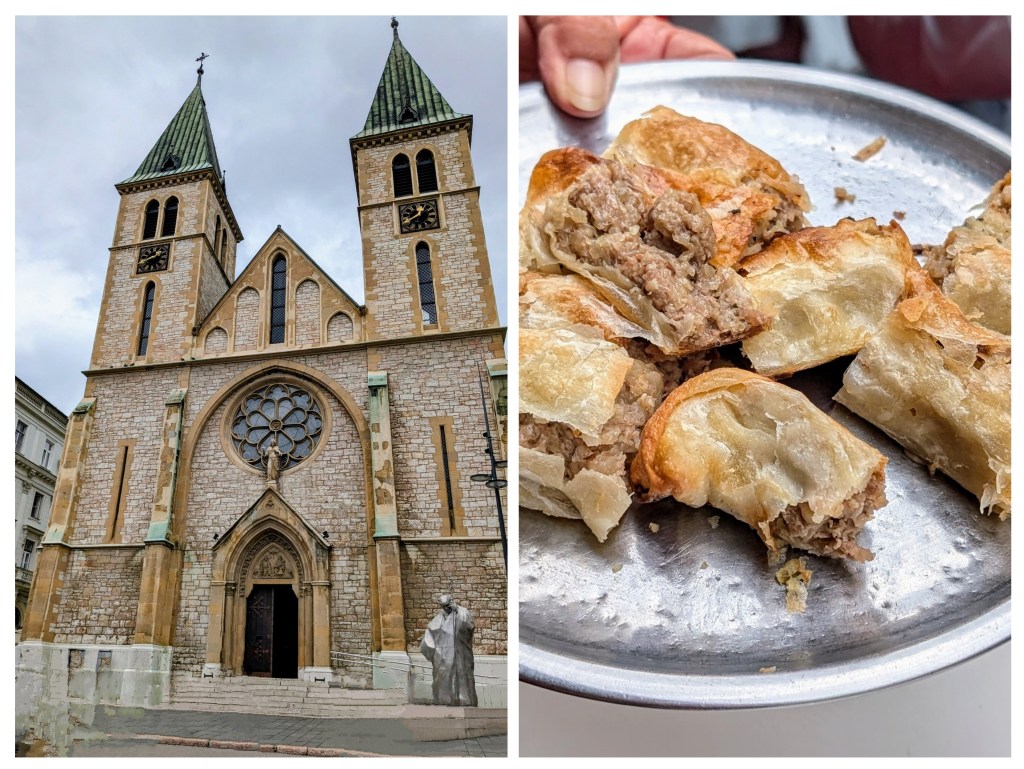
We said good-bye (for the day) to Neira at the Cathedral of the Sacred Heart (built 1889), and Elsa took us for a treat, a place that sold only “pitas.” These are not the familiar near eastern breads, but are rather pastries made from phyllo dough filled with meat, spinach, potatoes. Delish!
Last, we took the tram to the National Museum of Bosnia and Herzegovina, where I got my wish to see the famous Sarajevo Haggadah. This beautifully illustrated parchment document was crafted in Spain in the 13th century. It made its way to 16th century Venice, and eventually arrived in Sarajevo, where is was protected from German occupiers (and others), and is now preserved and displayed.
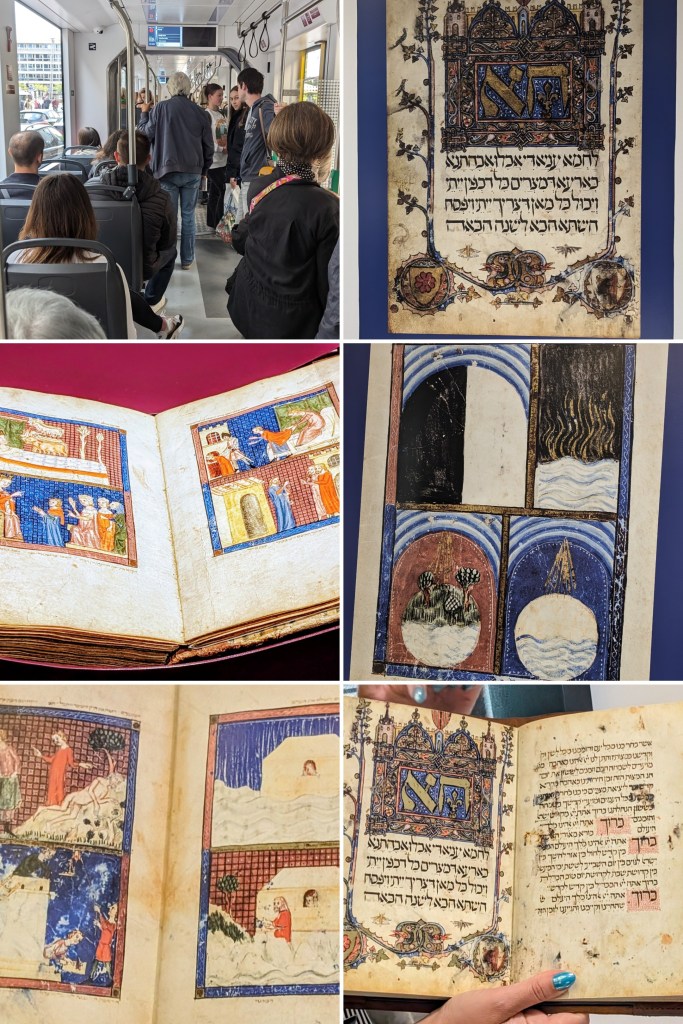
For those subscribers who enjoy historical fiction, there’s a wonderful novel, “People of the Book,” by Geraldine Brooks. It sort of follows the format of James Michener’s “The Source:” A professional document preservationist is asked to come to Sarajevo to restore the Haggadah. She observes certain anomalies about the Haggadah (a wine stain on a page, a screw missing from the binding, etc.). The author then goes back in time, telling the story, in consecutive vignettes over the years, of the Haggadah and its travels, and the people who came into contact with it, over 400 to 500 years (where that wine stain came from, e.g.). Captivating and engrossing, and a wonderful read. Just sayin’.


 Something to Declare
Leave a reply to travelswithvalerie Cancel reply