
September 23-25, 2024. Zagreb, Plitvice Lakes.
On Monday afternoon, we traveled 3+ hours to Zagreb, the capital of Croatia since 1557. The next morning our local guide, Kristina, took us on a walking tour. She noted that Zagreb has essentially two parts, the modern lower town (Donji Grad), and the older, medieval Gornji Grad (upper town).
We met at the large square in the lower town, dedicated to the 19th century war hero, Josip Jelačić. He’d been a field marshal in the Austro-Hungarian army and the Habsburg’s Hrvatski Ban (viceroy of Croatia) from 1848 to his death in 1859. He is credited with ending serfdom in Croatia. Kristina showed us the varieties of architecture in the square, from Austrian to Arte Nouveau to Communist.
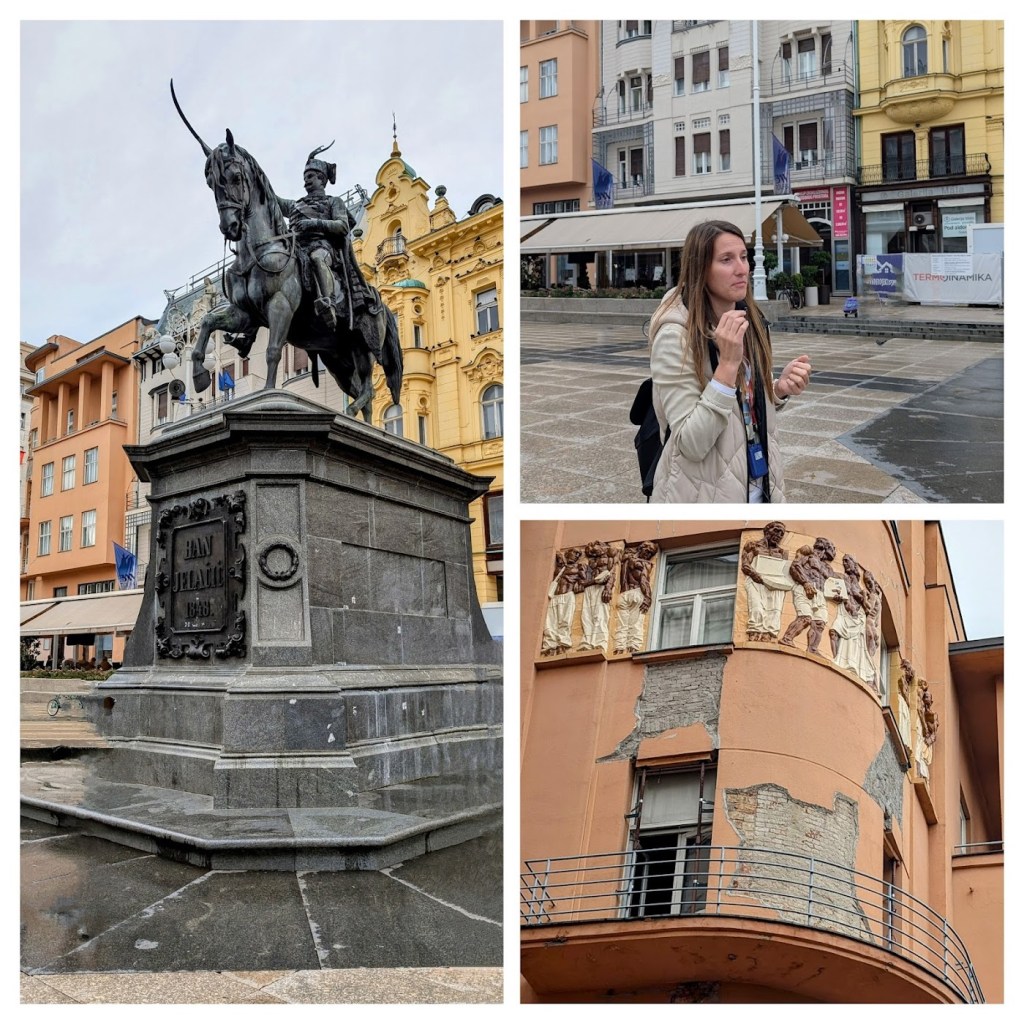
The image above, lower right, is the House of Popovic (a Zagreb trader) decorated in 1907 with a painted ceramic relief entitled Seljaci (Peasants), consisting of ten figures engaged in the trade of wheat. Note remaining damage from a serious earthquake four years ago.
You get from the Donji Grad to the Gornji Grad via Europe’s shortest funicular.
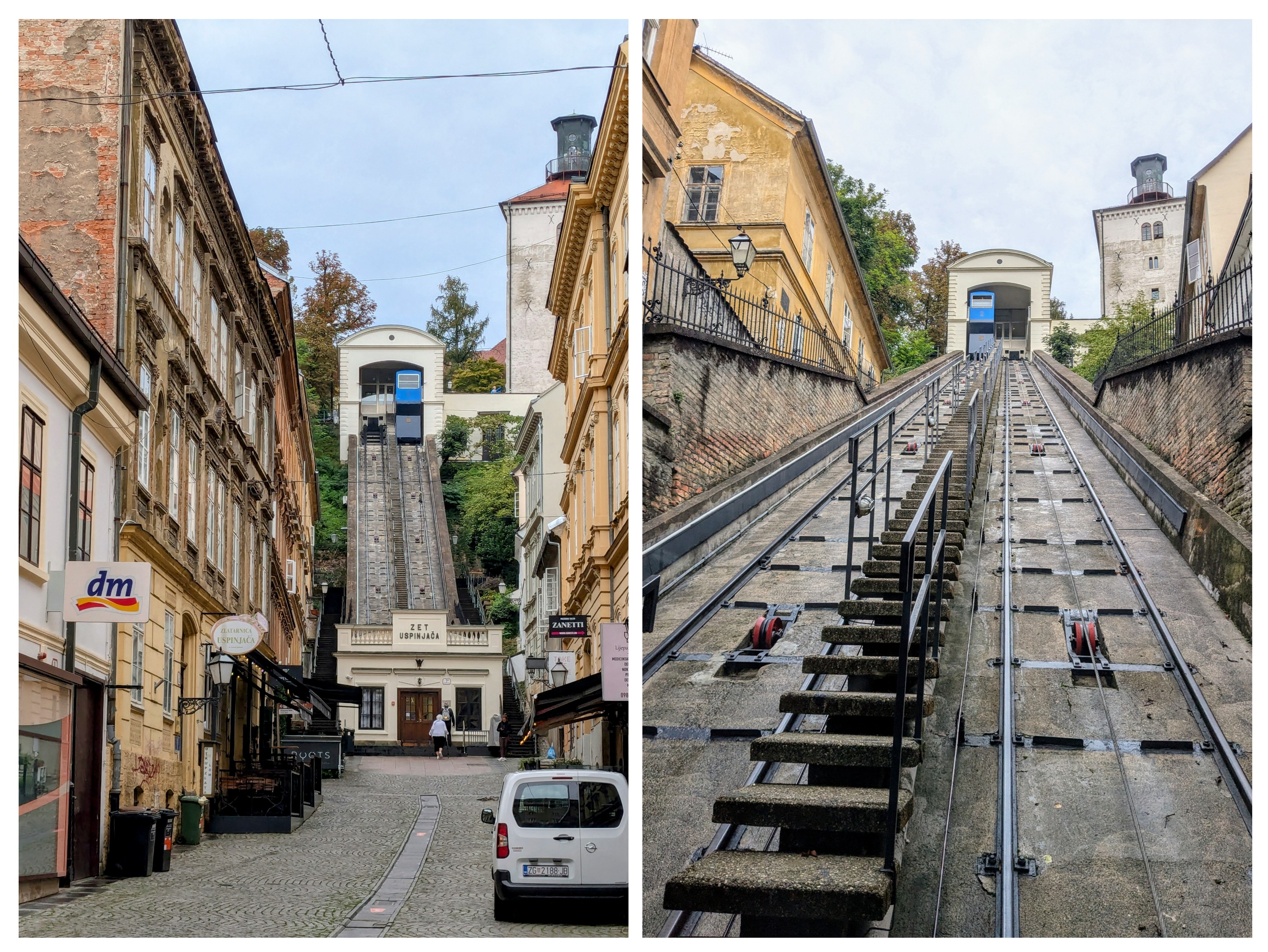
The ride from bottom to top takes about one minute which, Kristina pointed out, is about the time it takes to have a real French kiss. This reference is important because in the Gornji Grad is the Museum of Broken Relationships.

The museum’s exhibits include curated stories and artifacts relating to romantic breakups. This sort of levity is common among many of the museums in Zagreb, e.g., The Cravaticum (Museum of the Cravat)–Croatians claim to have invented the necktie: Croatian mercenaries, hired by King Louis XIII of France, had a piece of red cloth tied around their neck with their costume–the French vehemently dispute this claim; the Cannabis Museum; the Museum of Mushrooms; the Hangover Museum; the Museum of Chocolate. You get the picture. But don’t you dare make fun: They also have a Museum of Torture. These are in addition to more traditional, serious art museums.
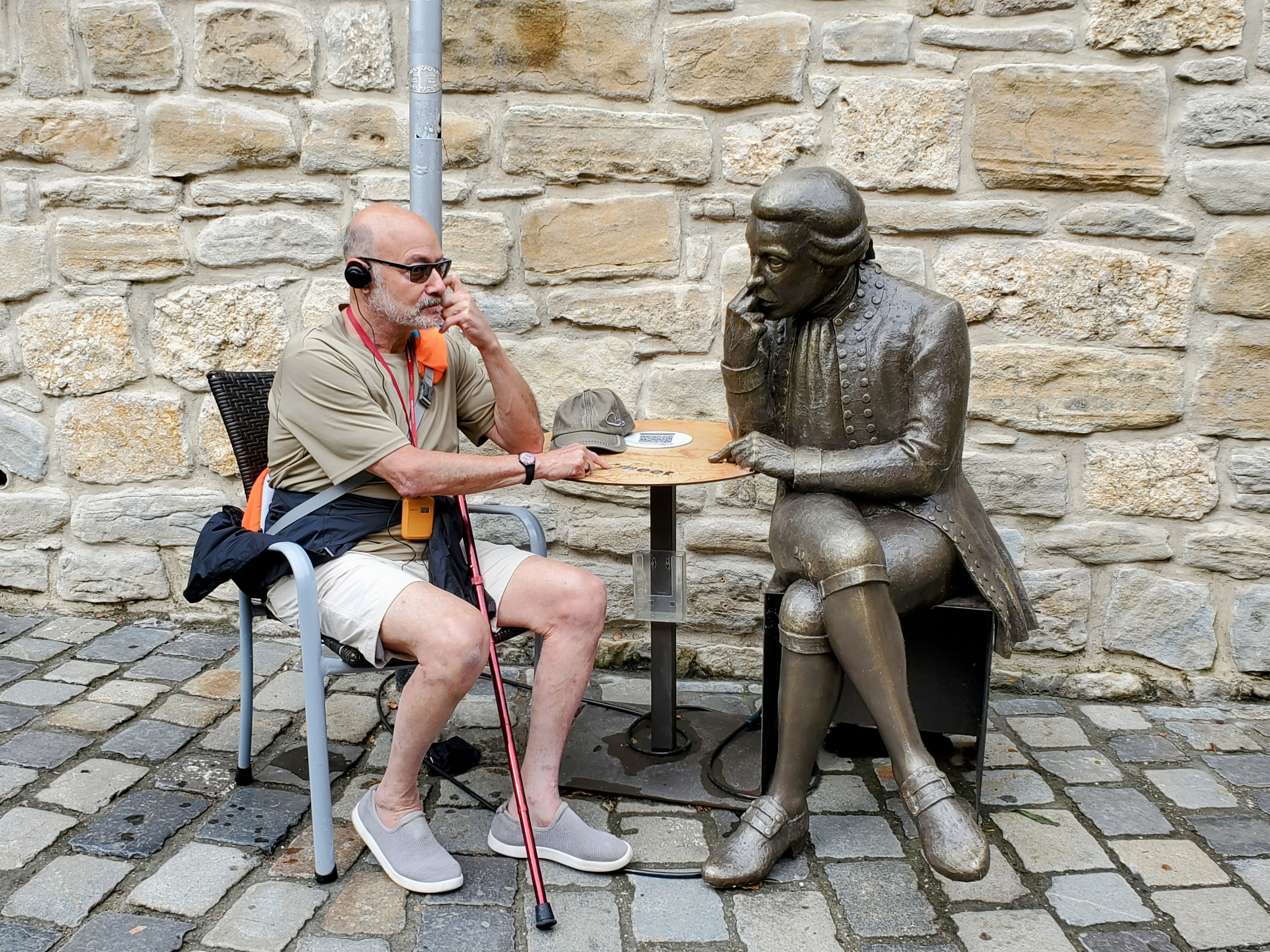
Zagreb also has statues scattered around the city, designed for people to sit down for selfies with famous Croats, including a guy in 18th century garb, whose name I never learned. I tried to engage him in a therapeutic dialogue but he was clearly too repressed:
We saw the Cathedral of St. Stephen (with scaffolding to maintain structures damaged by earthquake); the Stone Gate (with star-like snare on the roof, to catch flying witches on broomsticks [sic]; and St. Mark’s Church (with roof showing coats of arms of Croatia and Zagreb).
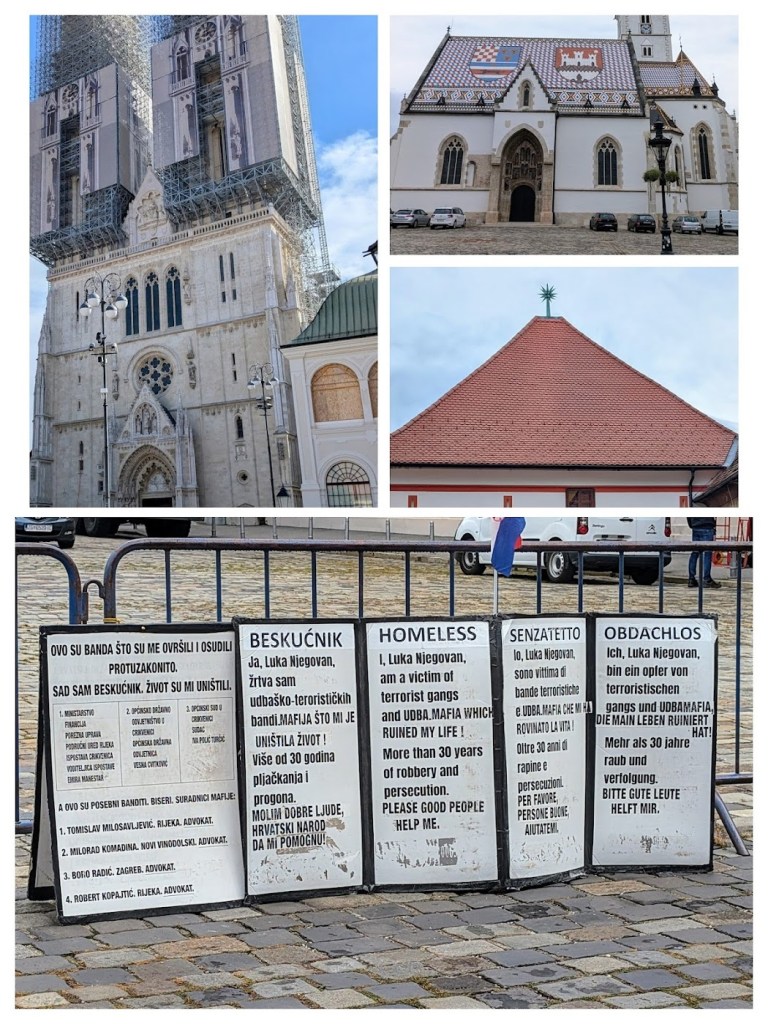
There was also, above, a political statement by a disgruntled homeless person. He was not physically present when we were there; people are not allowed to sleep on the streets. But their political statements can be out 24-7: Free speech must be honored.
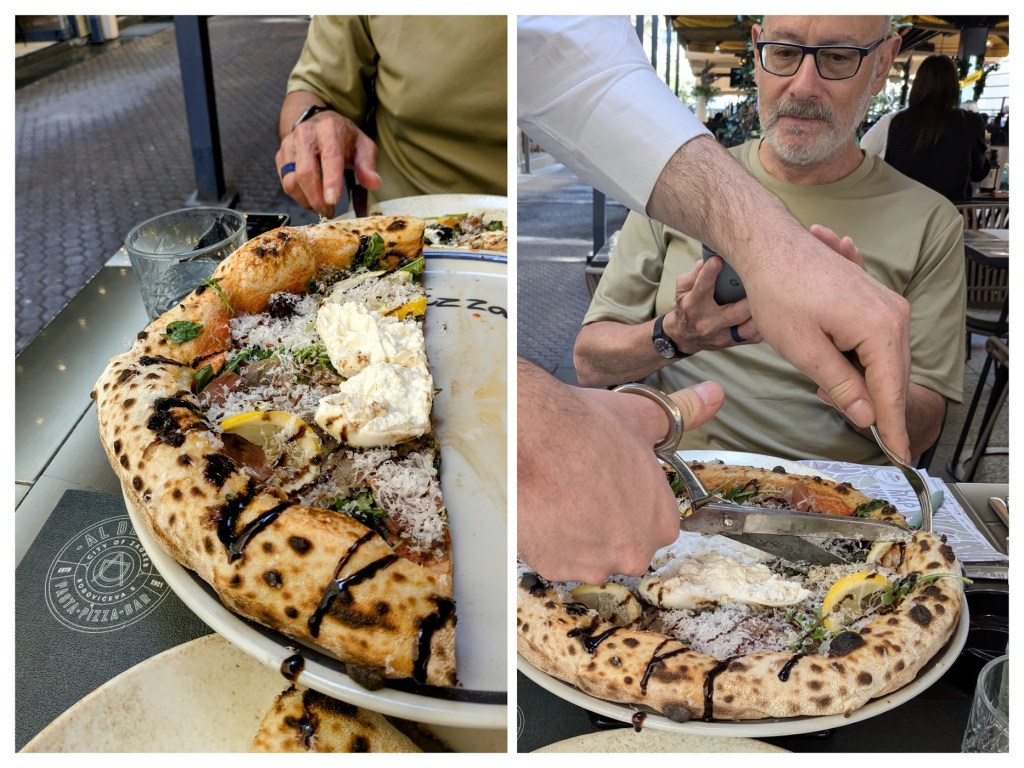
We made our way back down to the Donji Grad. On the way down, we had the funicular car to ourselves. We tried out Kristina’s suggestion, and found that a minute is a long time for a kiss. Lunch was pizza with smoked tuna, burrata, olives and lemon (odd but yummy combo), which the server cut for us with large shears.
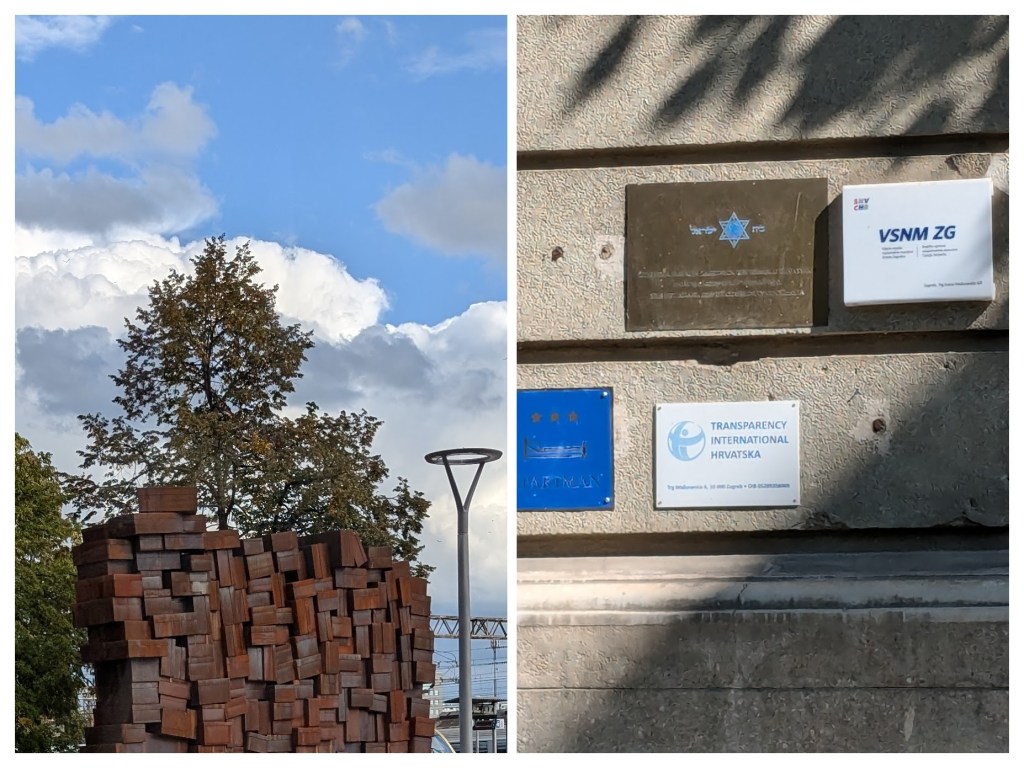
We made our usual search for local Judaica, but the Jewish Museum had strange hours that didn’t fit into our schedule, and the Synagogue was closed but represented by a small wall plaque on what appeared to be a residential building. We did see a monument to the Jews and other Nazi victims, consisting of a pile of stylized bronze suitcases (representing those forced to leave Zagreb for the camps).
This morning (Wednesday, September 25), we travelled 2.5 hours to the Plitvice (plit-VITZ-ah) Lakes to visit the National Park, Plitvička Jezera. It’s the first national park established in Croatia, during the Communist Yugoslav period. It consists of 114 square miles, with a series of 16 turquoise lakes linked by a series of waterfalls and cascades. Here are some photos from the 4-mile hike:

Truly gorgeous!
Lunch was local trout (grilled) and a traditional Croatian side dish of Swiss chard with potatoes (I googled a recipe and will try it at home.)
Tomorrow, more Croatia time: Rijeka and Opatija.


 Something to Declare
Leave a reply to Sharon Wieland Cancel reply