
Bruges (or Brugge, as the case may be)
Monday, October 20, 2025
Day trip to Bruges? There was a good chance of rain, but we decided to go for it.
Up and out, to the Gare du Midi, to catch the train (an easy one-hour ride) to Bruges, a world-class trading center and economic powerhouse from the 11th century until the 16th century. By then, the harbor had silted up and the economy collapsed. Bruges was a “backwater” until tourists discovered it in the 20th century. Currently, some eight million people visit each year. Traveling off-season, in October, we did not encounter crowds or long lines.
On the station platform, we had the good fortune to meet a couple from Israel via eastern Pennsylvania, Dan and Debbie (he’s a psychiatrist, she’s an artist).
In fact, we spent most of the day together. First stop was the Onze-Lieve-Vrouwvoorplein (Church of Our Lady):

The church has a famous Carrara marble sculpture of the Madonna and Child by Michelangelo:

Having visited the Carrara marble quarry in Italy on a Road Scholar trip a few years ago, we were happy to know about this gem.
On to the Market Square (yet another Grote Markt), where we saw the array of flags of Bruges, Flanders, Belgium, and the EU; right behind the statue of Resistance heroes Jan Breydel and Pieter de Coninck , facing south towards France, the enemy back in the day (below, left); Bruges’ oldest building (built in the 15th century, but looking incongruously modern), with a compass (clock?), gold flag and gold ball at the top (below upper right); and the Belfort (Bell Tower), which sounds on the quarter-hour with carillon chimes (below, lower right). Debbie and Dan agreed with us not to climb the 366 steps to the top.

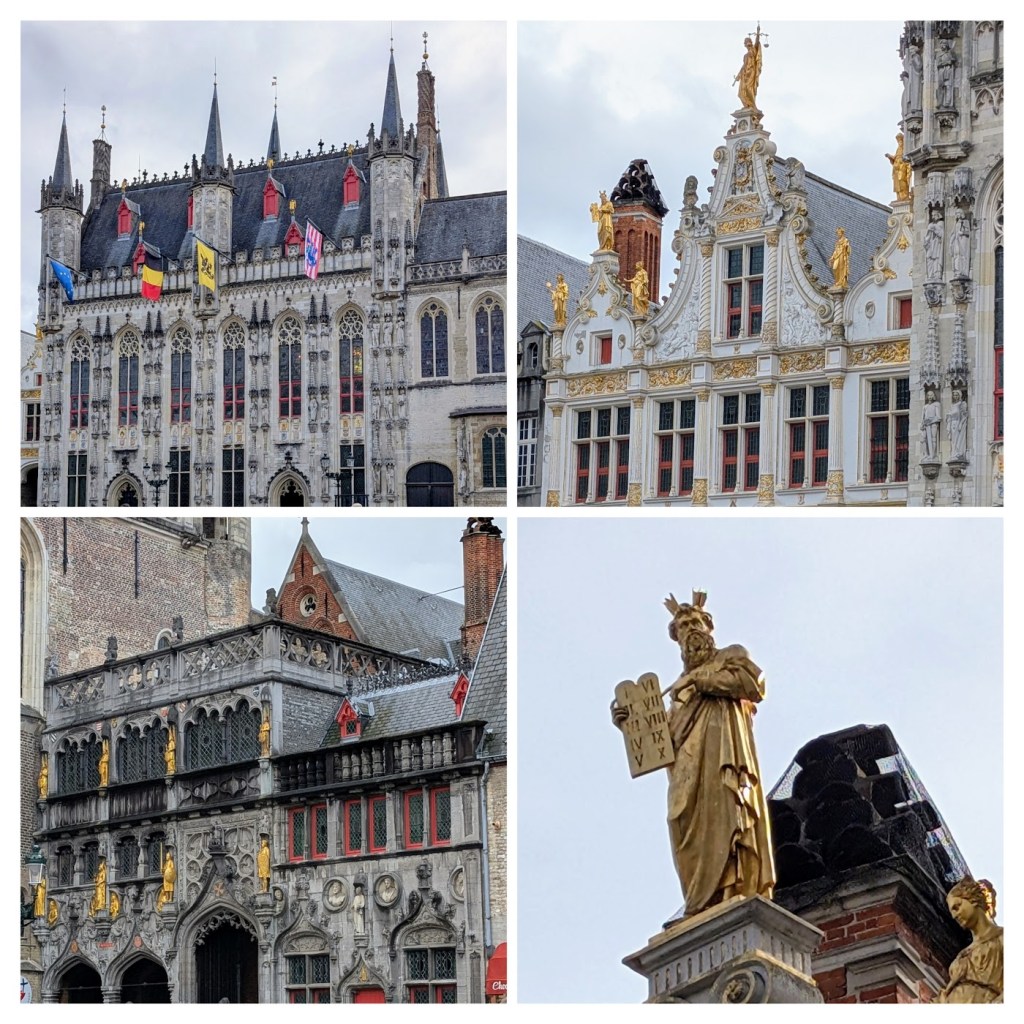
The Market Square is, oddly enough, smaller than the Burg Square (the city’s historical, political and religious heart, the next item on Rick Steves’ Bruges walk. There we saw (below, clockwise) the sandstone Stadhuis (City Hall) with its arches and prickly steeples; the gilded Brugs Vrije (Renaissance House), atop which was an image of Moses and the 10 Commandments; and the 17th century Proosdij van Donaas, named for St. Donation (Stef wondered if he is the patron saint of Fund-Raisers?), next to the Provost’s House:
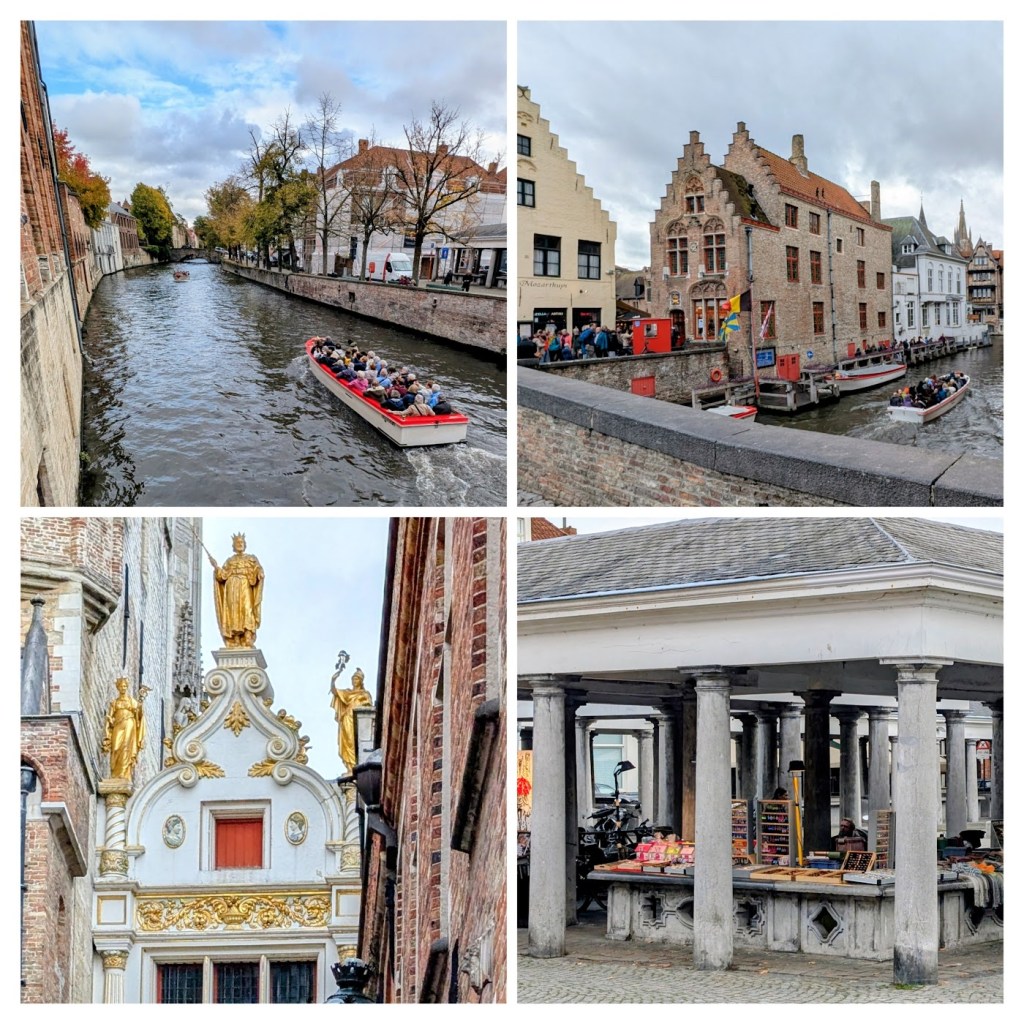
Through a passage called Blinde-Ezelstraat (“Blind Donkey Street”) we came to (below, clockwise) one of the many bridges over the canals; the old Vismarkt (fish market, no longer selling fish); and, when you turn around, the sky bridge atop which are gilded (what else?) figures of the Goldfinger family (not likely related to the James Bond character):
Then to (again, what else?) déjeuner with Debbie and Dan.
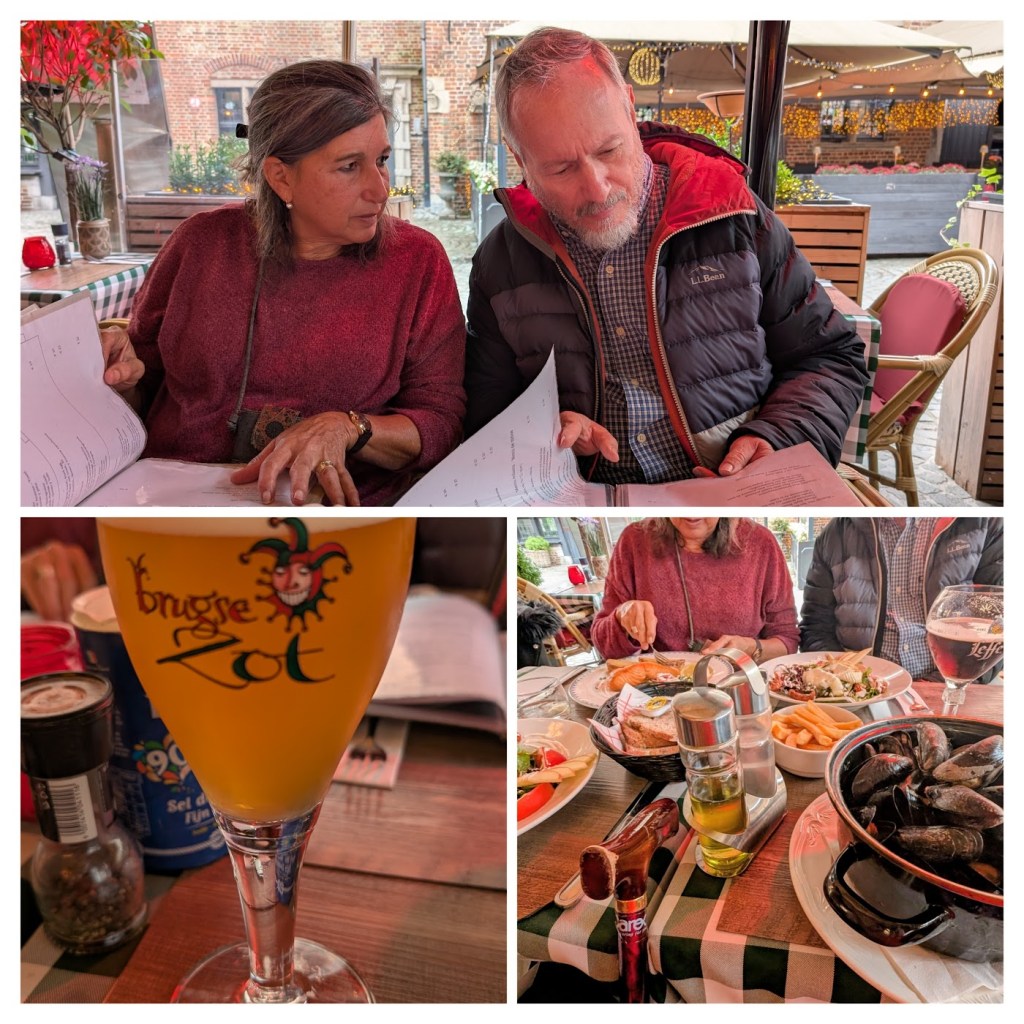
For Stef, a smoked salmon salad; D & D split a goat cheese salad and grilled salmon. I couldn’t resist another batch of moules-frites and a Bruges-style beer. FYI, my moules came with ordinary frites; no option for the waffle-y gaufrittes.
(Shout out to Neil for the hilarious observation that gaufrittes looked like the “love child of waffles and frites.”
By this time, it was raining (surprise!), but it let up enough for us to take a boat for a tour of Bruges’ charming canals.
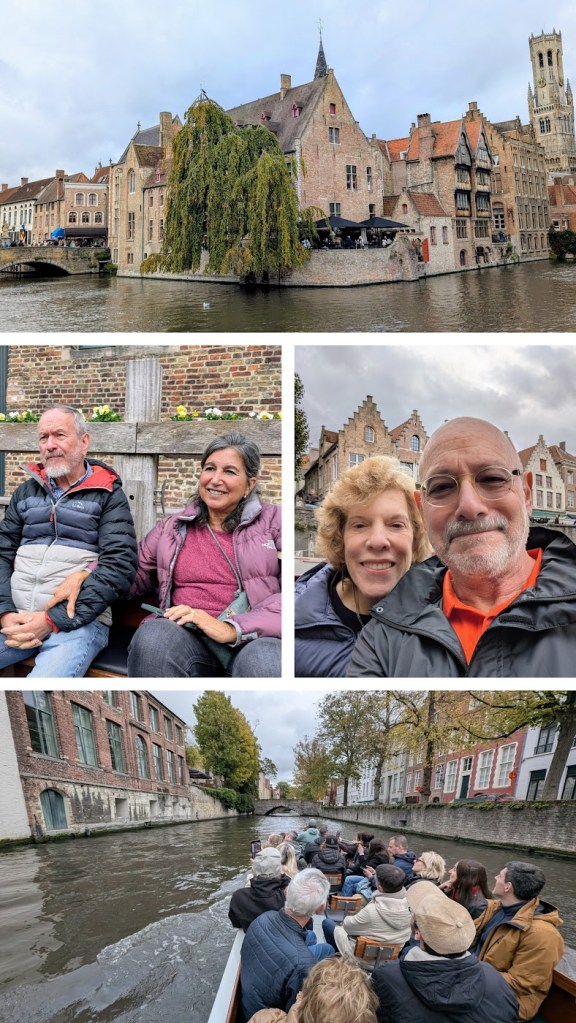
Our tour guide described the historical buildings as we passed:
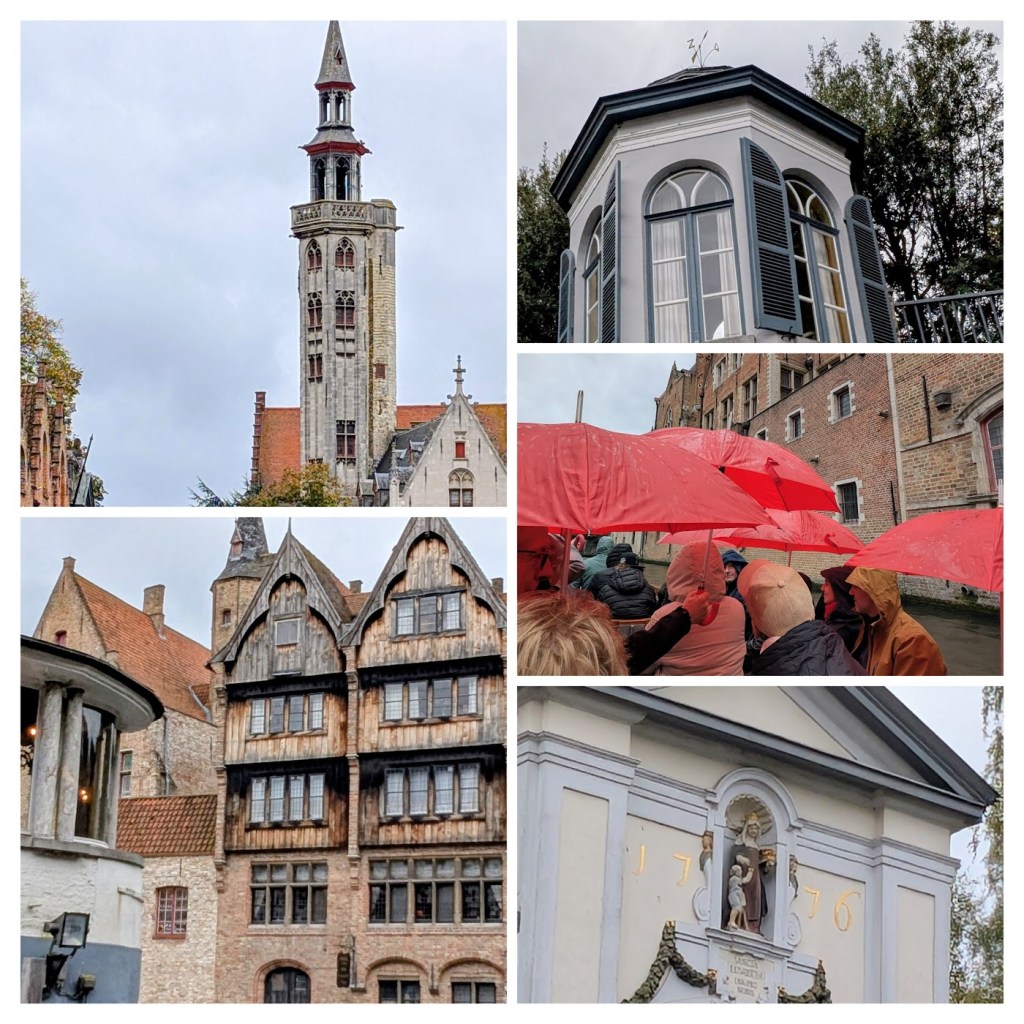
When it started raining again, umbrellas were distributed (very thoughtful).
After this, we found our way back to the train station, then to the Métro at the Brussels Gare du Midi, and then home. I prepared a mélange of garlic, onion, green pepper, mushrooms, left-over potatoes and boudin blonde (the local white sausage), which satisfied.
Tomorrow, the Musée des Instruments de Musique.


 Something to Declare
Leave a reply to Sharon Wieland Cancel reply