Uccle: The van Buuren Museum
Wednesday, October 22, 2025
We, and our new friends, Daniel and Debbie, selected as our activity for today the Musée David et Alice van Buuren. Located in the très luxueux Brussels neighborhood of Uccle, it is the former home and grounds built by David and Alice van Buuren in 1928.
David van Buuren (1886-1955) was a Dutch-born banker who came from Gouda to Brussels in 1909, and became a successful banker and financier. He married Alice Piet in 1922, and the two of them became famous philanthropists and art collectors. He was Jewish; she was Catholic.
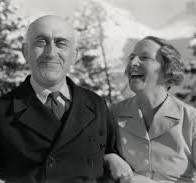
Their home and grounds became an Art Deco jewel. They intended the house to be a showcase for their collection, and employed the best French, Belgian and Dutch decorators. It’s chock-full of Art Deco pieces, carpets, furniture, stained glass, lighting fixtures and vases.
But first, Lunch!
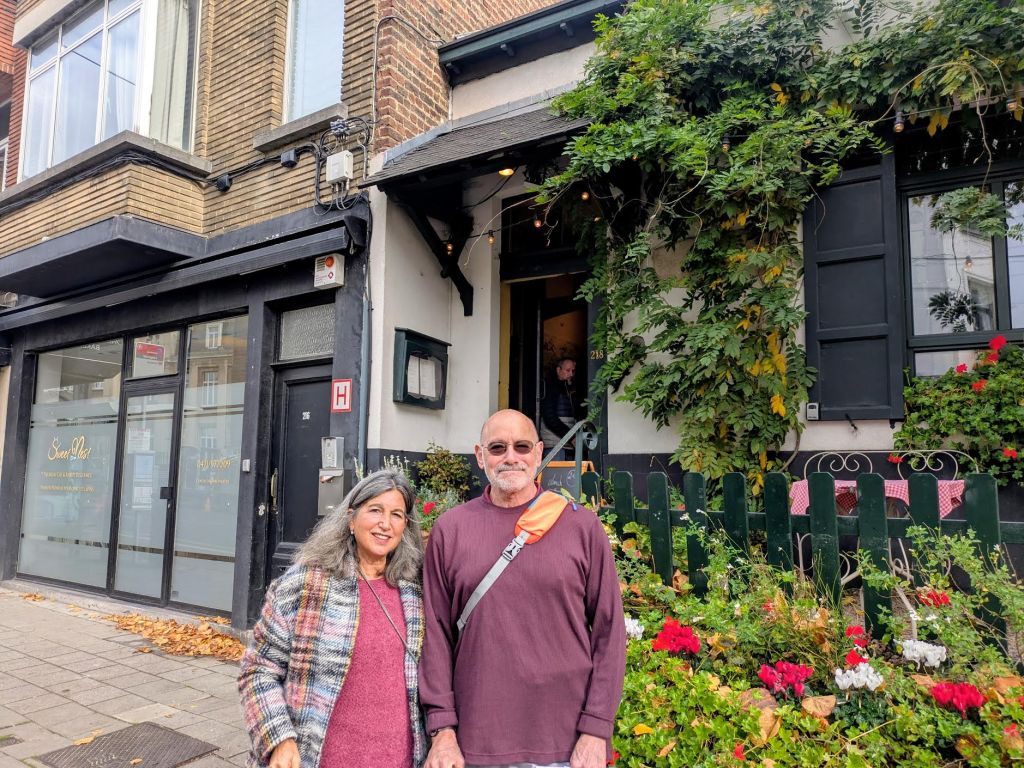
We researched nearby restaurants and decided on De Hoef 1667, Rue Edith Cavell 218. It was originally a postal relay, then a farm, before becoming a guingette (a type of tavern) and brewery, and, in 1955, a bistro. That’s Debbie and me in front of the restaurant (below).
(A factoid for you: The street name refers to Edith Cavell, a British-born nurse. In Belgium, during the First World War, she gained respect and admiration for treating the wounded, not discriminating between German and Allied solders. The occupying Germans took offense regarding the latter activity, and they had her executed by firing squad in 1915.)
The interior of the restaurant featured working fireplaces, and attractive period accoutrements. Debbie and Dan ordered fondue (which turned out to be cheese croquettes!); Stef had a yummy green bean soup and a quiche lorraine, and I did foie de veau with (what else?) frites.
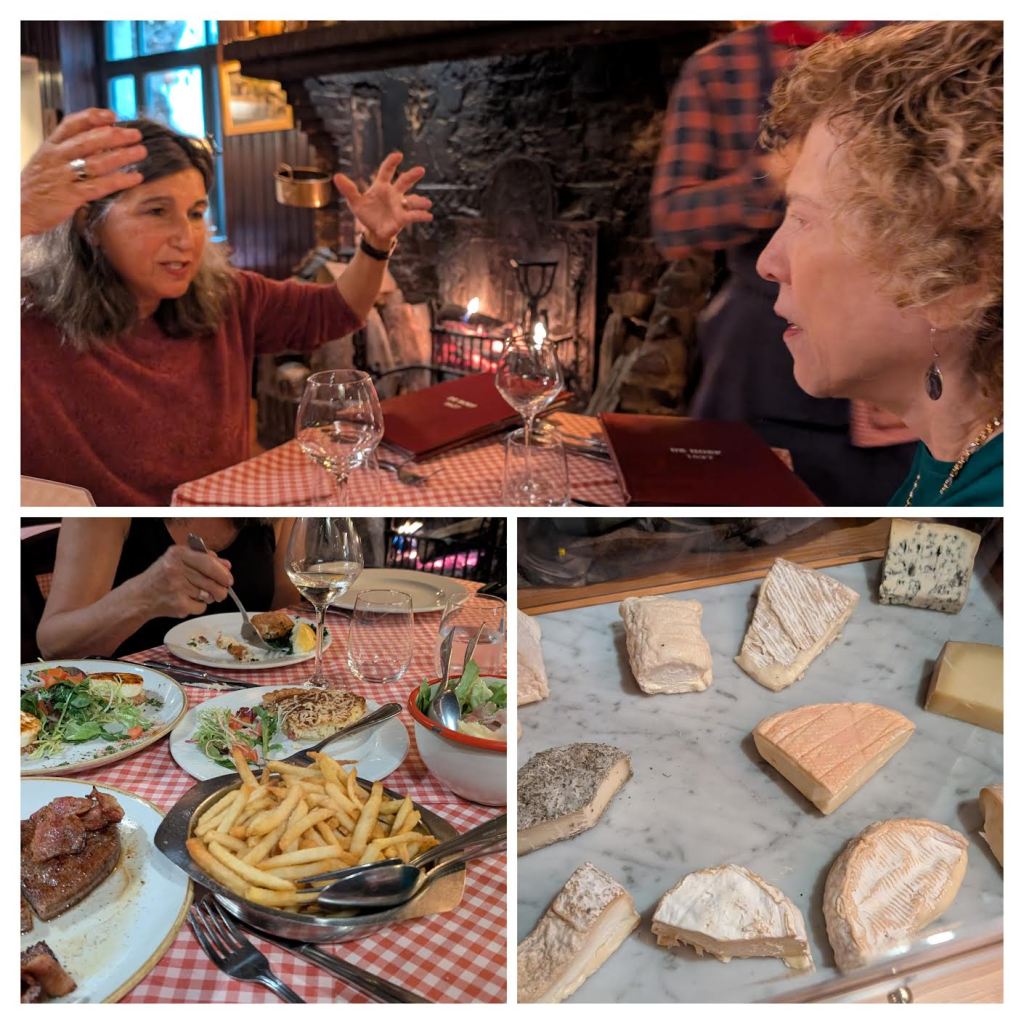
In the interests of food pornography, I couldn’t resist taking a photo of the selection of fromages (above, lower right).
Okay, on to the museum! From the former service entrance (now reception area), we went into the Dining Room.
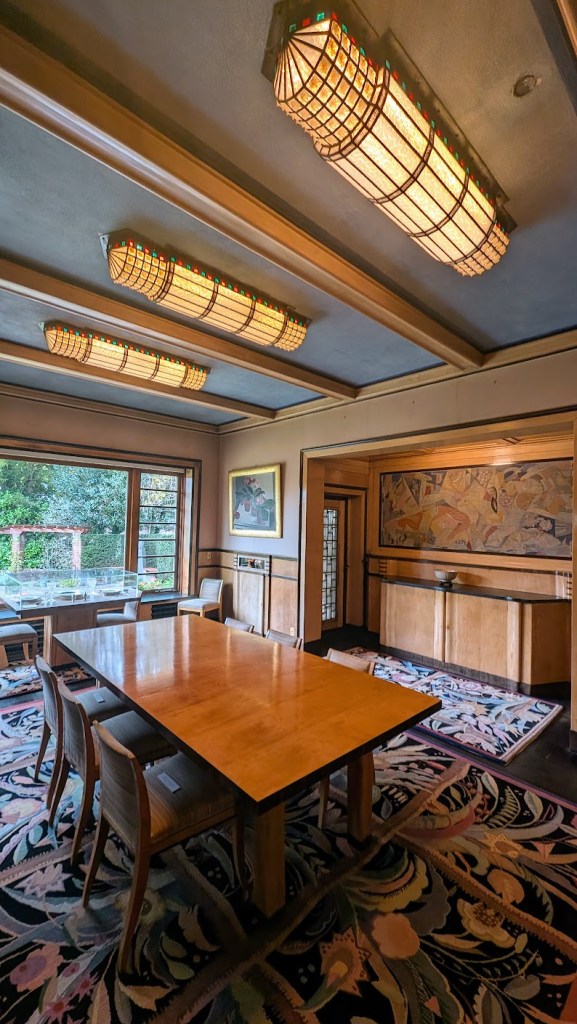
This space showcases sycamore, Brazilian rosewood and Macassar ebony. The Japanese lights in the sky-blue ceiling were intended to harmonize with the oriental cut of the windows. You can see the “Gallerie Botanique” array of avant-garde rugs.
We walked from the Dining Room into “The Little Black Lounge.”

Then to the Music Lounge (below) featuring a rosewood piano (below, upper left), and covered by a tapestry.
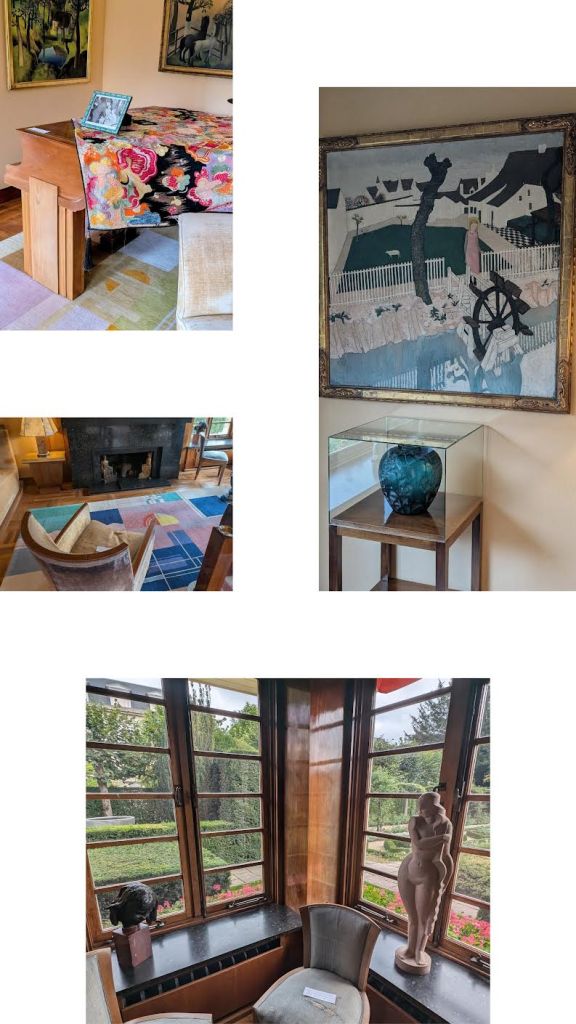
Note the Lalique opalescent green vase (above, top right), carpeting (above, left middle) with abstract shapes inspired by Cubism.
The “Cozy Corner” has a Labrador marble fireplace, and a comfy-looking rosewood and velvet sofa.
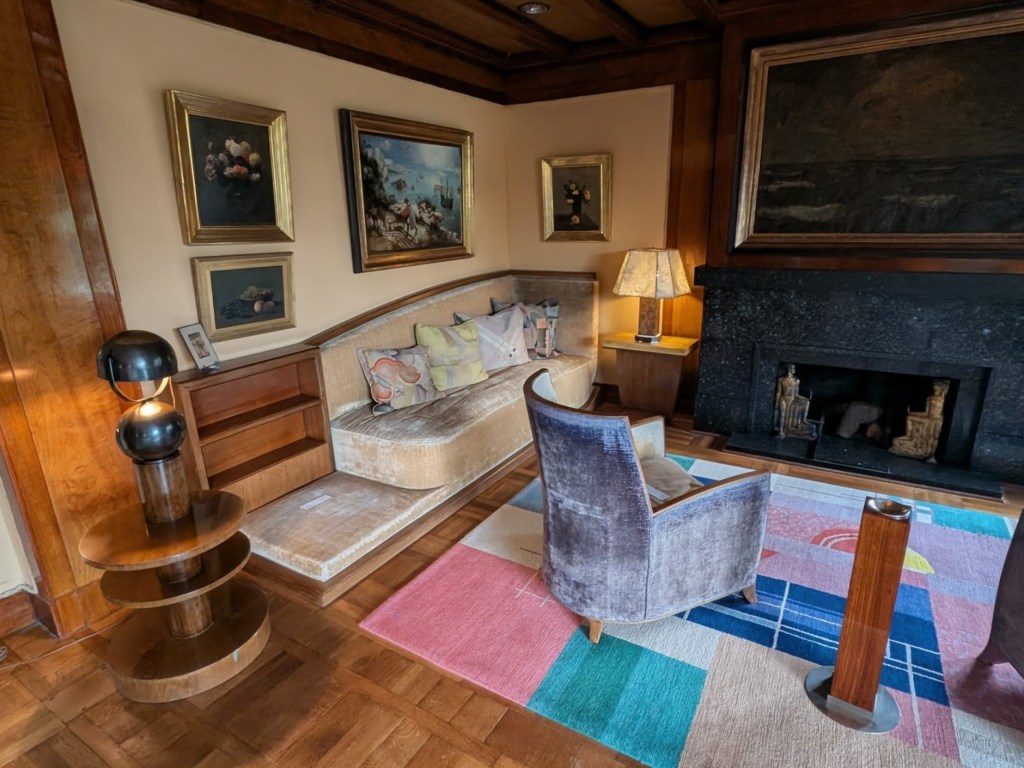
We stopped to admire a lamp atop a three-tiered pedestal table.
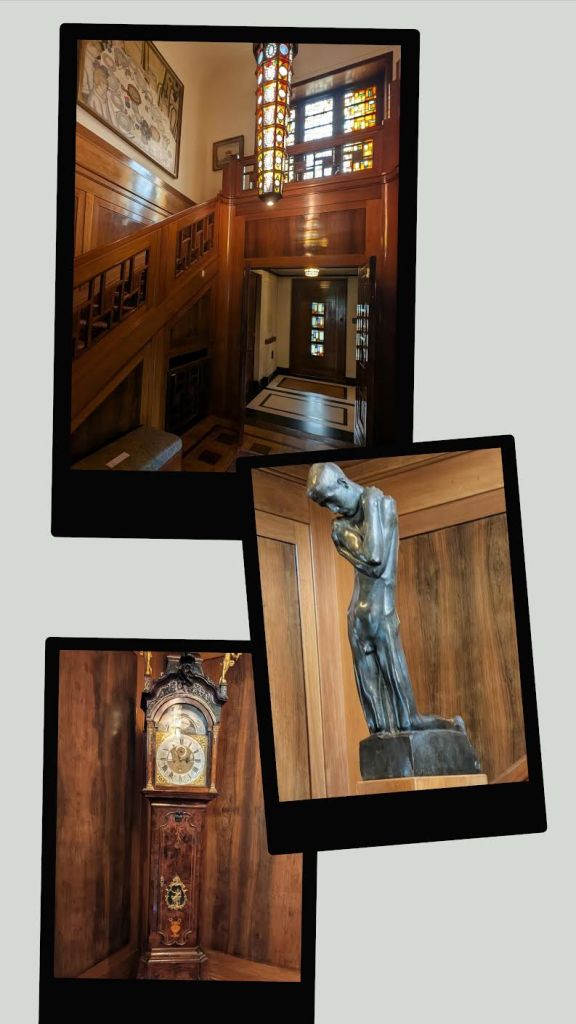
Then to the Entrance Hall, displaying a glass and bronze chandelier, the “Kneeling Man” sculpture, and a somewhat incongruous 17th century grandfather clock (a van Buuren family heirloom).
Up the stairs to David’s Study.

The Study is dominated by David’s desk (above, upper right), a stained glass window (above, lower left), and a painting called “Young Woman with a Mirror” (above, lower right).
Finally the beautiful gardens that included a maze in which we promptly got lost:

We were suitably impressed by the notable guests of the van Buurens: René Magritte, David ben Gurion, Raoul Dufy, Erik Satie, Christian Dior, René Lalique, Yitzhak Rabin, Moshe Dayan, and Queen Elisabeth of Belgium, to name only a few luminaries.
The van Buuren Museum was clearly a breathtaking highlight for all of us!


 Something to Declare
Leave a reply to ssingerphd Cancel reply