
Tokyo, continued, May 8, 2026
May 9, 2026, 4:40 am Japan Standard Time (JST).
Our first experience yesterday (Friday) was a visit to the Meiji Shrine. It’s a Shinto shrine (Shinto is the native Japanese religion, going back to the beginnings of Japanese culture). The shrine is dedicated to the deified spirits of Emperor Meiji and Empress Shoken.
For nearly 700 years (roughly 1192–1867), Japan had a dual government structure where the Shogun held de facto power as military dictator, while the Emperor remained the ceremonial figurehead and divine source of legitimacy. The Shogun (military ruler) was nominally appointed by the Emperor but, as a practical matter, the Shogun controlled all military and state affairs
Things changed in the mid-19th Century. During the reign of Emperor Meiji (1867-1912) (below), Japan was transformed from feudalism into a major imperial power. Meiji’s goal was to foster economic and industrial development, and to bring Japan into the modern world.
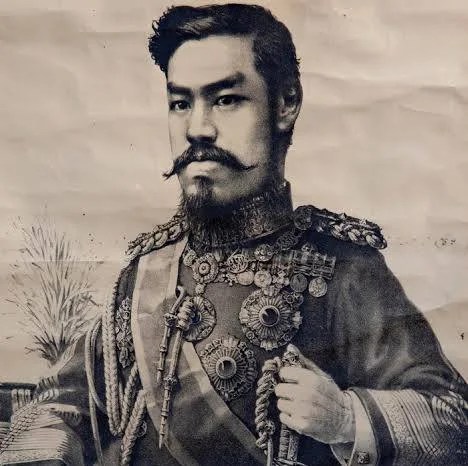
The shrine itself was completed in 1920, about 8 years after Meiji’s death. Surrounded by a forest of about 150 acres, the shrine was destroyed during the Second World War, but it was restored through public fundraising.
Yesterday, we traveled by van past carefully manicured trees, to the main entrance of the shrine. There we saw a “wall” consisting of kazaridaru (barrels of sake). These have been donated by the Meiji Jingu National Sake Brewers Association to commemorate the emperor’s role as a booster of industry (sake brewing is an industry, right?).
Why sake? Apparently sake (a bringer of joy) has been seen as a sort of bridge between the people and the kami (gods). No argument from me on that one!
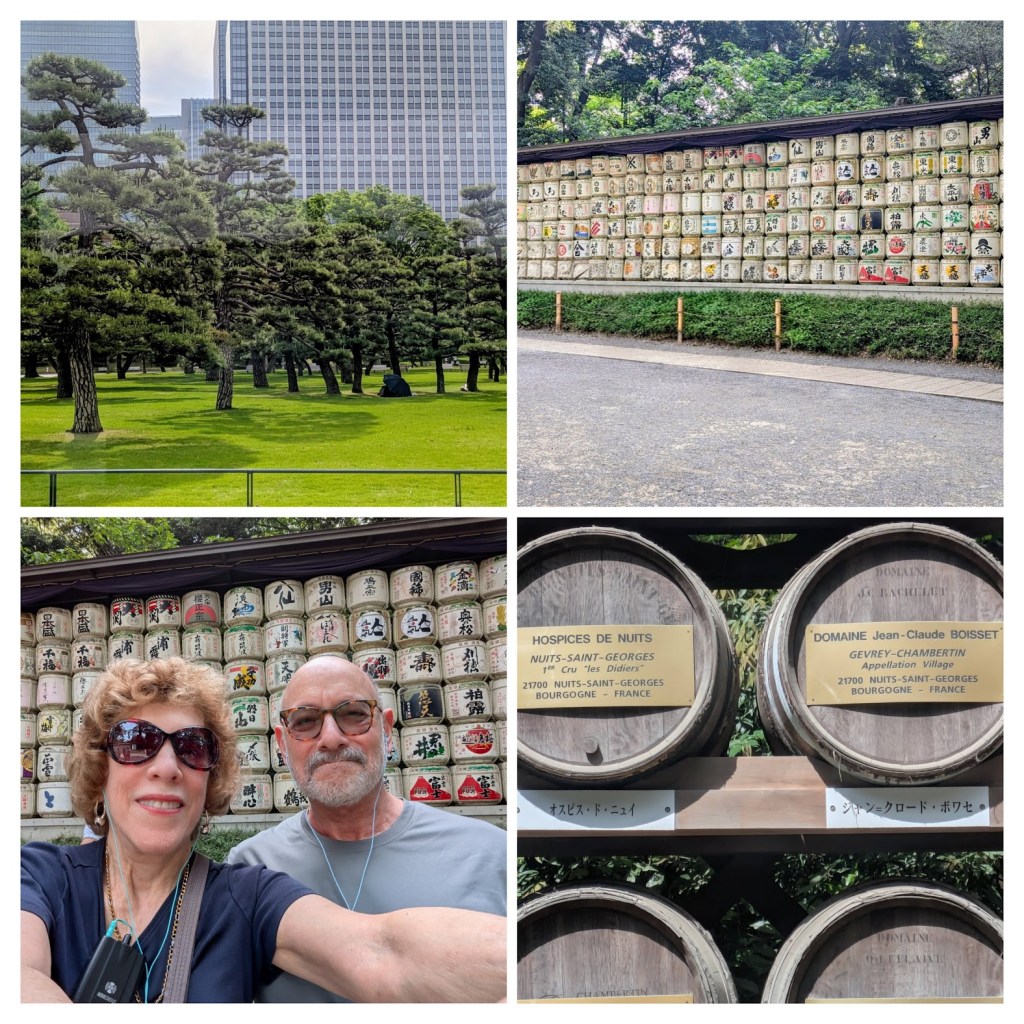
Across from the wall of sake barrels, there was another wall of barrels, these being barrels of French wine. These had been donated by vintners from Burgundy, to honor Emperor Meiji’s love of western culture. Culture and international amity through intoxication!
We proceeded through the forest to the gates of the shrine, where we were given the opportunity to purify our hands and spirits (you bring some of the water to your mouth, and then spit it out).
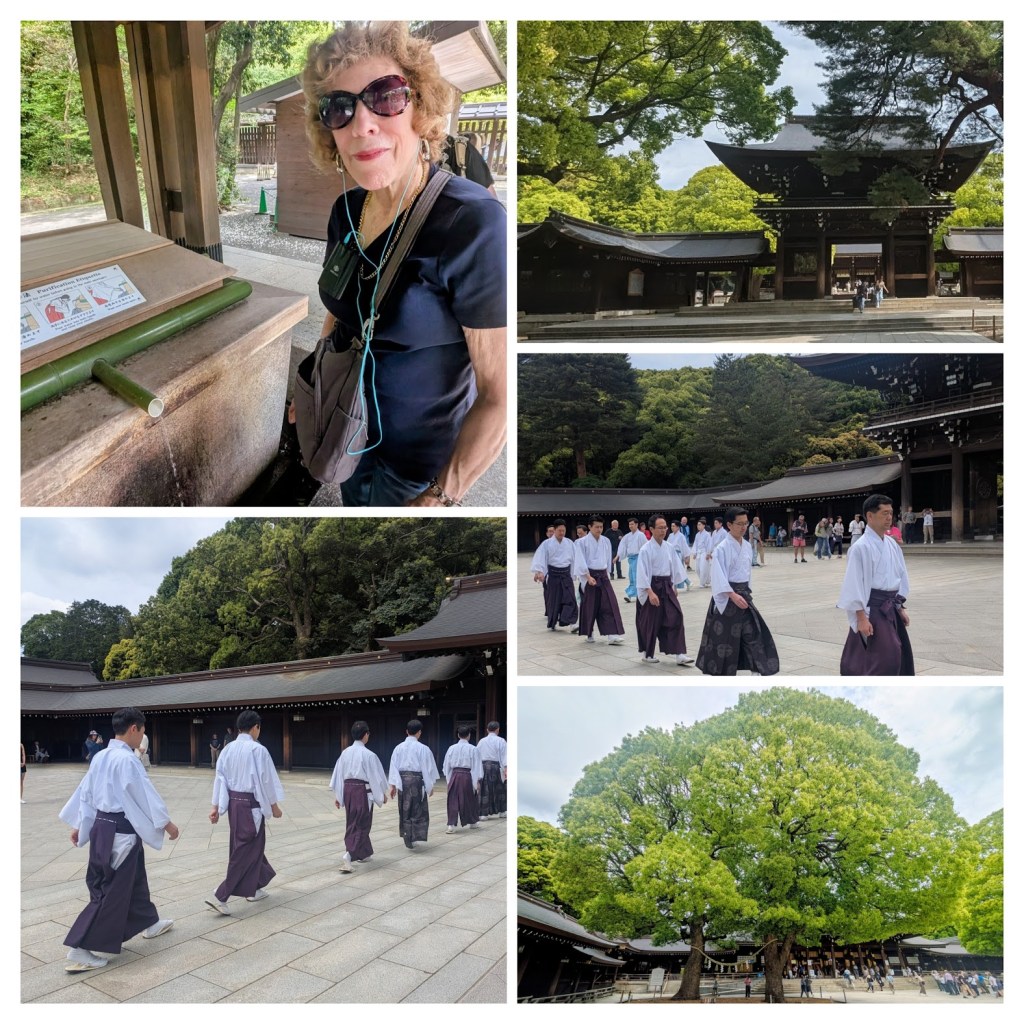
At the entrance to the shrine, there was a linear procession (above, upper right and lower left). There were also two sets of Meoto Kusu, Husband and Wife camphor trees (above, lower right), planted in 1920, representing sacred, loving marriage. Each pair of trees is joined together by a shimenawa rope (symbolizing marital harmony, long-lasting love, and family).
Andy had provided each of us with 5-Yen coins to toss into the designated receptacles at the gate of the shrine. After making this donation, we were instructed to bow twice, clap our hands twice, then bow once more. We then entered the shrine, removed our shoes, and sat on tatami mats. The priests and some dancers provided us with a formal welcome, as well as a blessing for our sojourn (sorry, no photos permitted).
After leaving the Meiji Shrine, we went to the Axis Building in the Rappongi District, to visit Nuno Textiles. There we were introduced to the renowned textile designer Reiko Sudo (below, left).
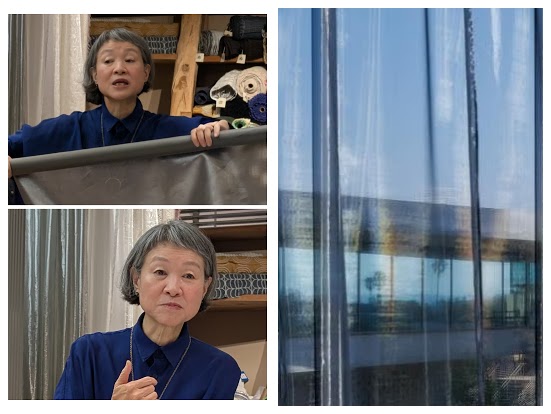
Reiko and her team combine modern technology with traditional Japanese textile traditions. Besides having her work displayed at New York’s Museum of Modern Art, Reiko won the contract to provide the drapes for the David Geffen Galleries of the Los Angeles County Museum of Art.
We were told that the contract required the creation of drapes that would (1) block at least 94% of the ultraviolet light (to protect the artworks), and (2) be nonetheless fairly transparent. Not an easy task, eh? Through many trials and experiments over more than five years, Reiko hit on the idea of incorporating chrome fibers into the material, which apparently did the trick (see above, lower right).
Afterward there was much opportunity for shopping (textiles, design works, etc.). Then to lunch at a place called Keyaki, where we dined on duck, tofu, fish and an omelette. You will notice that the omelette (shown below) is quite orange in color. We were told that, because Japanese chickens are fed a diet that includes seaweed (a source of carotene), Japanese egg yolks are deep orange.
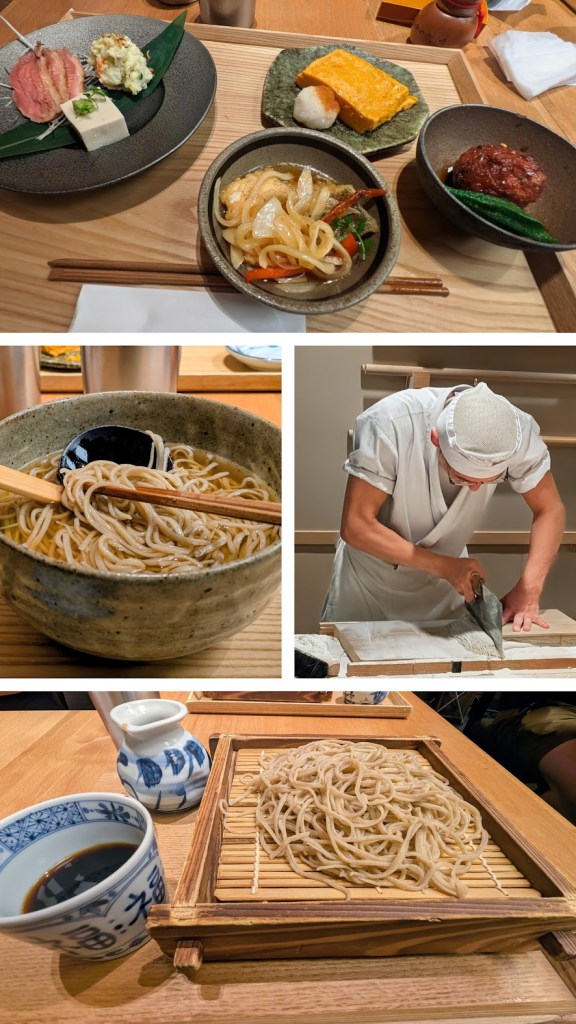
But the restaurant was really dedicated to the iconic soba (handmade Japanese buckwheat noodles) (above, middle and bottom). We were also given complimentary soba tea (brewed from the buckwheat) that was quite refreshing!
The last of the day’s activities involved a tour of the Rappongi Hills complex, including the Art Triangle Rappongi. This is a hub of contemporary art and architecture. We viewed exteriors including, inter alia, buildings in the Tokyo Midtown Complex:
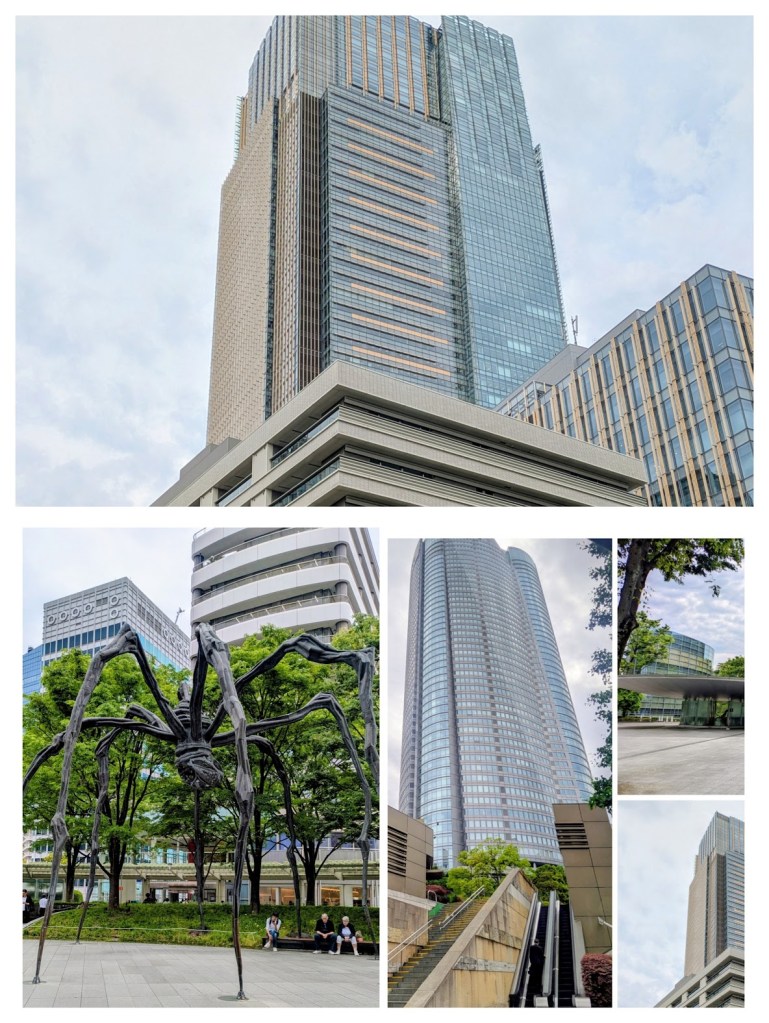
These sights included a stylized sculpture of a spider by Louise Bourgeois, called “Maman” (above, lower left). (Louise apparently had some “Mom” Issues.) We also walked through a display of Koinoburi, colorful windsocks in the shape of carp (below, top and lower left), flown in honor of Children’s Day (May 5). Because the carp is considered to be swimming upstream (against the current), they are supposed to symbolize strength, success and courage.
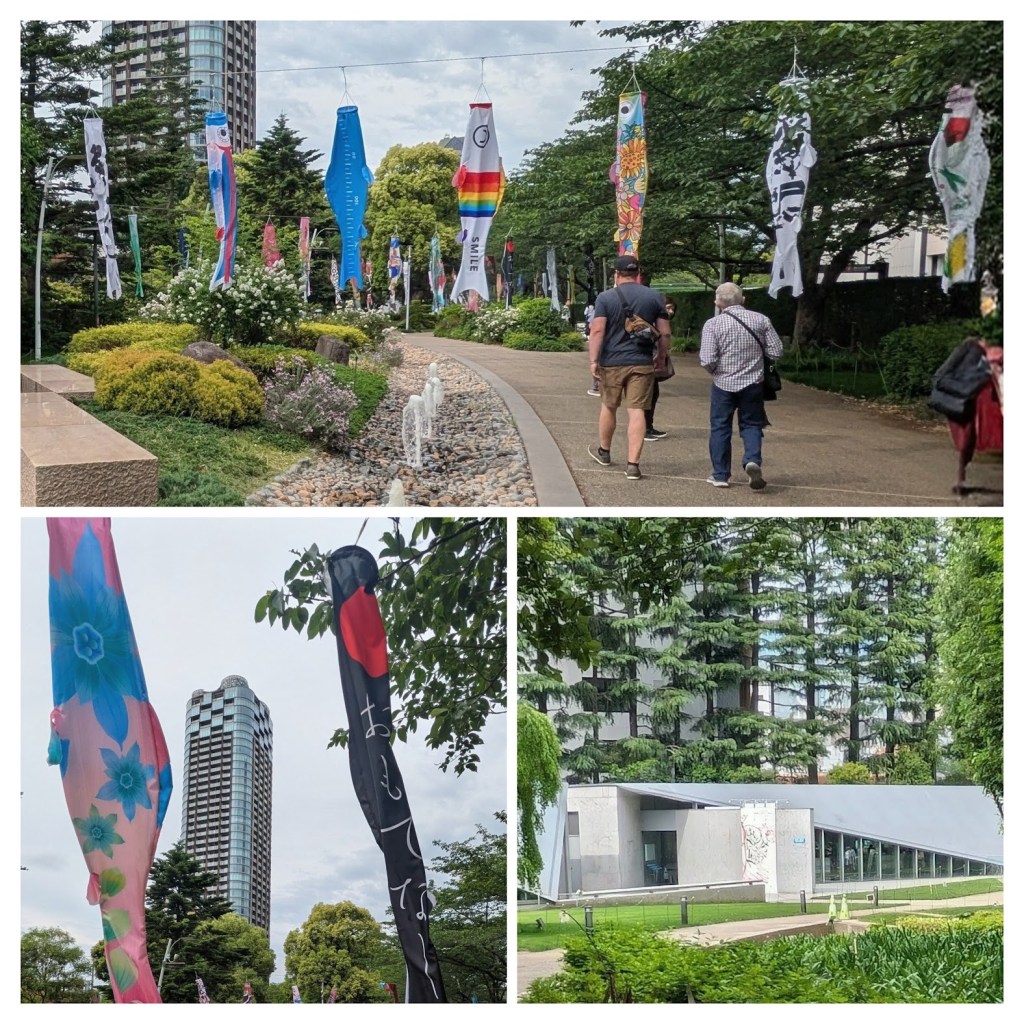
Near the hanging carp installation, we saw the 21_21 Design Sight, a joint venture between fashion designer Issey Miyake and architect Tadao Ando (above, lower right).
We also had the opportunity to sample some striking interiors, including a waterfall (below, lower right):
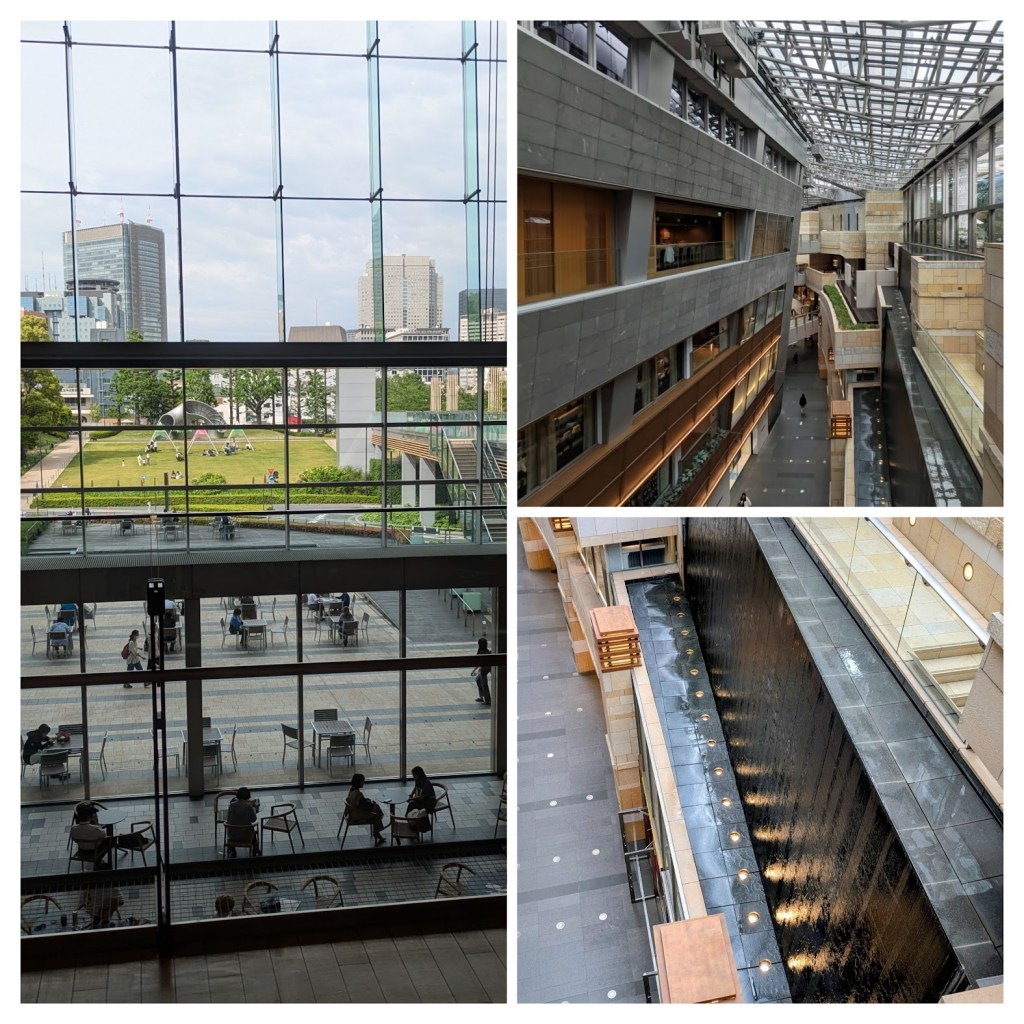
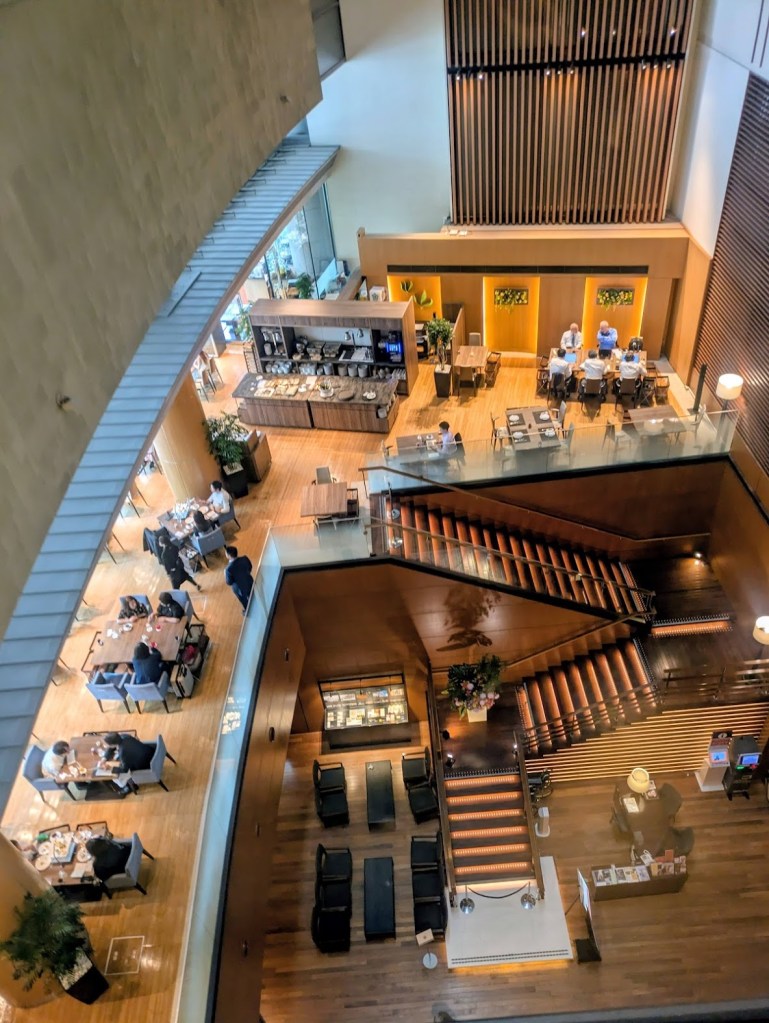
Speaking of striking interiors, Stef got this shot of one of the restaurants (Pomme d’Adam, or Adam’s Apple) in our Marunouchi Hotel :
Our Esprit tour included dinner at Gochisoya, a typical Izakaya (Japanese pub).
The name Izakaya (pronounced “ee-ZAKAY-ya” with the emphasis on the middle syllables) is derived from its historical roots as a sake shop that allowed customers to sit and drink on the premises. It is a compound word formed by combining two Japanese terms, “I” (to stay, remain, or sit) and “sakaya” (sake shop or liquor store). We were too pooped and jet-lagged, however, to join our companions at Gochisoya, and we made it an early night.
Then why, you may ask, the lengthy exposition on the name “Izakaya?” The pedant in me, I guess. Can’t help it.


Leave a Reply