
Tokyo, continued, May 9, 2026
Yesterday, Saturday (May 9), the “culinary” part of the tour began in earnest.
For literally hundreds of years, the Tokyo Central Market drew merchants as well as tourists to its major wholesale auctions of fish. The Central Market was surrounded by an unofficial “outer market,” an unorganized network of small stalls selling all sorts of cooking ingredients, cooking implements, and street food. In 2018, the Central Market relocated o a different part of Tokyo.
But the outer market remained, taking on the name “Tsukiji Market,” and retaining its flavor of bygone days, a warren of small vendors.
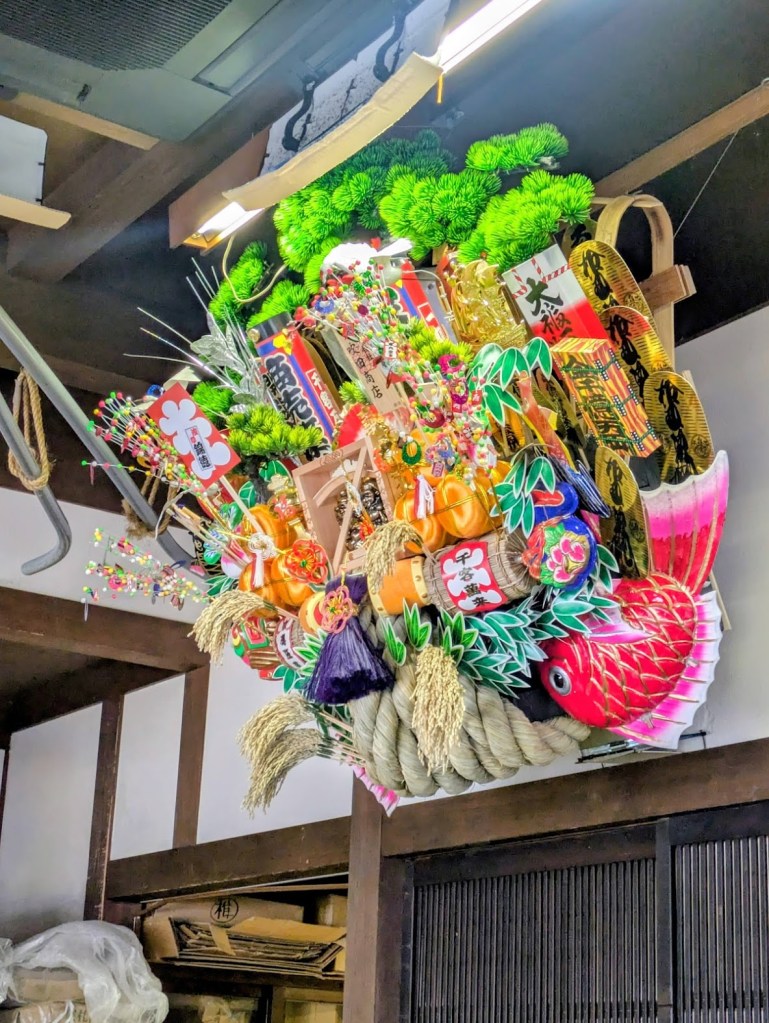
Yesterday (Saturday) morning, Andrew escorted our Esprit Travel group to the Tsukiji Market for a taste of its variety.
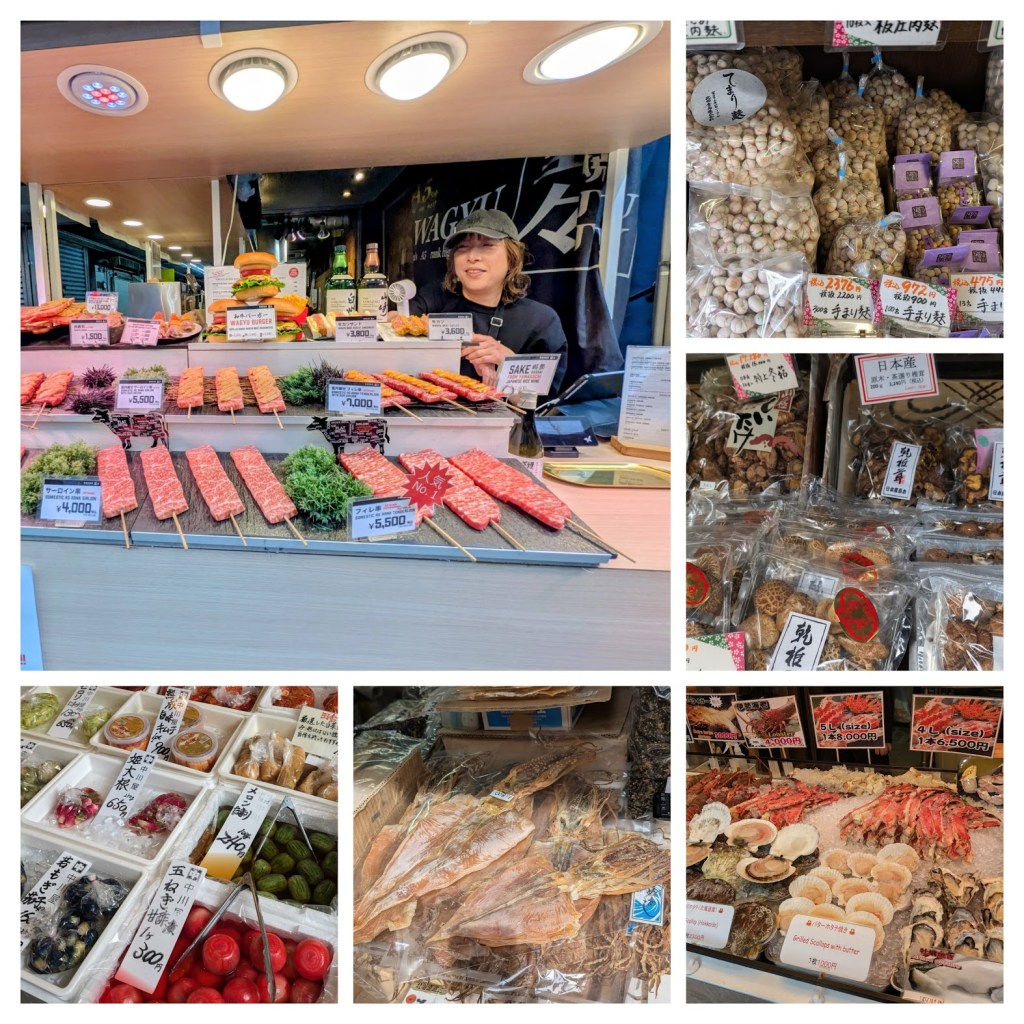
There we saw (above, clockwise from the upper right), ingredients for soup, a great variety of mushrooms, fresh seafood, preserved foods like dried fish, and produce. As well as what looked like beef-on-a-stick (“Wagyu-sicles?”) (above, upper left).
There were also sellers of prepared foods; we learned that this food has to be eaten where purchased (see sign below, top). Apparently it is also the rule that left-over wrapping and trash are to be returned to the vendor from whom the item was purchased. There are no trash cans. And, shockingly, no litter!
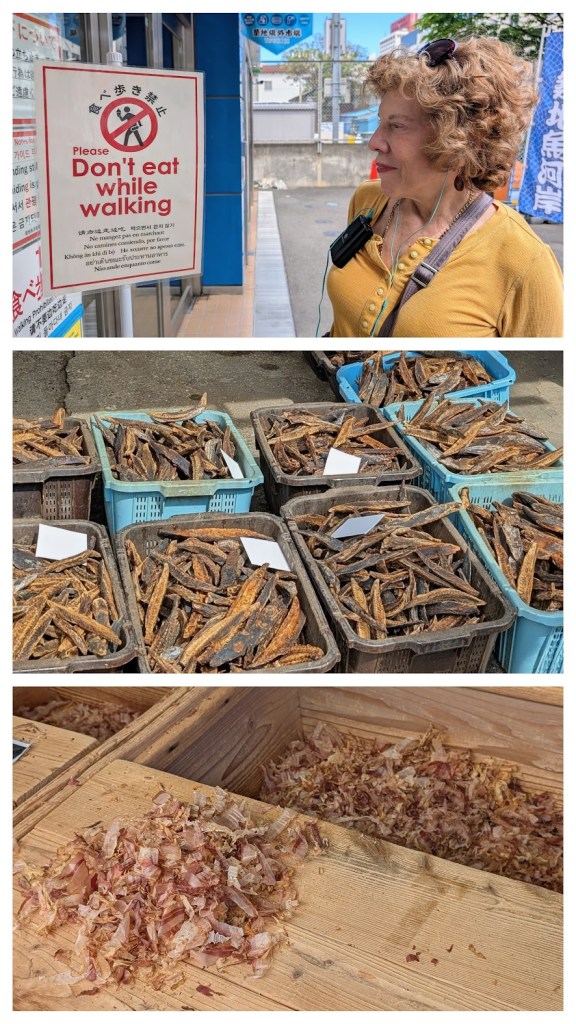
We stopped at a stall that had been in operation for decades, making shavings of bonito, a fish used in soup-making (above, middle and bottom). I bought some shaved bonito; future dinner guests, be on notice.
Since thereas some time left before lunch, Andy walked with us to the nearby Tsukiji Hongan-Ji Temple, a Buddhist place of worship.
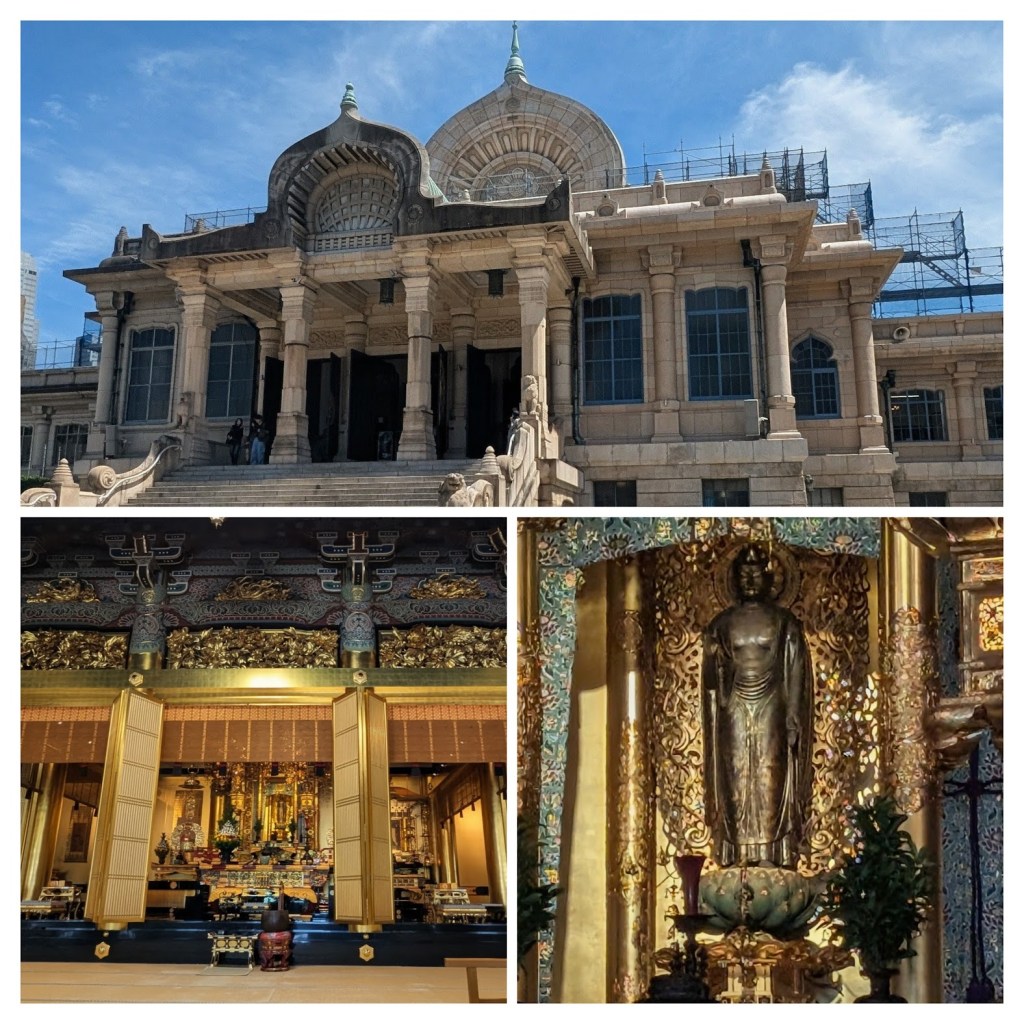
Non-Buddhists are welcome to visit. We saw a representation of the Buddha, standing on a lotus blossom (above, lower right). This juxtaposition is supposed to represent “light,” in the sense of “non-heavy,” i.e., being unbound by earthly concerns.
Then to lunch, at Toshi Sushi Washuku Dining establishment. There we were instructed by the distinguished chefs on how to prepare nigiri sushi (those pieces of raw fish on top of an elliptical ball of vinegared rice).
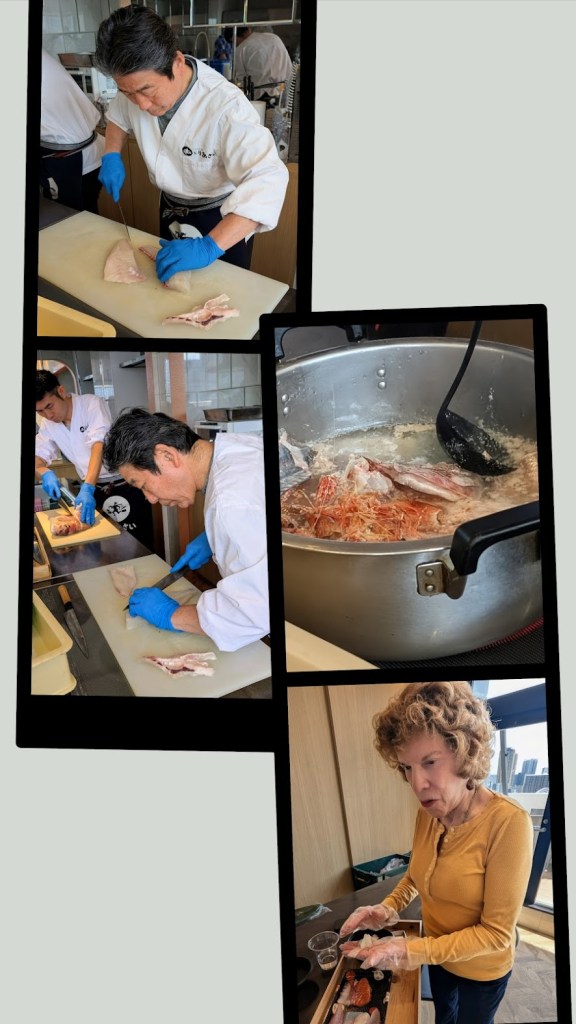
We ate what we made. In addition, we observed how the bones and head and non-sushi portions of the fish, and shrimp shells, were used to make miso soup (above, right).
After lunch, we proceeded to the Omote-Sando neighborhood of Tokyo, for a visit to the Nezu Museum. The building itself was designed by the famous architect Kengo Kuma. There is an adjoining multi-level garden with a display of purple irises.
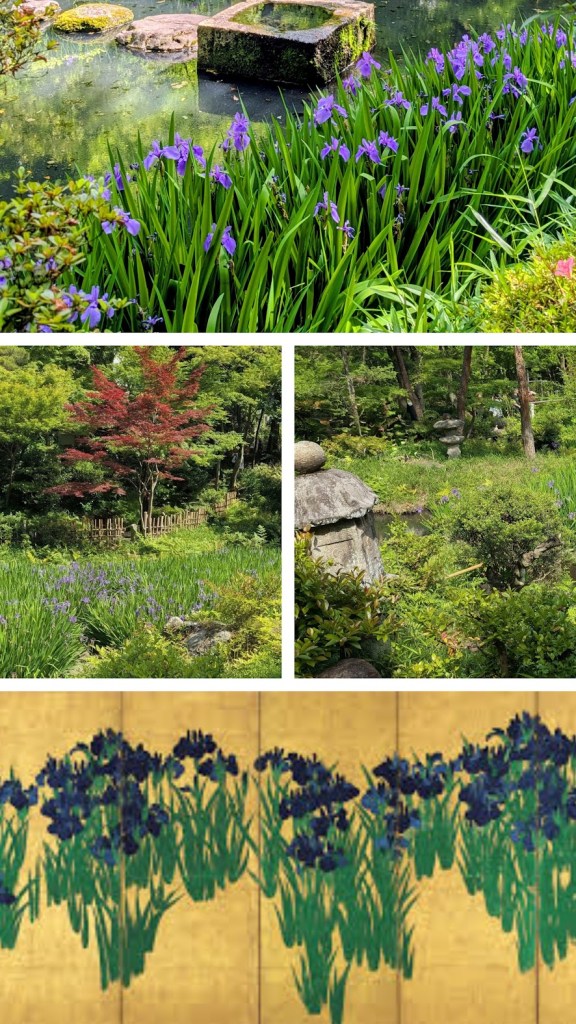
The main exhibit inside the museum of folding screen paintings of irises (above, bottom) by Ogata Korin (1658-1716). The exhibition is seasonal, timed to coincide with the blooming of the irises in the garden.
To conclude this food-packed day, we went to dinner at the Ten-Ichi restaurant, specializing in tempura, which involves careful and painstaking frying of vegetables, fish, shellfish, and other stuff. Ten-Ichi is famous for preparing the food right before your eyes, as well as for some famous guests over the years, including Bill Clinton, George H.W. Bush, Frank Sinatra, Jacques Chirac, Elizabeth Taylor, to name a few.
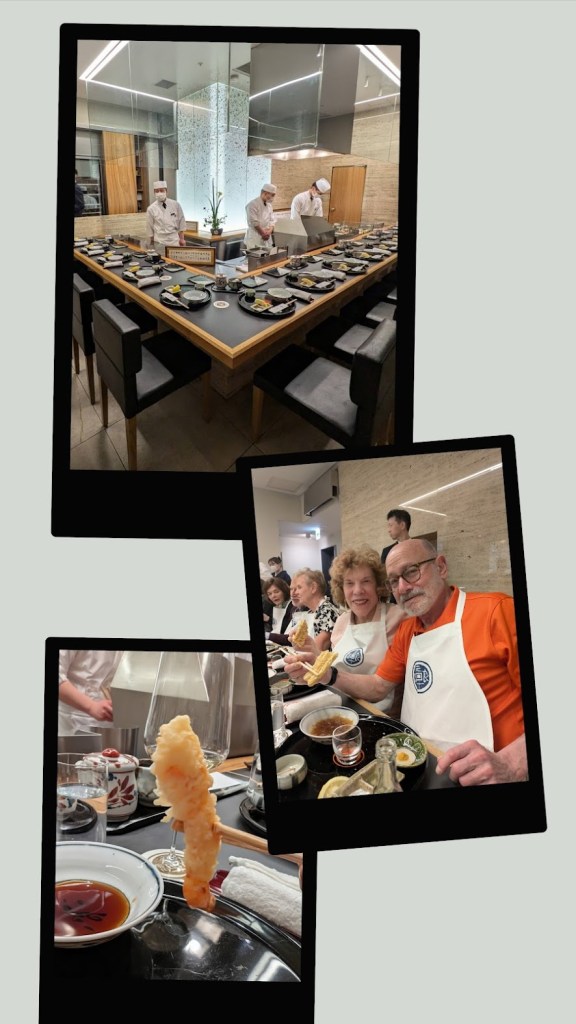
Warning: Pedantic observation ahead: “Tempura” is supposed to be pronounced with the emphasis on the first syllable (“TEM-pur-a,” not “tem-POOR-a“).
The tempura was accompanied by a nice, dry sake. Apparently etiquette forbids you to pour your own sake. So I, and the tour companion seated to my left, took turns filling each other’s glasses; quite satisfying to us both. Stef and her neighbor shared a half-bottle of excellent white wine. N.B.: Sake etiquette did not apply; You are allowed to pour your own wine.


Leave a Reply