
Stef and Stan in the Second City
August 24, 2026
Let’s get this over with: Here is the usual hommage in my intro blog post, this time to Fred Fisher, who composed the above-referenced tune in 1922. And to the performer, Frank Sinatra, who made it famous in 1958. Apologies to my subscribers under the age of 70, who’ve probably never heard of any of this. If you want to hear Frank sing it, double click on the image below.
Stef and I were wondering about the reference to “Todd’ling.” I mean, “toddling?” What’s “toddling?”
It turns out that the “Toddle” was a dance introduced in 1916. Chicago became the main hub of this “scandalous” dance, hence the nickname. Its name derives from the dance moves resembling the walk of a toddler!
Here is a link that opens a video of people dancing the Toddle: https://share.google/Fsxx5f2g4mebdPhHx. Another link will appear in blue: https://share.google/Fsxx5. Click on that link and the video will appear. You then have to go to the top of the video and un-unmute it to hear the music. A bit complicated (sorry), but it was the only way to reference these clips and allow you to open them.* So, aren’t you scandalized?
As you know from previous posts, Stef and I are Frank Lloyd Wright fans. We’ve traveled to see Fallingwater in Pennsylvania, the Robie House in Chicago, and (very recently) the Massaro House in Mahopac, NY. Among the Wright sites we haven’t yet visited is his studio in Oak Park, IL.
So when we saw a blurb from Road Scholar about their tour entitled “Winding Through the Windy City: Art & Architecture in Chicago,” it was kind of a no-brainer.
In traditional Road Scholar fashion (this is our 4th RS trip), our day started with a lecture on Chicago’s history. The dynamic talk included the following tidbits:
- Chicago is famous for its gangsters, e.g., Bugsy Moran, Baby Face Nelson, John Dillinger. Except to note that the most notorious Chicago gangster, Al Capone, was originally from Brooklyn, NY (just sayin’).
- The Chicago Fire, which destroyed the city in 1871 and left homeless 100,000 of the city’s 300,000 residents, was not because Mrs. O’Leary’s cow knocked over a kerosene lamp. The cause was unknown, and she was a probably a victim of anti-Irish sentiment (“fake news?”). She was formally exonerated in 1997.
- Chicago’s nickname, “The Windy City,” derived from the competition for serving as host city of the 1893 Columbian Exposition. Chicago’s competitors complained that the city’s boosters were full of hot air. (And the nickname may be also related to the high winds blowing in from Lake Michigan.). Anyway, Chicago was selected to host the Exposition.
- The 1893 Exposition debuted an “attraction” consisting of a large, upright wheel that turned around and around, with seats of cars attached to the edge for people to ride in. It was invented by George Ferris; It took 20 minutes for a single revolution, and held up to 2,160 riders. Rides cost 50 cents ($18.55 in today’s dollars: Pricey!).
- The Art Institute of Chicago has the second largest collection of Impressionist paintings in the world (the Musée d’Orsay in Paris has the largest).
- Chicago established its commercial chops with merchants Sears, Roebuck, Montgomery Ward, and Marshall Fields.
- Chicago was the home of the first thermonuclear reactor, and where they made the first cell phone. It was also the home to Jane Addams‘ Hull House and Hugh Hefner’s Playboy Mansion.
Following the lecture, we headed out to Chicago’s Picasso sculpture.
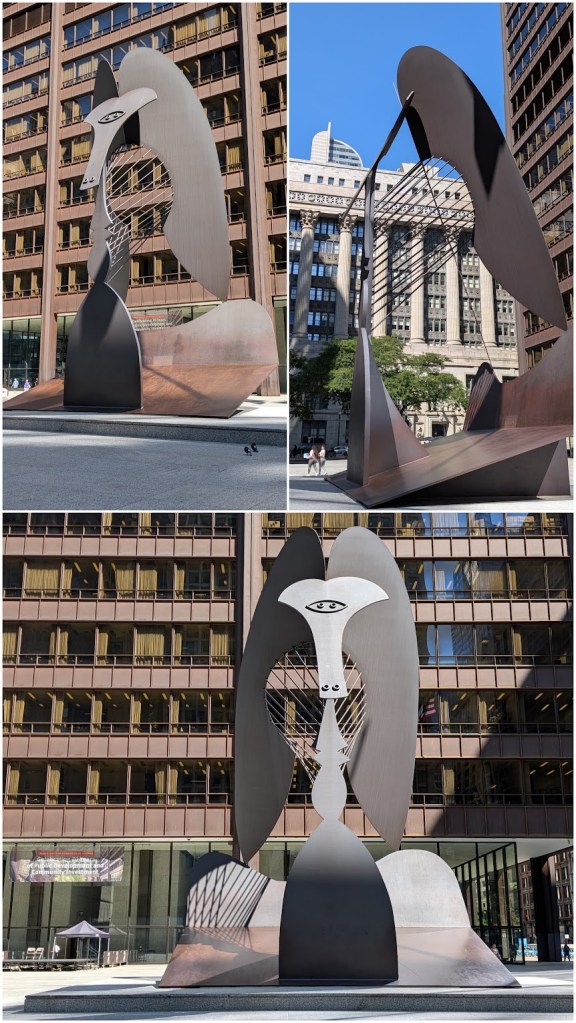
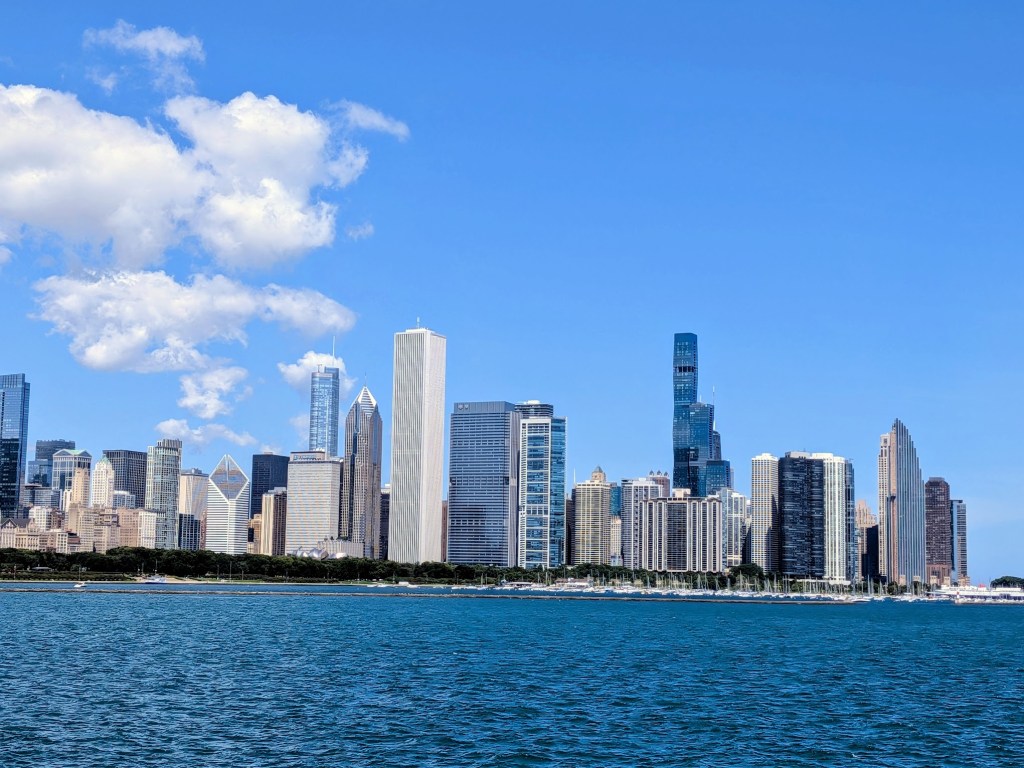
The figure (untitled, hence called “The Picasso”), has been viewed as everything from a human female to a stylized figure of Picasso’s dog. (In modern art, the question is what it looks like to the viewer, right?) Then to Planetarium Point where we got a wonderful gander at the Chicago skyline from across Lake Michigan.
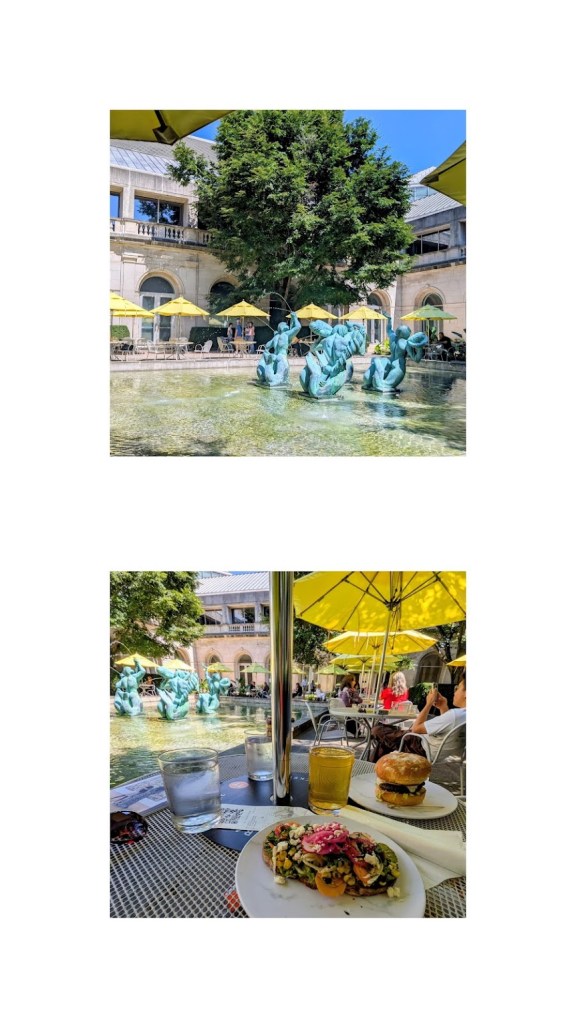
Most of the day was spent at the Art Institute of Chicago, where we started with lunch al fresco next to a pool with an aquatic sculpture fountain.
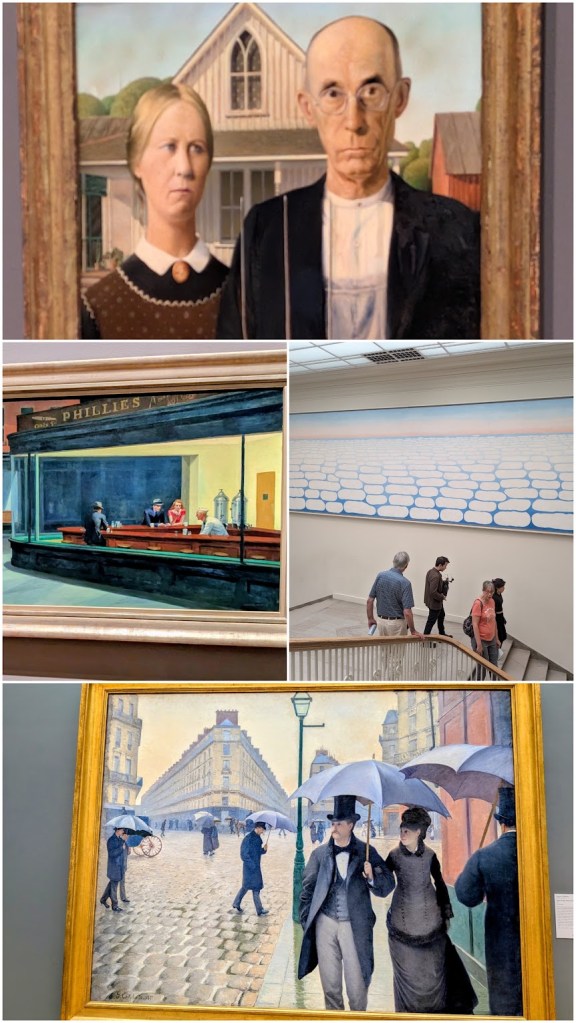
Our lively and informative guide showed us the original of Grant Wood‘s American Gothic; Edward Hopper’s Nighthawks (where the three male figures were modeled on Hopper himself, and the female figure, his wife); Georgia O’Keefe‘s Sky Above Clouds (inspired by her first airplane ride); and Gustave Caillebotte‘s Paris Street, Rainy Day.
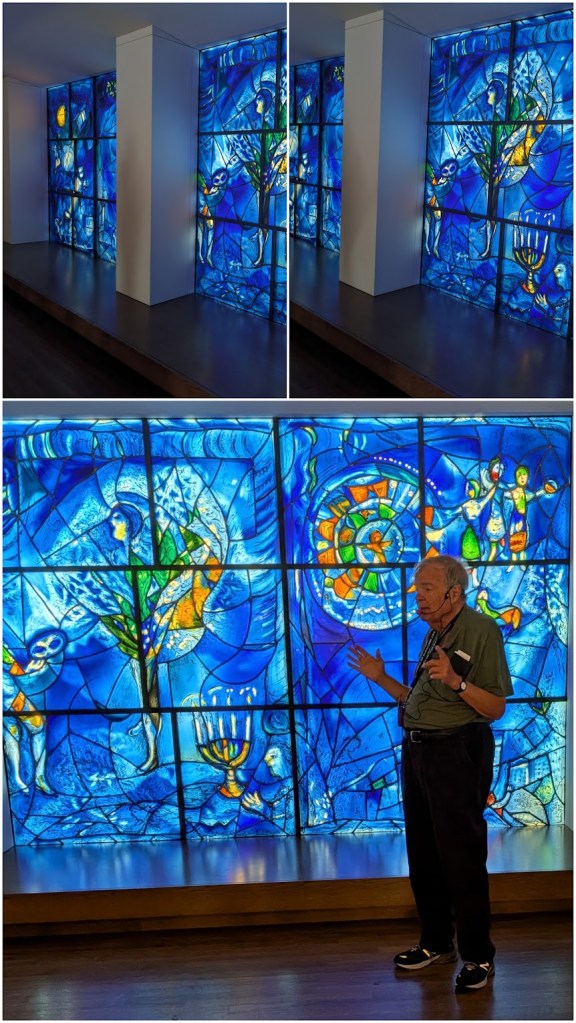
We stopped by windows done by Marc Chagall (whose birth name was Moishe Segal)…
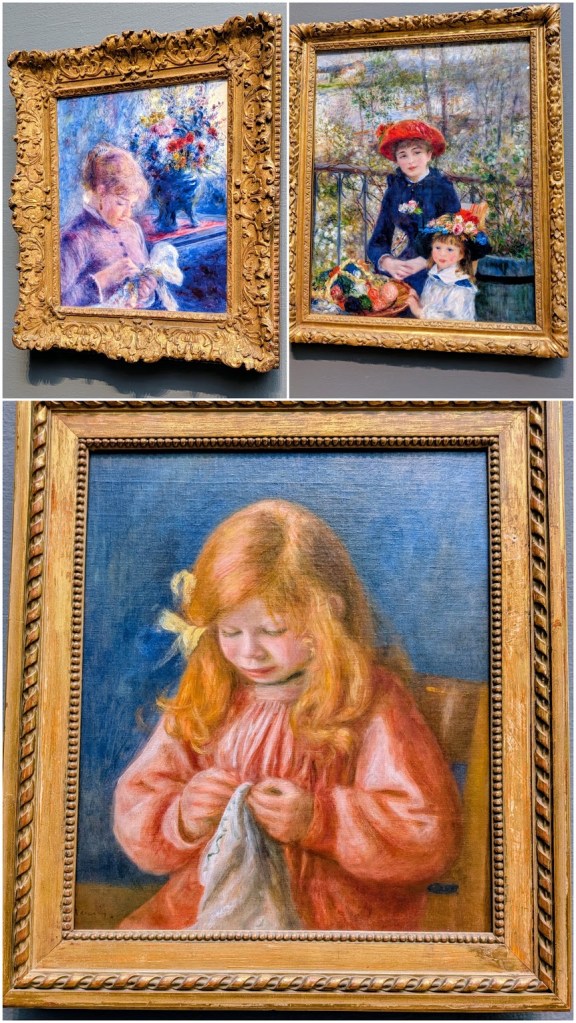
…and then to a room full of works by Pierre August Renoir (including one of Renoir’s long-haired son, Jean, sewing); this was obviously way before Jean Renoir became one of the world’s most renowned filmmakers).
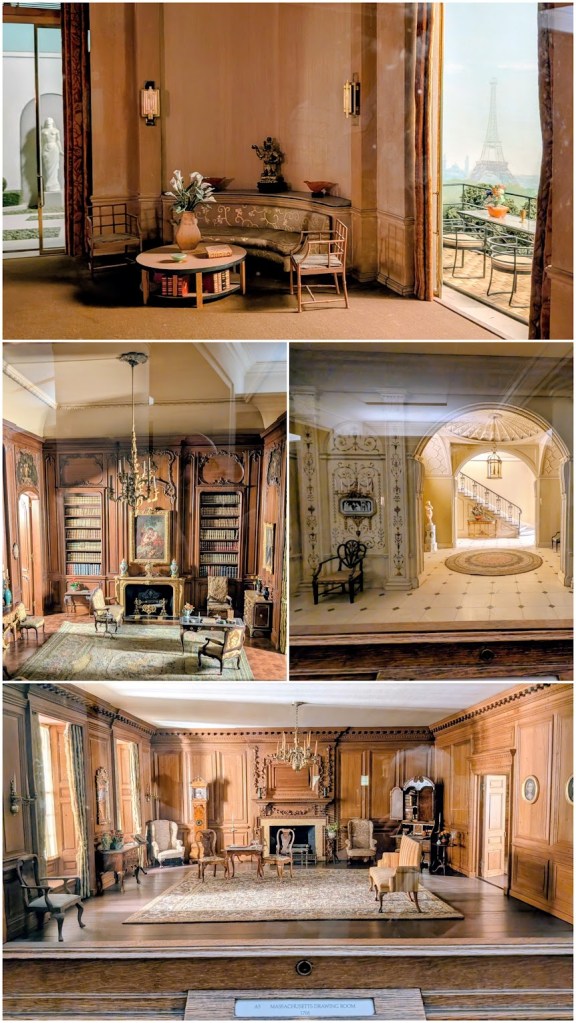
We were shown the Thorne Miniature rooms, which displayed painstakingly-created scenes of period rooms at the scale of 1 foot=1 inch, including one in which you can see the Eiffel Tower out the window. The artist, Narcissa Niblack Thorne, was married to James Ward Thorne, who co-founded Montgomery Ward & Co.
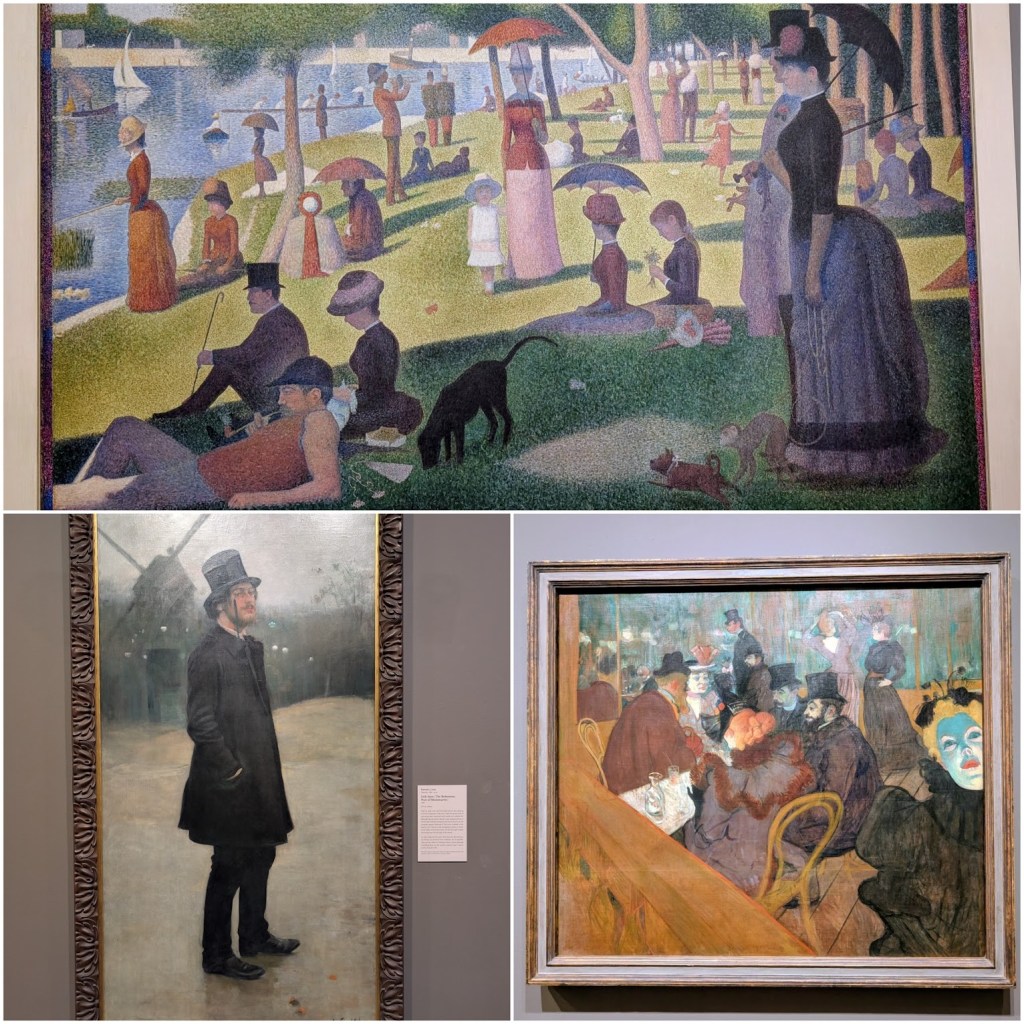
Finally we saw the world-famous painting by Georges Seurat, titled A Sunday Afternoon on the Island of La Grande Jatte; Ramon Casas‘ painting of the composer Erik Satie; and Henri de Toulouse-Lautrec‘s At the Moulin Rouge.
By this time, we were fairly “arted-out,” and my legs were feeling rubbery. Time to go back to the hotel, write this post, and hit the hay.
(* If you can’t use the links, please Google “Frank Sinatra – Chicago (That Toddlin’ Town)” and “Danse Libre – The Toddle at Gaslight Tango June 9, 1912.)”


Leave a Reply