
Stan and Matt Visit Ireland
October 15, 2026
This is the refrain from the tune, “Molly Malone,” which celebrates the legendary Irish fishmonger from “Dublin’s fair city.” It’s an old folksong and is the unofficial anthem for Dublin.
As you may know, this Ireland trip is my way of making it up to my son, Matt, for our failed attempt to see the Northern Lights in northern Canada. (See the series of posts this past winter titled “If Anyone Can, Yukon”.)
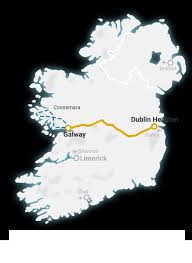
Matt’s been here before. He even braved driving on the left-hand side of the road with right-handed steering. (When I brought this up to Stef, she put her foot down and forbade us to do any driving on this trip.). This is the first time in Ireland for me. We’ll be in Dublin and its environs for most of the trip, with one over-nighter in Galway.
According to our travel guru, Rick Steves, Dublin was founded as a Viking trading colony in the 9th Century C.E. As the seat of British rule in Ireland, it grew with the British Empire, becoming a center of commerce and wealth (at least for the Anglo-Irish who lived in the eastern part of the country). The city was largely rebuilt during the Georgian Era (1714-1830), and became a hub of elegance and culture, poetry and literature.
This is not to omit mention of the oppression of the native Irish population, or the potato famine of the 1840s. Or the Easter Rising of 1916, and the ensuing civil war that led to the establishment of the Irish Republic.
We landed in Dublin this morning and utilized the Dublin Express service to take us to the Trinity City Hotel. Too early to check in, we dumped our luggage and went off on one of the two self-guided walking tours suggested by Rick Steves. Today’s tour was of the part of Dublin north of the River Liffey.
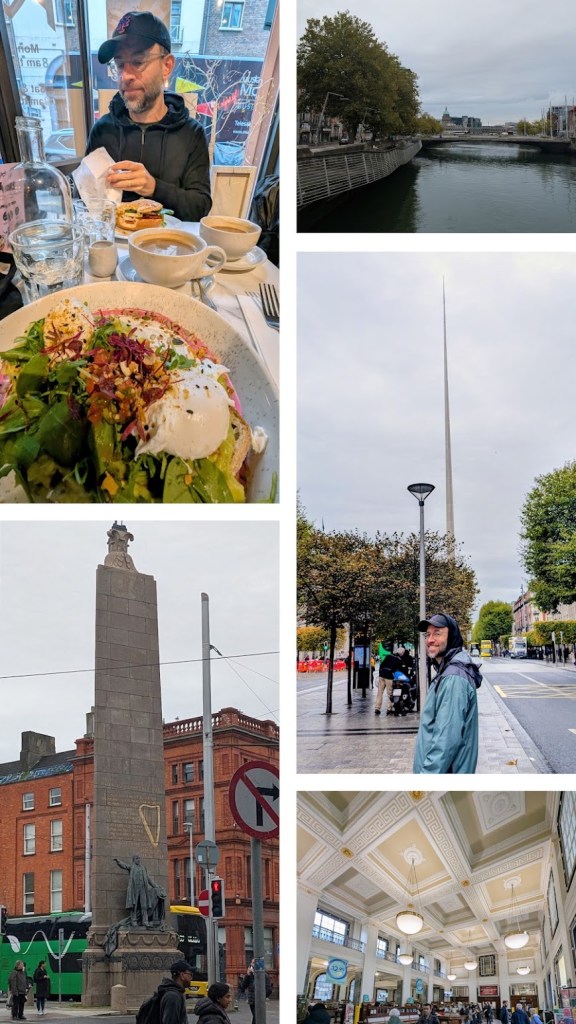
After breakfast at a place called Pog (below, upper left), we walked to the O’Connell Bridge (below, upper right), named after Daniel O’Connell, Dublin’s first Catholic mayor.
Rick tells us that the bridge is sort of a border between the grittier working-class northern part of the city and the wealthier, cultured south side. (Rick notes that “Dubliners joke that the ‘north siders ‘ are known as ‘the accused,’ while ‘south siders’ are addressed as ‘your honor.’”
From the bridge, we walked north along O’Connell Street, to the General Post Office (above, lower right), where the Easter Proclamation (the proclamation of Irish independence) was read by the activist Patrick Pearse in 1924. We were told that a wall of the Post Office is marked by bullet holes dating back to the Irish revolution, but we weren’t able to find any.
From there we walked past The Spire (above, upper right). The Spire was erected at the the site of the former column dedicated to Horatio Nelson, the British hero of the Battle of Trafalgar. The Nelson column was blown up by the IRA in 1966, to commemorate the 50th anniversary of the 1916 Easter Rising. Well that’s making a point!
The walk up O’Connell Street terminates at the Charles Stewart Parnell Monument (above, lower left), to commemorate the English-educated Protestant who had served as a member of the British Parliament. Parnell had also fought for Irish independence in the 1880s, and was jailed for his activities. According to Rick Steves, the Irish Catholic Bishops of this time were opposed to an independent secular Irish state. They participated in a successful movement to drive him from office on the basis of a sex scandal. Plus ça change, plus c’est la même chose, n’est-ce pas?
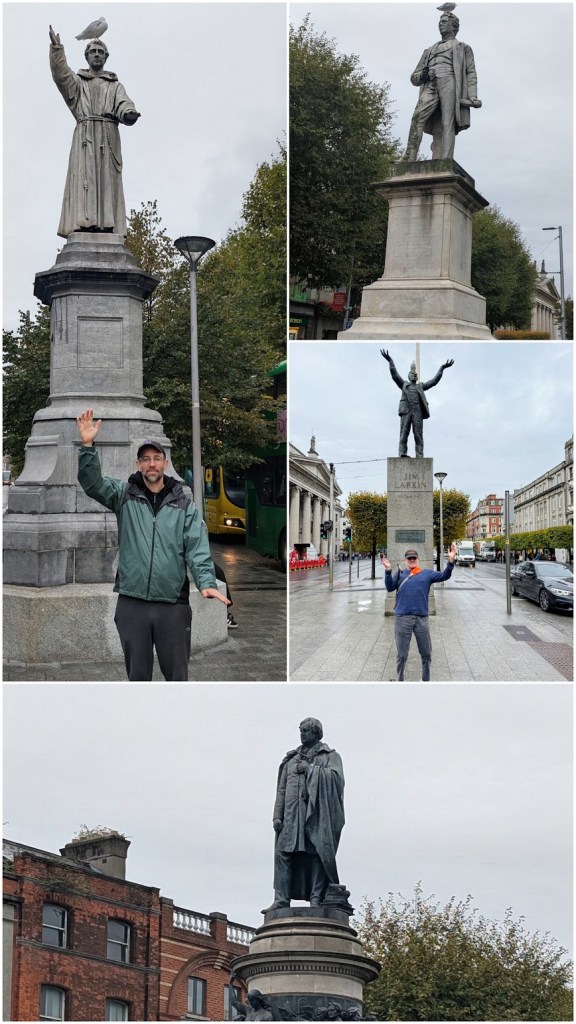
Along the O’Connell Street route, the median displayed statues of other Irish heroes, such as (below, clockwise from the upper left) Father Mayhew, Sir John Gray, James Larkin and, of course, Daniel O’Connell himself.
Completing the visits to these monuments to Irish historical figures was a stop at the Garden of Remembrance.
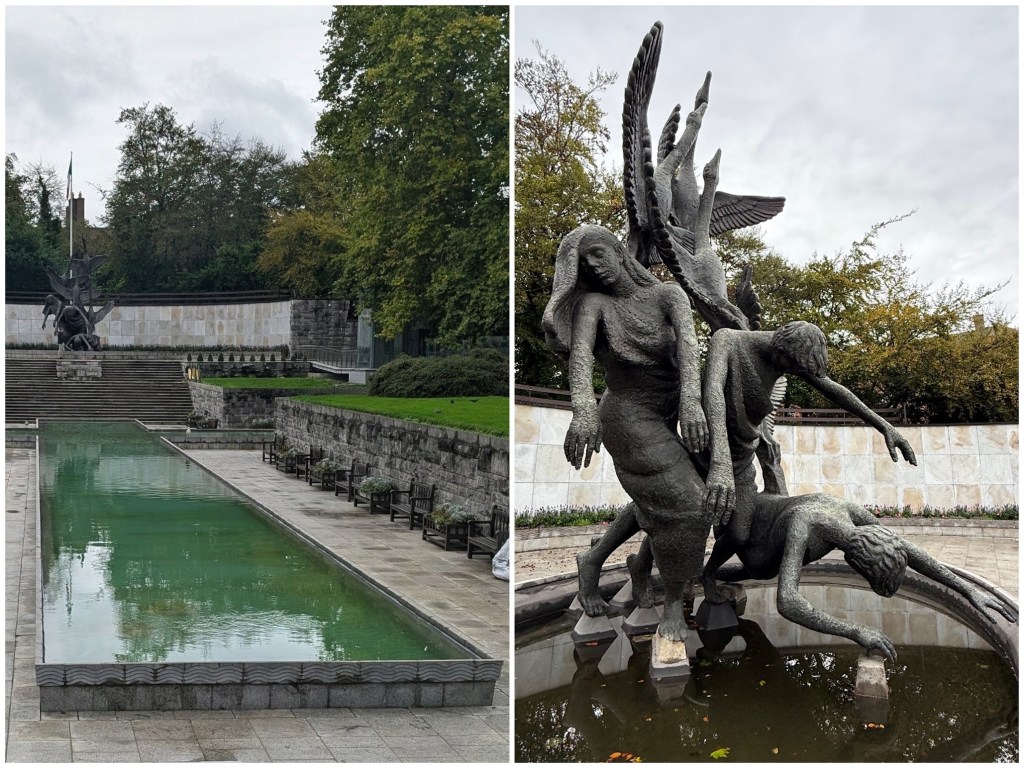
The Garden is dominated by a cross-shaped pool, at the head of which is a statue of the mythical Children of Lir, four siblings who turn into swans. In
William Butler Yeats‘ poem “Easter, 1916“), this is treated as a metaphor for the birth of a “‘terrible beauty,” i.e., an independent Ireland.
By this time, we were jet-lagged and flagging. So we joined the locals (below, lower left and right) and retired to John Mulligan’s Pub, established in 1782. There, Matt and I relaxed with pints of Guinness (below, top left and right).
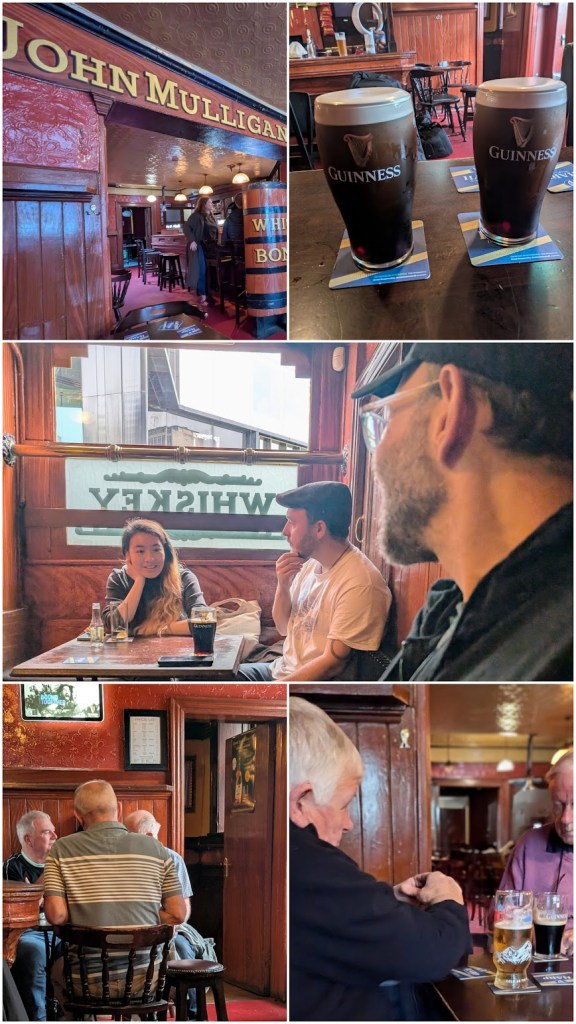
We struck up conversations with a young couple from Brooklyn, visiting Ireland on their honeymoon. And we met another couple from Wales (above, center), and discussed the finer points of the Welsh dialect, and the woman’s research interest in polar expeditions of the early 20th century. Guinness clearly has the ability to facilitate intellectual repartee!
Then back to the hotel to unpack and settle in, and an early dinner at The Old Storehouse on Crown Alley in the Temple Bar neighborhood.
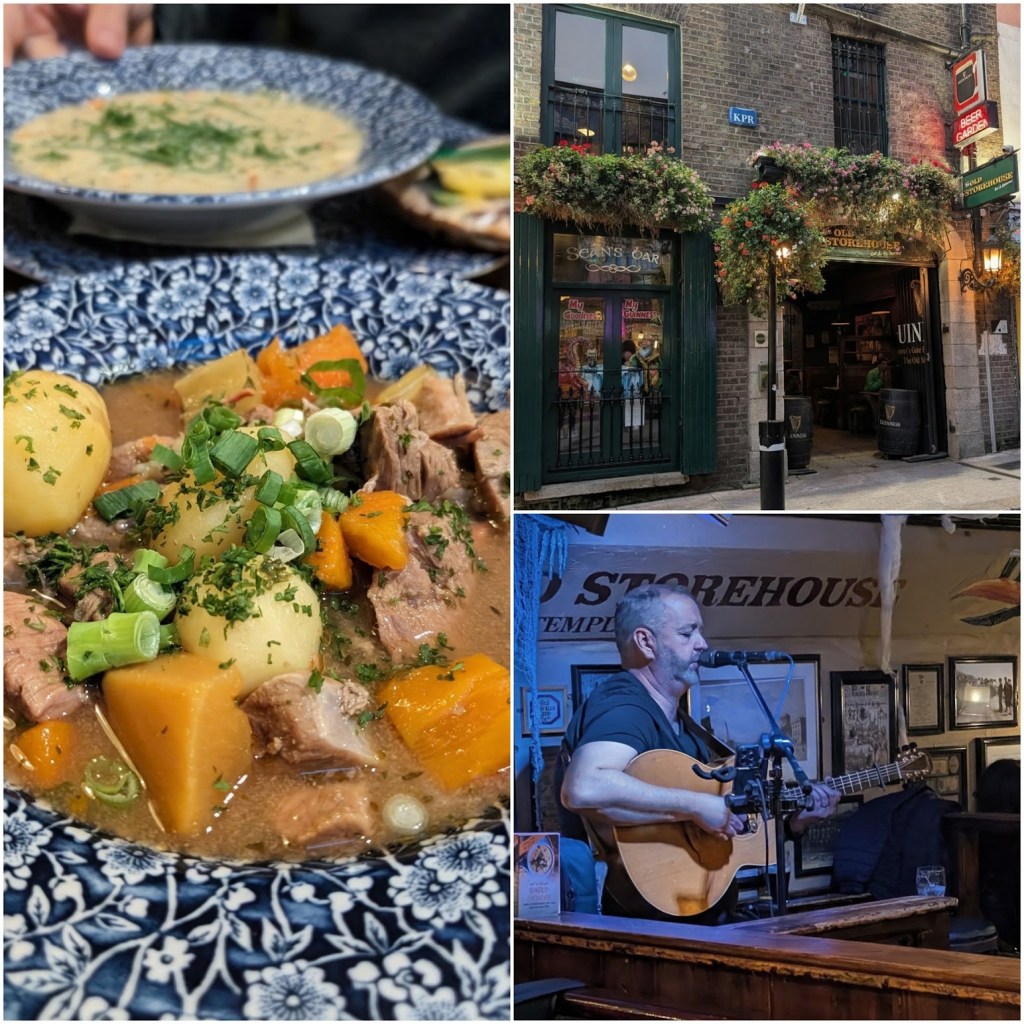
Irish stew, seafood chowder, and live music…….and more Guinness! Back to the hotel, to write this post and collapse.


Leave a Reply