
Stan and Matt Visit Ireland (Day 2)
Friday, October 16, 2026
Today we completed Rick Steves’ self-guided walking tour of Dublin. First stop was Trinity College. The college was established in 1592 by Queen Elizabeth I, supposedly to bring Protestant enlightenment to the Irish (although Catholics weren’t permitted to study at Trinity until 1793). In the meantime, however, the Catholic Church banned Catholics from attending the university, and treated attendance at Trinity as a mortal sin. The ban wasn’t lifted until 1970.
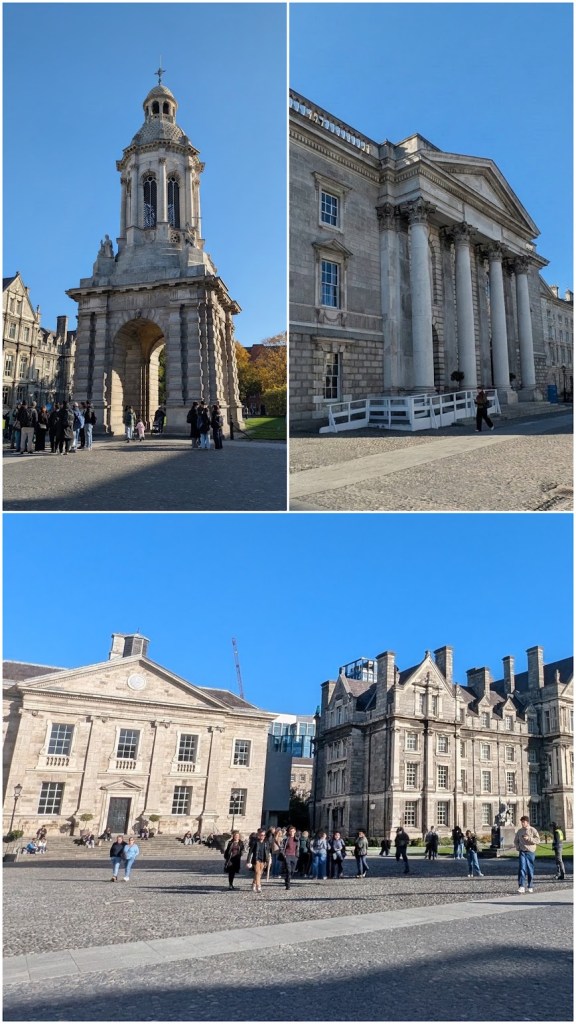
The Campanile (bell tower) (above, top left) was built in 1853. There is a long -standing superstition that any student who walks beneath the Campanile while the bell is ringing will flunk their college exams. (So the students avoid it until after their graduation.)
Trinity was attended by such literary giants as Jonathan Swift (“Gulliver’s Travels”), Oscar Wilde, Bram Stoker (“Dracula”), and Samuel Beckett. You might have to include George Lucas as a sort of adjunct student as well, since the impressive Long Room inside the Old Library (below) was supposedly the model for the Jedi Archives in “Star Wars: Episode II – Attack of the Clones.”
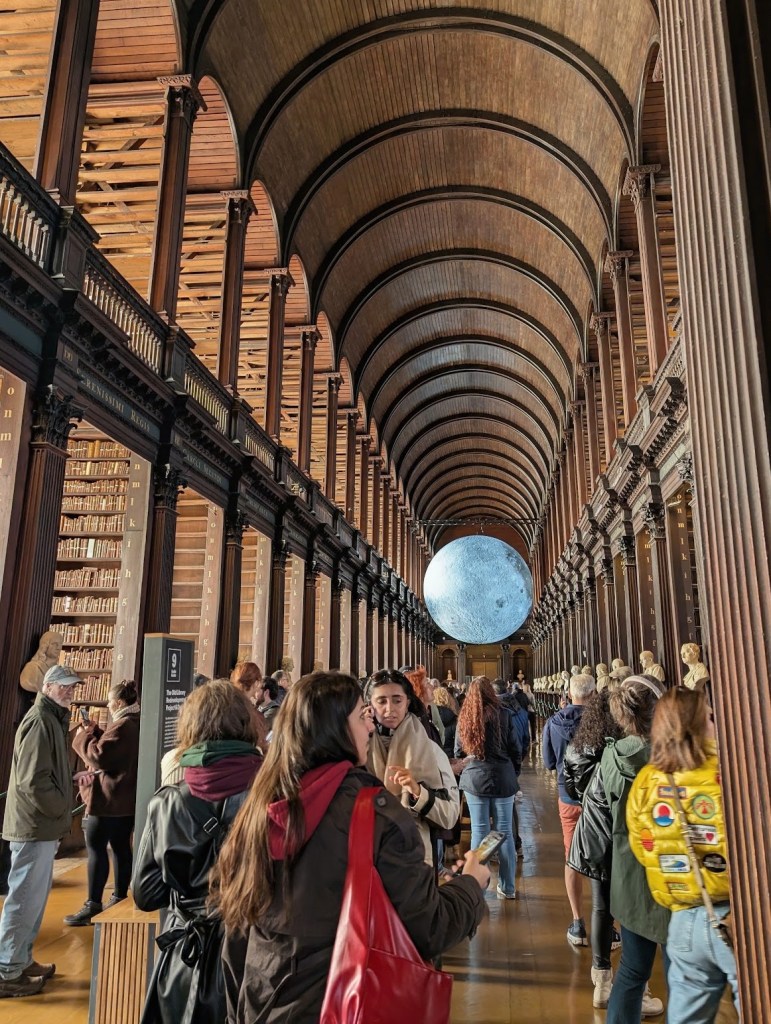
So it may not be a coincidence that the Long Room contains a mock-up of the Moon?
From the Renaissance to the Futuristic, back to the Medieval: Trinity is the repository of the Book of Kells, a 1,200-year-old illuminated manuscript of the New Testament.
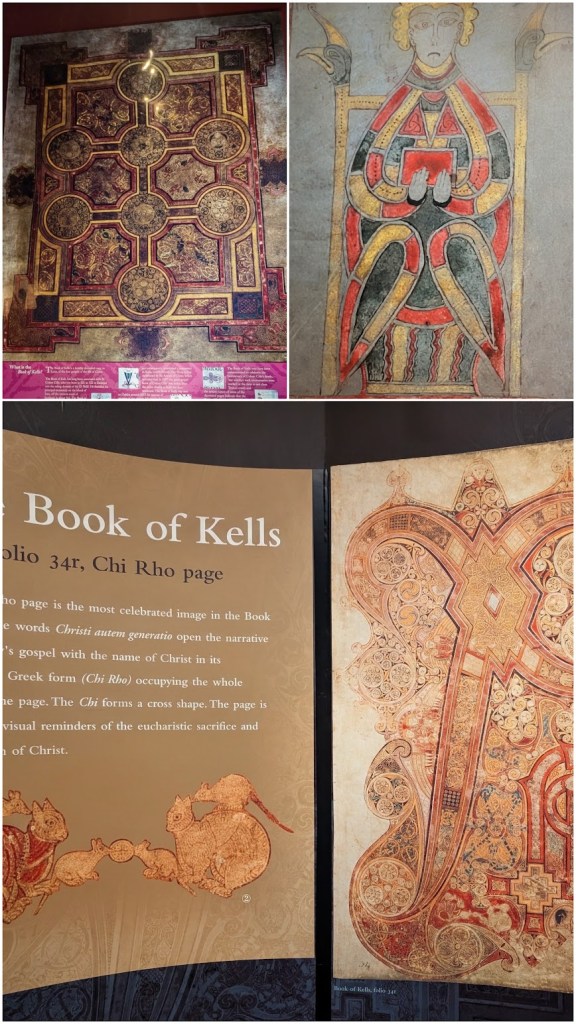
The manuscript was created at the beginning of the 9th Century, written on calf skin (vellum), taking about 185 calves to finish the job (!). It was actually begun in Scotland, but Viking raids caused the monks to flee to the Abbey of Kells in Ireland.
Then to lunch at Keogh’s, where they serve the Breakfast Bap. A bap is a soft, flour-dusted bread roll originating in Scotland. The ones at Keogh’s (below, top) are stuffed with fried egg, sausage, bacon and “black pudding.” (I’d tell you what goes into a black pudding, but I don’t want to gross anyone out; Stef, please forgive me!).
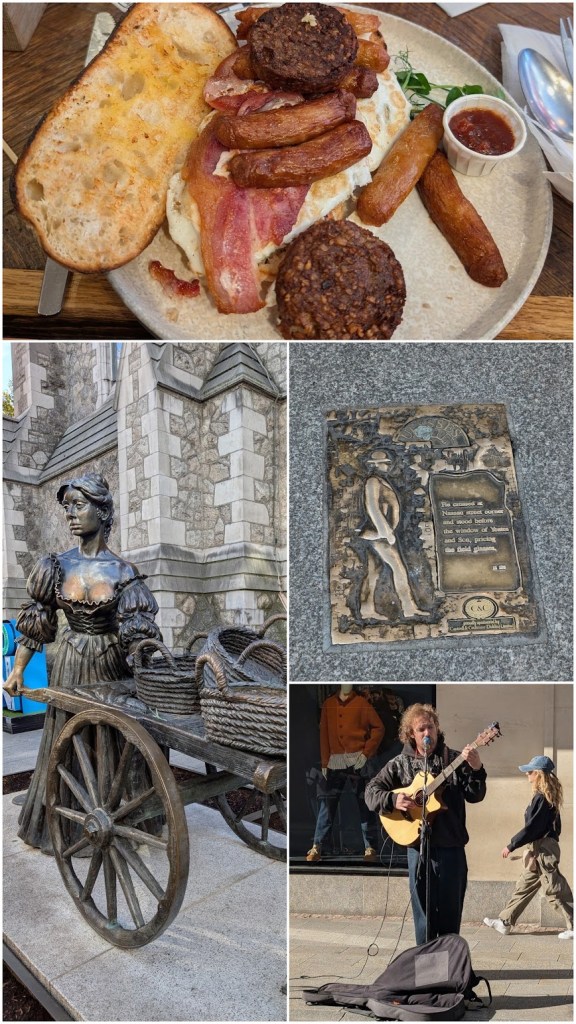
After consuming a variety of meat products sufficient to put us in the Cardiac Care Unit, we continued the walk. This included visiting the iconic statue of Molly Malone (above, lower left) (“Cockles and Mussels,” remember?). Rick Steves notes that some tour guides cooked up a b.s. “legend” about obtaining good luck in sex by rubbing the statue’s bosom. The neighborhood is loaded with street musicians (above, lower right).
We also saw the Ulysses Plaque (above, middle right), which commemorates James Joyce’s famed novel describing a day (June 16, 1904) in the life of Leopold Bloom, celebrated annually as “Bloomsday.”
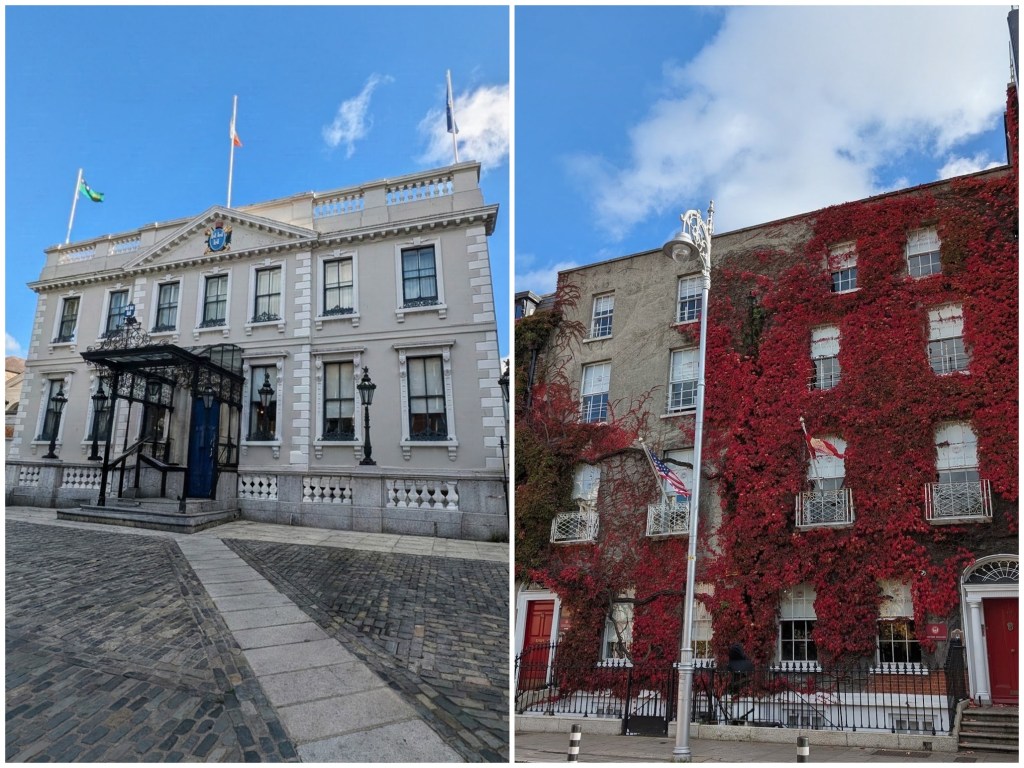
On to Grafton Street, an upscale pedestrian shopping street, rife with flagship stores. And a gander at Mansion House, the home of Dublin’s Lord Mayor (below, left). We were surprised to see the red ivy-festooned Dublin campus of Boston College (below, right)
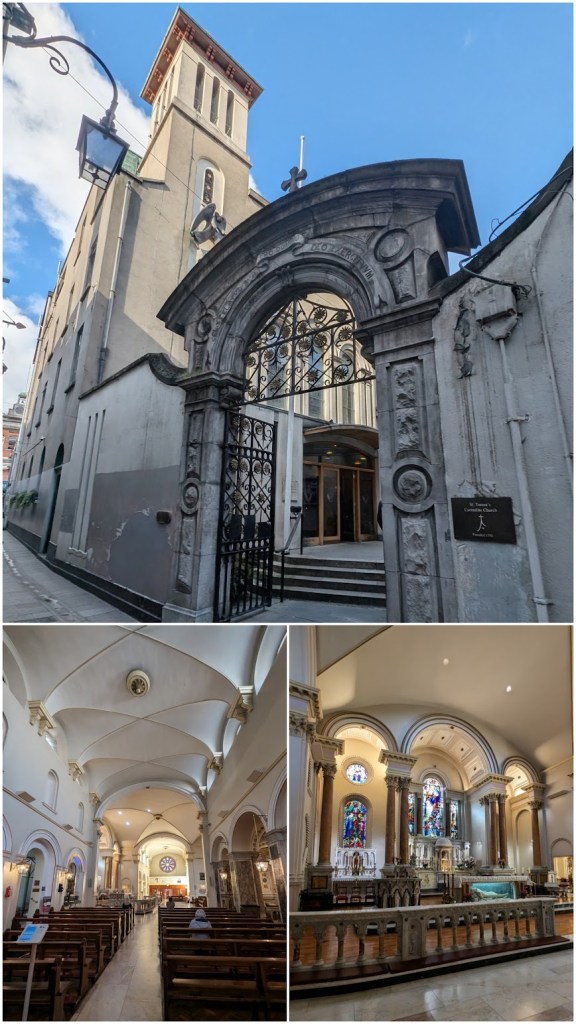
The walk took us to St. Theresa’s Church, tucked away on a side street, where Daniel O’Connell (remember him?) had held political meetings.
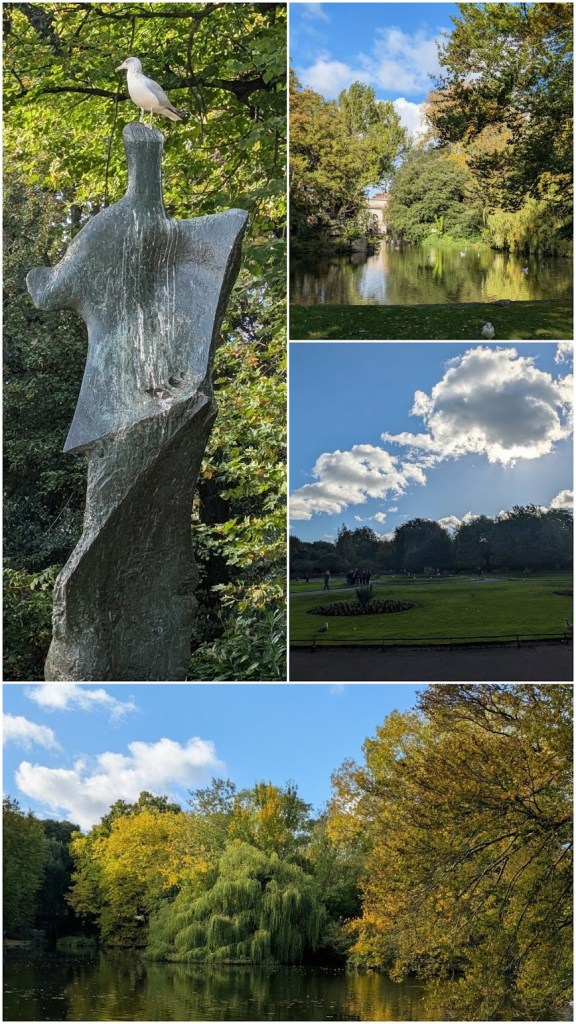
Our walk concluded with a visit to St. Stephen’s Green, originally a common area for grazing livestock. Now it is a lovely park, surrounded by Georgian houses, and containing a monument to W.B. Yeats (below, upper left) by Henry Moore. The sculpture is also a sort of….um…..resting place for seagulls.
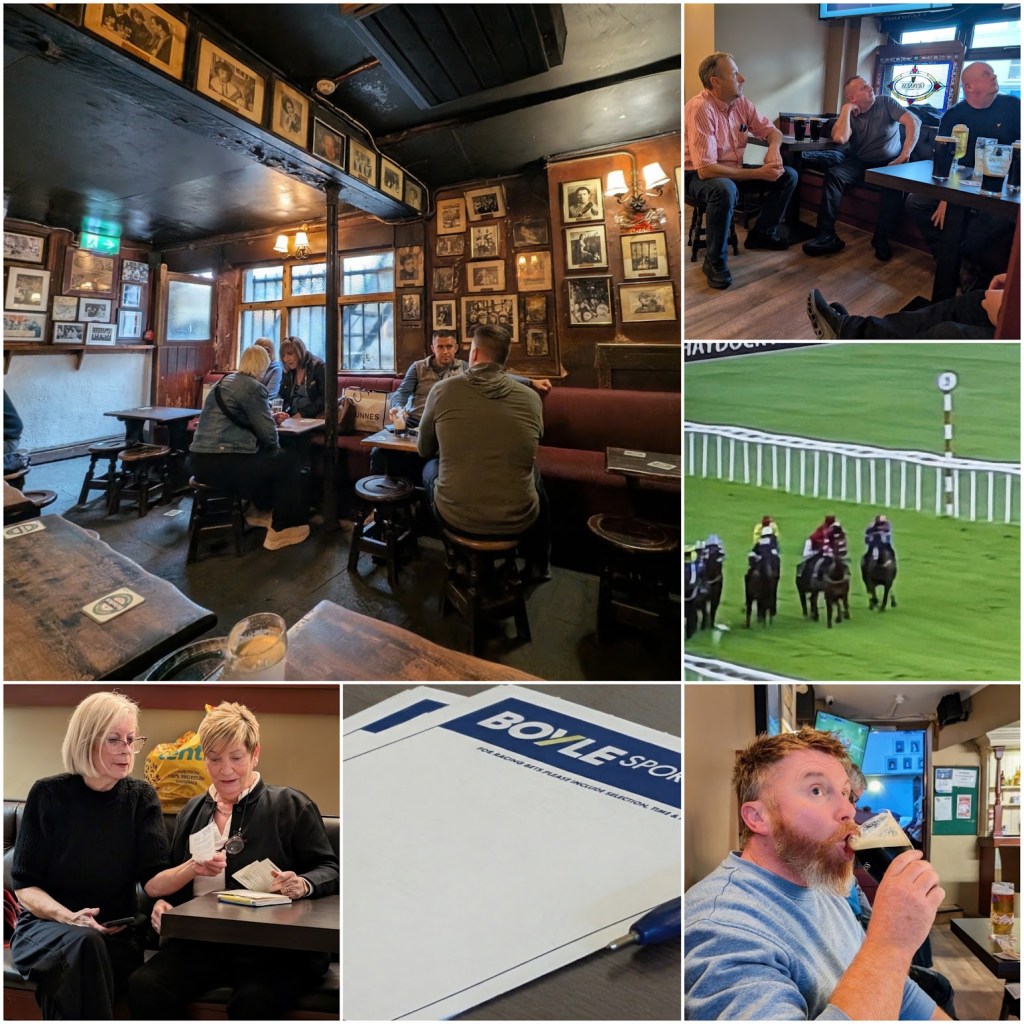
The day concluded with a visit to another pub, the Padraig Pearse, for some more Guinness and a taste of a delish whiskey called “Crested,” made by Jameson’s. Turns out that this pub is known as a gathering place for horse betting. The gentleman shown below, lower right, noted that there are several pubs in Dublin connected to bookmaking establishments.
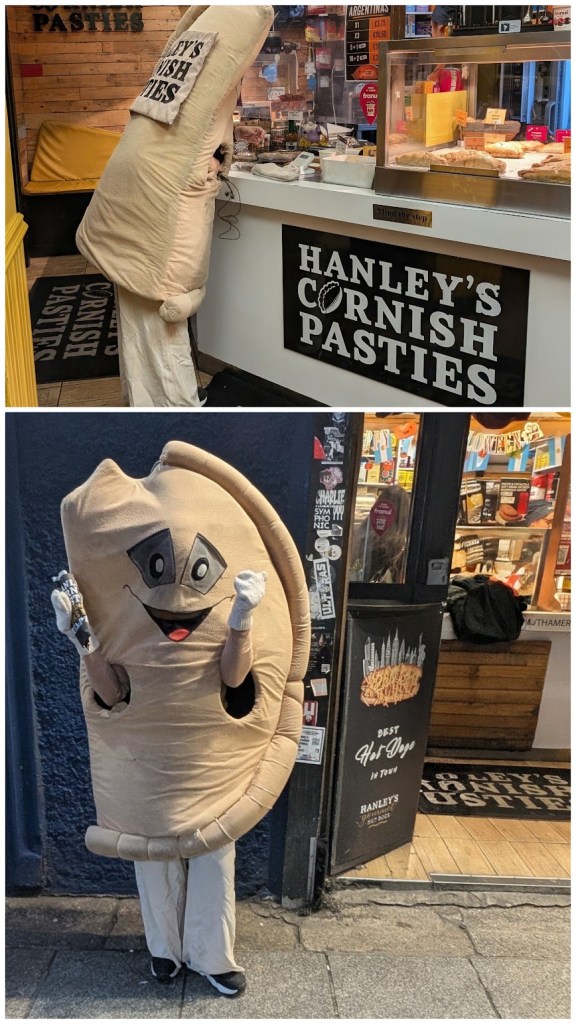
The day ended with dinner at Hanley’s Cornish Pasties. A pasty (the “a” in “pasty” is pronounced the same as in the word “last”) is a filled pastry, sort of an empanada on steroids, originating in Cornwall in England (hence, “Cornish”). We watched one of the employees don her pasty costume and go out and do some personal advertising.
Tomorrow…..off to Galway!


Leave a Reply